11/22/11

David Gaider is a Virgin: a review of Dragon Age: The Calling

I do not usually make predictions as I read – I have no inclination to do so and hardly believe that anybody who reads for pleasure does – but I knew immediately what I expected to happen at some point in Dragon Age: The Calling when Fiona, the elf mage, gets into an argument with King Maric of Ferelden. She accuses him of being a poor father. He gets angry and tells her that she doesn’t know the first thing about him.

And all I could think was: “Oh no. He’s going to fuck her.”

Dragon Age: The Calling is the sequel to David Gaider’s debut novel, Dragon Age: The Stolen Throne, which was awful. The Calling opens with King Maric, who successfully expelled the Orlaisian occupation and regained his kingdom in the first novel, holding court with the Grey Wardens, an order of warriors dedicated to fighting the darkspawn, considered irrelevant by the major political bodies as the darkspawn are quarantined in the underground ruins of the Dwarven civilization.

Maric agrees, with the flimsiest of reasoning, to accompany the Grey Wardens on an aimless quest into the Deep Roads based on the questionable visions of their new leader. And off they set, meeting with mages, fighting with darkspawn, slaying dragons, and making stilted conversation. If The Stolen Throne used fantasy plot #5, The Calling is written according to fantasy plot #1: the dungeon crawl. This plot is the bread-and-butter of licensed fantasy fiction, a travelogue through a particular location often interrupted by interminable battles and sex scenes written by people who do not seem to have ever been in a fight or a woman.

As readers of The Stolen Throne will recall, the Deep Roads were already the location for the most boring portion of David Gaider’s first novel. They are the setting for the majority of this novel. It is safe to say that plot is not Gaider’s strong suit, and he attempts to make up for it here by narrating incidents. The plot itself is just substantial enough to fill a two-hundred page paperback. The Calling is just a bit shorter than my hardback copy of Nabokov’s Ada, or Ardour.

At 440 pages, the narrative structure of The Calling shakes under the weight of all the incidents Gaider packs onto it, especially when so much of the narration is on the order of “he thrust his sword into the darkspawn.” I could easily forgive the contrivance of Maric accompanying the Grey Wardens on their quest in the Deep Roads if those incidents were not so similarly contrived, described in such beige prose.

I previously praised Gaider for having moved on from his reliance on adverbs. It seems I spoke too soon, as we get such descriptions as: “The water was littered with bits of flotsam that pooled at the edges, lapping wetly against the stone…” How else would water lap? Particularly grating is the statement that “Fiona was glad to be getting out of there finally.” Say that out loud; every time I do, it comes out as “thud.” And it follows – somewhat less gracefully and grammatically – the same formula as nearly every sentence from The Stolen Throne. X does Y, Zly.

The childish humor also makes a return. When talking about dreams and visions, Maric, King of Ferelden, confides in the Grey Wardens: “I once dreamed Loghain brought me a barrel of cheese. I opened it up, and there were mice inside. Made of Cheese.” When faced with an insurmountable horde of opponents, one of the Grey Wardens mentions that he has very few arrows, to which another replies “I’m running out of clean smallclothes.” I cannot roll my eyes enough.

Probably the worst of the extraneous bits is the encounter with the demon, which traps Maric and the Grey Wardens in dreams tailored to their deepest wants. Maric realizes first that he is trapped in an illusion, breaks free, and travels across the Fade (Gaider’s term for the world of dreams to which the consciousness travels when asleep) to help the others. Only Fiona, the elf-mage Maric will so obviously boff at some point, has a bad dream. Maric and company find her tied up, her back whipped raw by the demon’s avatar, a handsome gentlemen from Fiona’s memory. The sexual tone of this scene is patently obvious, and it sets up what I can only refer to as the fantasy maiden’s mating call.

The fantasy maiden’s mating call is when the fantasy novel's masturbatory object signals to the protagonist that she is ready for him to fuck her by telling him about some sort of horrific abuse she survived as a child. It could be sexual, physical, or supernatural, but the telling of it always ends on the tip of the protagonist’s erection. Fantasy authors (and writers in other genres, to be fair) mistake this as good characterization; the characters share important details about their pasts which lead to mutual affection. Unfortunately, its not only a cliché, but somewhat creepy.

Fiona, who has just physically and mentally relived the sexual torture she tells Maric that she experienced from the time she was seven until she was fourteen years old, informs Maric of her past. He tells her about his – he saw his mother killed in front of him. Granted, he eventually avenged her, regained his kingdom, and now rightfully presides over it, but both he and the narrative seem to think that this is a rough equivalent to the torture that Fiona underwent. And it puts her in the mood. They do it only a few feet from where their fellow spelunkers sleep.

Now, as a straight male, I am not one to speak about women’s issues. It is not my place. But even then, I find this scene offensive; not even so much for its subtext, but for its utter contrivance. It rings spectacularly false, from the moment it starts until the actual sex ends in (thankfully) abbreviated fashion.

The fetishization of the elf mage becomes even more blatant when Maric, knocked unconscious during a battle, looks up at Fiona, who is cradling him in her arms. “He looked up at Fiona’s face and thought only how beautiful she was. Those dark eyes had seen so much suffering.” So she’s covered in “black ichor” as Gaider redundantly puts it, bruised all over, and has confided in Maric a past fraught with horrific abuse, and Maric, thinking he will soon die, leaving his very young son in charge of a kingdom, can only think of how hawt Fiona looks, that he wants to comfort her, and tell her that things will be okay.

I cannot continue to read or write this review; I cannot see. My eyes are so permanently rolled.

My review of The Stolen Throne received numerous comments to the effect that I set my standards too high for a fantasy novel, particularly a licensed one. Putting aside the ability of supposed fans of the genre to denigrate it as a whole with their low expectations, I have to point out that I am only judging Gaider’s writing according to his own metric. In a recent interview at the New York Comic Con, Gaider said about Dragon Age as a whole: “It's also character-driven, and thus concerned more about the human condition than it is about being epic.”

That statement is utterly gob-smacking when juxtaposed to The Calling, which is the very definition of plot-driven and ham-fistedly characterized. It is the apotheosis of tie-in literature, the quintessence of all those malignant aspects I previously enumerated. The Calling, and its author, have nothing to say about the human condition. They trade in only the worst kind of fantasy; neither entertaining nor escapist, but dull and imprisoning in its rote plot and tortured prose. It is the sort of fantasy writing that does not evoke the imagination; it does not challenge the reader. It is not fantastic in any sense. The Calling panders.

A little bit of humility would behoove a writer who is fairly new to prose fiction, but it occurs to me that David Gaider is not, and likely never will be a writer a prose fiction, nor humble about his position. He is a pretentious writer of game books. The Calling is a Fighting Fantasy book or a D&D campaign in which the player makes no choices, builds no characters, and participates in no adventure. We only read Gaider’s fantasies as told to himself, relevant only to those who share them.

11/16/11

Immortals (Tarsem, 2011)


I left Tarsem’s newest film, Immortals, thinking that it was the best bad movie of the year (Ebert called it “the best looking bad film you will ever see). Its advertising campaign proudly referred to it as coming “from the producers of 300,” as sure a sign of its quality as any. Supposedly based on Greek mythology, it tells the story of Thesus, a bastard peasant, as he helps to save Greece from the schemes of King Hyperion, who searches for the Epirus Bow in order to free the Titans.

Theseus, for those who do not know, was not a bastard or a peasant in Greek Mythology; he was jointly sired by Aegeus, king of Athens, and Poseidon, each of whom slept with Aegeus’ wife, Aethra, on the same night. The Minotaur was not a giant man wearing a bull mask, nor was the labyrinth a temple gravesite. Hyperion was a titan, not a warlord who tried to free the titans. The titans, generally speaking, were not depicted as blue skinned monsters with animalistic tendencies, nor did the gods follow a “Star Trek” style prime directive in their relationship to mortals. Zeus frequently states that mortals must rely on themselves, that men have limitless potentials and etc.

Immortals makes use of the “digital backlot” technique popularized by Robert Rodriguez’ Sin City, its heavily stylized visuals reminiscent of 300. The aesthetic here is that of a comic book adaptation, with everything that entails. The cast was chosen, as best anyone can tell, based on their looks. And not necessarily whether or not they look right for their parts as ancient Hellenic warriors and priestesses and Olympians. It seems a distinct possibility that casting was done according to how good each member looked in a costume.

But Eiko Ishioka designed those costumes, so, yeah. And if Immortals rests entirely on visuals (and it does; the plot and dialog are either formalities or excuses) those visuals, for once, carry the movie. If a town etched in a cliff side, whose distance from a deadly drop could be well measured in feet seems like a geographical and technological improbability, and obviously a computer generated façade, it is also an image of extraordinary romance. If the action sequences which make use of Hong Kong style fight choreography, with spinning fighters and whipping chains, seem like anachronisms, they are at least visually pleasing and compellingly so. If Micky Rourke, Frieda Pinto, and Henry Cavill’s acting leave something to be desired, their faces and bodies leave nothing outside of visual satisfaction.

Immortals is the work of Tarsem, director of The Fall, The Cell, and the upcoming Mirror Mirror. Ecstatic visuals are his modus operandi, and Immortals, he admits, was a willing departure from the tableaux visuals of his previous films, in which he used photographic tricks to create his vision. It is true that Immortals bears his trademark sensibility – from the early depiction of the Titans hanging from bars by their teeth, to visions of an Olympus free of clouds and sunlight, the audience knows that this film is not a retread of previous cinematic versions of Greek myth – but it is also true that reliance on computer generated images diminishes this vision. For all that the images appear unique; it is abundantly clear how those images were created.

Some would place Immortals as a descendent of 300, or of Clash of the Titans, or of the Ray Harryhausen films of a bygone era, as a special effects showcase and a shallow, if not outright misuse of mythic sources. I think the real antecedent would actually be Mario Bava’s Hercules in the Haunted World, another work of a true auteur and dynamic cinematographic virtuoso. Like that film, Immortals is well worth viewing for its style alone, but is similarly forgettable for every moment that its characters speak rather than act.

Immortals is obviously less personal than Tarsem's other films. It watches very much like a summer blockbuster, in fact. But it would be a wonderful turn if summer blockbusters could actually attain this level of visual splendor regardless of their hackneyed scripts.

11/7/11

The Eight Immortals (Chan Hung-Man, 1971)

I probably should feel somewhat remiss that before I watched this movie (and subsequently perused a Wikipedia entry) my only knowledge of the eight Taoist immortals came from Jackie Chan’s Drunken Master, where he plays a young Wong Fei-Hung who learns “eight immortals drunken boxing” from Beggar So.
The Eight Immortals is an anthology film, telling traditional tales of the immortals before bringing them together for an action-packed finale. The film uses a framing device to tie them together – a pair of itinerant story tellers in contemporary (for 1971) Taiwan entertaining their listeners with music and banter. They begin with the tale of Lu Tung-Pin, who helps a woman to reunite with the man she loves. Then there is the tale of Iron-Crutch Li, whose crutch turns into a peach tree, which bears fruit with curative properties. And it goes on from there.
The film’s raison d’être begins about half-way through, after introducing the eight immortals and the incidental characters who will be reunited for the finale – an assault on the manor of the evil “red demon from the Chinese mainland.” The red demon kidnaps women, extorts enormous amounts of capital from the peasantry, and is actually a pig-demon in disguise, whose queen is a rat-demon. It is not difficult to guess that this is intended as a thinly disguised dig at the PRC.

This portion of the movie is also relentlessly grim, and contrasts starkly with the introductory scenes in which the immortals sing and crack jokes while helping ordinary people with their ordinary problems. The first part of the film resembles the sort of whimsical fairy-tale films of Alexander Ptushko, while the second part is like a Harryhausen effects show-case by way of Chang Cheh. The Red Demon not only rapes the kidnapped servant girls, he eats them, and the film graphically shows the latter. One servant girl – the now married young woman helped by Lu Tung-Pin in the film’s first segment – is tortured and branded on camera. When the eight immortals succeed in killing the red demon’s queen, her true form is revealed with a cross-fade from the actress to a dead rat. A real dead rat – with its head crushed in a pool of blood.
The cognitive dissonance caused by the whiplash between the lackadaisically paced introductions of the immortals and the brutal finale is the result of the film’s production origins and era. 1971 was the year of Chang Cheh’s The New One-Armed Swordsman, easily the most violent and bloody Chinese language film of its time, and a considerable financial success. Hong Kong and Taiwanese genre films had grown increasingly violent since the beginning of Shaw Brothers’ “New Wuxia Century,” which brought the sensibilities of Chang Cheh to the forefront of a genre normally reserved for child-stars and cute teenage starlets like Fung Bo-Bo and Connie Chan, respectively. The violence and sadism in The Eight Immortals is clearly intended to keep the movie relevant, as far as violence and sadism can be characterized as such.
While the general zeitgeist of early seventies genre film explains the finale, it is the involvement of Taiwan’s CMPC production company that explains the earlier sequences of the immortals and their interactions with the mortal townsfolk. The Central Motion Picture Corporation was the Kuomintang’s subsidized film unit which introduced ideologically tinged films and film movements, such as the wave of “healthy realism” melodramas from the 1960’s. The introductory sequences usually serve the purpose of “promoting morals,” like respect for elders, rendering fair service, reciprocity, etc. Even the story-teller framing device can be read as the promotion of humble means of entertainment during a time of modernization.

But it’s fairly obvious that the major selling point of The Eight Immortals was not the inculcation of national values, but a wacky, violent, special-effects driven fantasy. And the effects can get very, very weird. Miss Ho, the lone female immortal, at one point attacks the red demon with a giant peach, which opens up to reveal a huge pig’s head, which spits a dart out of its mouth. Iron-Crutch Li uses his crutch as a flamethrower. The demon-queen, fearing an immanent loss to the immortals and their army of angry peasants, lifts up her shirt and shoots poison gas from her belly-button.
The long and violent action sequence will probably be of most interest to the audience to whom Fusian tried to sell The Eight Immortals, and that audience will probably yawn for the first half of the movie, if not balk at all of the singing (and there is a lot of singing). But I actually quite liked the first half for all of its quaint whimsy and old-fashioned moralizing. The barely concealed political posturing is funny too, and if the action is sparse for the first half, the assault on the Demon King’s manor is a masterpiece of absurdity. The Eight Immortals is a fun movie in the same vein as the stupendously silly Monkey Goes West series from Shaw Brothers director Ho Meng-Hua.

10/25/11

Ling Huan Shao Nu (Wang Cheng, 1992)

As mentioned in my review of Drunken Dragon, I review things out of order. In keeping with the season, I’m watching horror movies, or at least horror-tinged movies. And as much as I would love to write an overview of the whole Hello Dracula film series, I can neither find the movies nor information about them in English and even the Chinese Wikipedia page is, perhaps understandably, less than comprehensive.

The Hello Dracula films are Taiwanese, jiang-shi (hopping vampire) themed children’s films. Taiwan’s film industry produced a gaggle of fantasy movies in the eighties, of which Hello Dracula is one of the best, in part because it is one of the oddest, and one of the least appropriate for its intended juvenile audience by western standards. Ling Huan Shao Nu (灵幻少女) is the final film in the series. The movie I previously reviewed, I believe, is the second, although I reviewed it under the impression that it was the first. There are six films starring Liu Chih-Yu as Ten-Ten and Gam Tiu as her grandfather, and another film (3-D Army) with a different actress playing the part of Ten-Ten.
Ling Huan Shao Nu opens with Ten-Ten chasing her grandfather, who has abruptly left, into the woods, where hopping jiang-shi vampires accost her to the iconic theme of John Carpenter’s Halloween (this will not be the last time that it plays, nor the only bit of music pilfered from a western film). Ten-Ten wakes up, suddenly, accidently punching her adopted sister Yuan-Yuan in both eyes. Grandpa dispatched Yuan-Yuan to bring Ten-Ten to the altar, where they, and fellow disciple Ah-Tsun, will pay homage to their deceased elder. Cue goofy dance routine – a staple of the series – here.
Grandpa charges Ah-Tsun with clean-up duty after the ceremony finishes, but Ah-Tsun decides that he will practice his Daoist magic instead. He lets a spirit loose which makes a bigger mess than what he initially had to clean. Ten-Ten helps him contain the spirit, and Yuan-Yuan tattles on them, and then leaves them to clean the mess up themselves.
Ten-Ten and Ah-Tsun plot revenge using an out-of-body spell that allows Ah-Tsun to possess the body of the visiting Mr. Chen to torment Yuan-Yuan. If you are wondering if this is headed anywhere, the answer is no. After punishing Yuan-Yuan for telling on them, it’s off to Mr. Chen’s home, where a malign spirit haunts the Chen family. Using the same out-of-body magic to confront the ghost, Ah-Tsun gets separated from the battle. And while Ten-Ten and her Grandpa fight the evil ghost, Ah-Tsun meets Orchid, the ghost of a beautiful young girl who wants to reunite with her lover in the afterlife, but is betrothed against her will to the King of Ghosts. Ten-Ten, Ah-Tsun, and Grandpa then beat up the King of Ghosts, saving Orchid from an eternally unhappy marriage.
 
With the Chen family safe and the King of Ghosts out of the picture, Ten-Ten and Ah-Tsun try to help Orchid, who, having missed her opportunity to reincarnate, is destined to wander the earth as a lonely ghost. Ten-Ten uses Daoist soul-transference to send Orchid on her way. What this means, I have no clue. But it apparently awakens Grandpa’s old nemesis and fellow student Jomoro. Jomoro plans to kill Grandpa and Ten-Ten, but Grandpa uses the last of his magic to teleport Ten-Ten away before he dies, with Ah-Tsun’s soul transferred into the body of a turtle and Yuan-Yuan killed in battle -- nobody bothered to transfer her soul into a barely sentient animal. And then the Daoist family's home explodes, and the credits start to play.
 Like the other movie in the series that I have actually seen, the goofy comedy slowly descends into bloody morbidity by the end of Ling Huan Shao Nu, and the worst part is that there is no resolution to the conflict. This was the last film in the series released. But unlike the previous movies, which had clear indicators of a temporal setting (such as the Republican army troopers led by Boon Saam), Ling Huan Shao Nu seems completely unconcerned with verisimilitude or internal consistency. The jiang-shi vampires only appear in the opening dream sequence and the ghosts and evil spirits Ten-Ten fights wear costuming straight out of Tsui Hark at his nuttiest.
It is that lack of concern with not only believability, but historical and mythic precedent that makes Ling Huan Shao Nu quite fun to watch. Rather than jiang-shi, the Daoist team has to fight horse riding ghosts in suspiciously European armor and skull faced villains and ambiguously gendered warlocks. Cheesy special effects fly all over the place, the young lady who plays Orchid seems to channel Joey Wang as she flutters about on wires, and the actor who plays Ah-Tsun wears a vest of exploding fire-crackers as punishment for tormenting a procession of ghosts. He walks away without a scratch, much less a second degree burn.
And if the final film moves at an even more break-neck pace than its predecessor, it’s also easier to follow. And thanks to the cast being older, it’s also less unsettling when they handle dead bodies or flirt whilst surrounded by dead bodies. But even so, the final scene is so bloody that I cannot comprehend what sort of kid could watch this movie without scarring his or her psyche. And that too is kind of what makes Ling Huan Shao Nu fun. It presents the macabre as a joke, but that last scene is kinda horrifying.

10/18/11

Axing of the Coffin (Fu Ching-Wa, 1969)

When it comes to legendarily silly re-titles, Crash Cinema actually beat Dimension Entertainment for the title of “best ever.” This 1969 supernatural melodrama, the first film of director Fu Ching-Wa, found its way onto DVD through some rather fortuitous circumstances. Some guy, recently returned from a trip to Taiwan with a bunch of film reels, posted on what was then the “kung fu fandom” message boards, wanting to know what he should do to sell his newly acquired film legacy. Somebody wanted to know what he had, and he posted an impressive list of titles, all obscure, with some, like Pan Lei’s The Sword, thought to be lost in their original format.

I’m guessing that the movie I just finished watching was on that list under the title Chuang Tzu Tests his Wife. But that doesn’t sound so cool to the sort of customer who buys DVDs at the brick’n’mortar, and, although the reel has embedded subtitles, it has no on-screen English title. So Crash Cinema, one of the companies to which the individual who posted at “kung fu fandom” was directed, could rename Chuang Tzu Tests his Wife whatever they wanted when they released it on DVD. And they chose an attention getter, I have to admit. Axing of the Coffin: it sounds like the title of an Iron Maiden tribute album.

This movie is actually a remake of the very first movie filmed in Hong Kong in 1913, and the very first Chinese film production internationally distributed. Chuang Tzu (in pinyin: Zhuangzi) marries a young woman, and decides to test her loyalty by faking his own death. While his wife prepares funeral arrangements, a young man comes to call on Chuang Tzu for tutelage, but takes an interest in the young widow, which she reciprocates, forgetting the funeral arrangements and enjoying the new courtship. When the young man reveals himself to actually be Chuang Tzu, her shame and embarrassment lead her to suicide.

Axing of the Coffin apparently follows the plot of the original film, which I have not seen, but makes additions, such as the villainous Chi Hsuan who attempts to take the young woman by force before Chuang Tzu marries her. Saved from the advances of General Chi, Szu Chin enjoys a happy marriage with Chuang Tzu, frolicking in a garden playing with butterflies. Chuang Tzu’s occupation as a travelling sage takes him abroad often, leaving Szu Chin lonesome for his company. A meeting with a woman who refuses to leave her husband’s grave. The encounter gets him to thinking about his wife’s loneliness and need for companionship, and inspires him to test her loyalty to him.

The original story sounds sadistic enough, but the update further supplements its exploration of Chuang Tzu’s jealousy with a sequence where he tests his wife by disguising himself as the Chi Hsuan and threatens to rape her. Szu Chin passes this test handily; threatening the apparition of Chi Hsuan with her own death should he touch her.
His second test is even more elaborate, as he fakes his own death, disguises himself as a younger man who courts Szu Chin, and fights Chi Hsuan who returns, for real this time, to try to marry Szu Chin. Chuang Tzu, still in disguise, kills Chi Hsuan and marries Szu Chien, but pretends to fall ill to a strange disease which only a concoction made out of fresh human brain tissue can cure. The only fresh source of human brain tissue, unfortunately, is in what Szu Chien believes is her dead husband’s coffin. So she proceeds to pick up an axe and try to extract Chuang Tzu’s brain herself.

At this point, the goes into full out horror mode, with Chuang Tzu rising from his grave and floating around in optical printing effects and spooky blue lighting. He chases the confused and terrified Szu Chien about their home, demanding to know why she would be so disloyal to him.

As his magic disappears and Szu Chien realizes that it is morning, Chuang Tzu appears behind her in the flesh. Ashamed of herself, Szu Chien flees into the woods, Chuang Tzu chasing after her, and hangs herself. Chuang Tzu realizes the grave sin he has committed against his wife, and holds her body, calling her name.

In some versions of this story, Chuang Tzu turns himself and his wife into butterflies, and as they flutter away together they slowly turn into dust as they fly away together. The film seems to set this up in scenes where Chuang Tzu and Szu Chien admire butterflies together. This sort of mystical ending would put Axing of the Coffin in line with other fairy tale-esque horror films of the time, like the Korean film The Thousand Year Old Fox, but the ending as it is strikes an appropriately melancholy note.

Axing of the Coffin is actually more unsettling in its premise than its horror segments. The supposedly wise Chuang Tzu really seems to get off on toying with his wife’s emotions, and I wanted her to actually run off with a good-hearted young scholar by the end of it. But, I have to admit that the horror sequence is an entertaining showcase of late sixties effects work and cinematography. The sequence benefits from an effective performance from the lovely Sam Juet-Jam. But the standout is Tung Lan as Chi Hsuan. Often cast as a villain in Shaw Brothers films, he snarls his way through the scenery like its just delicious.

This movie probably is an interesting little curio, but it is difficult to imagine that there is too much of an audience for faintly misogynistic, mystical Chinese tragedy these days, especially given that it features none of the outrageous grotesqueries of later Taiwanese and Hong Kong horror films and strains to create the sort of atmosphere seen in similar films, like Bao Fang’s Painted Skin or Li Han Hsiang’s The Enchanting Shadow.

9/22/11

My Blade, My Life (Chen Ming-Hua, 1982)


Pearl Chang receives a lot of attention from cult movie sites because her most seen movies – the ones widely circulated with English dubs – are more than a bit crazy. She’s an interesting character: a female director and producer in a segment of Chinese language film where the only other women to play major roles were Mona Fong, Kao Pao Shu, and occasionally Hsu Feng; an actress so uninhibited that she very often goes so far over the top that she leaves the rest of her often wild films well below her.

The Pearl Chang movie that everybody, it seems, sees and reviews on their blogs is Wolf Devil Woman, occasionally asserted to be a very loose adaptation of the Liang Yusheng novel that would eventually inspire Ronny Yu’s classic The Bride with White Hair. If this is true, the film itself provides little evidence to believe it. Everything that has been said about it is true. Pearl does slay an innocent bunny, the villains really do dress like Klan members, and the direction is all kinds of brilliantly awful. And Miss Chang’s direction is rivaled only by her performance, a snarly, foaming at the mouth performance.

Pearl Chang’s other widely seen films – widely seen, I would assume, because they received English dubs – are less wild, although they seem to lie well outside the mainstream of even the more fantastical genre films from Hong Kong and Taiwan. Matching Escort, I believe, is meant to be semi-comedic, but the rubber and foam decorated sets are trippy by any standard. And Miraculous Flower, while nowhere near as bizarre as Wolf Devil Woman or Matching Escort, contains some of the most audacious wire work seen outside of a Robert Tai film.

But Chang’s oeuvre is hardly one-note. Her television work, serials like Bodyguards and Angry Sword Kang Hua, would hardly give one the impression that this is the same actress who would grab a defenseless crab, break it open and eat its guts as she does in General Invincible (Cheung Pang-Yee, 1983), more or less in one take. Pearl plays somber characters, respectable swordswomen and proud martial artists, just as capably as she goes over the top. This versatility can be seen in her films too, as in China Armed Escort (Chen Ming-Hua, 1975), King of Fists and Dollars (Chen Ming-Hua, 1981), and in the morose, spaghetti-western and chambara influenced The Elimination Pursuit (Cheung Pang-Yee, 1983).
It is this sort of performance that we see in My Blade, My Life, a wuxia picture in the mode of the more action-oriented Gu Long adaptations. Pearl plays Lu Du Shing, a travelling sword-fighter whose only goal is to kill the famous swordsman, Peerless Swallow.

Unfortunately for Lu, Peerless Swallow is in absentia from the martial world. Everybody is looking for him, including his pretty fiancé, the heir to a wealthy manor and nominally the leader of its martial arts clan. Without Peerless Swallow around to police the martial order, the less respectable elements raise no small amount of chaos. Peerless Swallow impersonators attempt to wrest control of rival organizations, an apparently religious “Yin-Yang sect” attempts to forcibly convert the unwilling, and the jealous Cheng Chien-Sheng hatches a bizarre scheme to marry himself to Lu’s fiancé to gain wealth and power.
Lu really just wants to kill Peerless Swallow. Dressed as a man and treated as such (although, in the wuxia film tradition, the disguise is rather transparent to the audience), Lu finds herself in the company of a stranger who calls himself the representative of Peerless Swallow. He is an excellent martial artist, and the only friend that Lu has made in the entirety of her journeys. But he is also sick, poisoned from a previous battle. And as they travel together, his true identity is exposed. He is Peerless Swallow, which will be obvious to the initiated viewer because perennial wuxia hero Ling Yun plays him.

My Blade, My Life plays out very much like a Gu Long pastiche – its plot is much less baroque than the way it is presented – and would be very much typical except that the Pearl Chang plays the lead. As mentioned, her acting is far more subdued than in her more infamous films, but she still gives a strange and – I can think of no better way to express it – uninhibited performance. Her demeanor here is icy, and the character she plays has given up her identity as a woman in order to take revenge. Pearl walks with an unexplained limp, hobbling around until a fight breaks out. Her character is so quick that her opponents die after a single stroke, but when she fights a skilled swordsman, the limp inexplicably disappears, and she bounces off of out-of-frame trampolines or flies about on wires.

The frigid demeanor recalls roles played by Hsu Feng or Angela Mao, but quiet moments between her and Ling Yun’s Peerless Swallow, the sometimes exaggerated limp, and the occasionally brutal fight scenes (Pearl shoves chopsticks into a random mook’s face, in one of the most memorable), bring her character to a more human level than the sort of idealized woman-fighter-in-drag often seen in wuxia pictures of this vintage. Pearl is such a dynamic presence without the snarling and wild gesticulating seen in her other films that it’s almost hard to believe that those are her best known roles. I honestly like this subdued Pearl Chang quite a lot.
Pearl Chang is not the only actor to play against type. Yueh Hua, Chen Sing, and Tsung Hua get roles as minor villains; Lily Li is a ditzy little girl who can’t fight; Cliff Lok plays a jealous, mendacious swordsman – quite a departure from his goofy sub-Fu Sheng comedic heroes.
And My Blade, My Life, for all that it presents a less wacky Pearl as its lead, still puts out a suitable portion of weirdness for those specifically attracted to it. The Yin-Yang Sect’s lair, for example, takes the Yin-Yang motif to highly improbably ends. Not only is the interior evenly split between stark black and stark white, but its members costuming is bisected as well. The leader, played by Yueh Hua going against type, carries the motif to his eyebrows.

If that description does not make it obvious, the makers of My Blade, My Life imbue far more creativity into their product than what is typical in Taiwanese genre-films, and they have a budget to match. Produced by I Film Co., at least a couple of sets will be familiar to fans that have seen the Yueh Hua starring Drunken Swordsman (Cheung Git, 1979). The cinematography from Yip Ching-Biu – who also filmed The Whirlwind Knight (Sek Kin, 1969) and The Dream Sword (Li Chao-Yung, 1979) – is familiar, if less interesting than his previous work.

My Blade, My Life is a really good wuxia picture. That it stars Pearl Chang engenders expectations that differ from its goals, but it is likely more in line with what Miss Chang’s fans expected from her at the time of its release. Those of us who watch these movies as a hobby (and given the effort it often takes to acquire them, it is very much so) often forget that their makers never thought that people on the other side of the world would watch them thirty years later, let alone write about them on a giant information database. Our perspectives become a bit skewed by this distance. My Blade, My Life will serve as a testament to this fact for some, but for others – and I suspect for the audience for whom it was initially made – it is just a really fun little genre excursion.

And boy do I love Pearl’s costume.

9/14/11

The Legend of Heroes: Trails in the Sky

You may have noticed that most of my game reviews start out with a recollection of a conversation with my good friend RockManXZ24. We talk about video games a lot; it was a common point of interest when we met in the sixth grade; it continues to be a common point of interest now that we’re adults.

Our most recent conversation about video games occurred just after I finished Persona 4 (which I’ll review later), and just as I was about to finish The Legend of Heroes: Trails in the Sky. He had just finished playing through the demo of Dragon Age 2, and we talked while he plowed his way through twelve-year-old n00bs in Halo 3 multiplayer. Our topic: are Japanese otaku more intrinsically sentimental than American nerds? Our conclusion: possibly, yes.

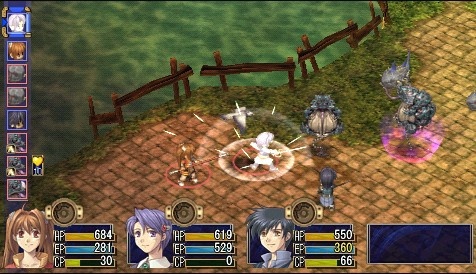
Few games convey that sentimentality better than The Legend of Heroes: Trails in the Sky, with its gentle J-pop theme song and its teenage heroes dancing around their veiled romantic feelings for each other. It is a game cast in the familiar JRPG model, concerned more with telling its story than with introducing the player to complicated game mechanics or micro-managed character progression. This seems, to me, slightly unusual for developer Falcom, as even their recent games, in spite of their cutesy art style, employ fairly sophisticated game mechanics. On the other hand, The Legend of Heroes series began with a fairly rote Dragon Quest clone.

But while the Falcom of old often experimented with their game design – look at their early action-RPG Sorcerian for a wild mixture of side-scrolling action with Wizardry-esque character/party building – the development team now focuses mostly on polishing conventional gameplay to mirror sheen. Ys 7 feels like it could be a remake of a classic Playstation era game, and I mean that as a compliment. Trails in the Sky, while originally released for Japanese PCs in 2004, feels like a classic game that has aged extraordinarily well.
That doesn’t mean that the gameplay is dated – far from it, in fact. The battle system is turn-based, laid out on a grid, much like a tactical RPG. It reminded me a bit of the Korean game, Astonashia Story, or NIS’ Rhapsody (as it was originally released on the PS1), only done properly. The turn system uses random bonuses, and the player can manipulate turn order with carefully timed magic and special attacks to utilize the bonus turns. It makes the battles far more interesting and involved than many turn-based JRPGs.
On top of that is the orbment system. The orbment is part of the character set-up, and it decides which magic attacks the character can use. Equipping a fire or earth element quartz to a character’s orbment will allow them to use a fire or earth spell, and it will also raise their attack or defense, respectively. This allows the player to make a character an attack or support unit as he or she sees fit, and it also helps to mitigate the necessity of buying the sometimes prohibitively expensive equipment available in the game’s shops.
While playing through the game, the player can choose to complete side quests which award money, experience, and items; particularly if the job is well done, as the game grades the player’s performance. But the player can easily forgo the extra quests and focus specifically on the main plot if he or she so wishes. Since fighting enemies awards materials more than experience, it eliminates the incentive to grind, although level-grinding is an option, however tedious.
But, again, the real focus of Trails in the Sky is its story, its characters, and its setting. The very Japanese aesthetic will turn off those who find anime style art and story-telling anathema – it is actually rather trendy to complain about games being “too Japanese” right now – but Falcom has done a great job of evoking that aesthetic without pandering to a certain questionable contingent of Japanese consumers, quite unlike certain other Japanese developers.
 The story follows two teenage kids, Joshua and Estelle Bright, respectively the daughter and adopted son of military legend Cassius Bright, as they become initiated into the paramilitary/mercenary organization known as the Bracer Guild. As they start their careers as junior bracers, Cassius suddenly disappears, and Joshua and Estelle undertake their journey around the continent of Liberl to become full-fledged members of the guild, running into a planned coup against the reigning Queen of Liberl and helping to foil it.
It is actually a very typical plot for this type of game, in which the protagonists start off on a journey of personal interest that eventually folds into a larger conflict with clandestine forces of unmitigated evil. Trails in the Sky does a very good job, it must be said, with not letting the plot get away from itself. The conflict here is local, and stays that way. Too many JRPGs play their cards too quickly and leave the player wondering why a couple of kids are the only ones who could possibly save the world. Here, it is two teenagers with specialized training foiling a plot of national importance with the help of veteran mercenaries and, it is explicitly stated by the protagonists, a lot of good fortune.
And, of course, there are budding feelings of the two main characters. Most of the narrative is played from the perspective of Estelle, a tomboyish type who prefers action to introspection, who is confused by her feelings for her adopted brother. Joshua is cool and level-headed, and more than a bit mysterious. He obviously has feelings for Estelle too, but in typical Japanese fashion, the two can hardly be arsed to actually speak up and tell each other how they feel until the very end of the game. It is to the writer’s credit that the characters do not realize their feelings for each other because Estelle gets kidnapped and Joshua has to save her. In fact, Estelle is never really imperiled; she’s competent and capable, in spite of her hot-headedness. The game treats her and her relationship with Joshua respectably.

That the characters are likable, their banter well written (and excellently translated, thanks to American publisher XSeed), and the pacing well planned help immensely. Fans have often compared playing Trails in the Sky to reading a book, which the game invites not only with heavy amounts of text, but by segmenting its narrative in chapters.
And did I mention sentimentalism, yet? Everything about the game is so sweetly realized that I didn’t want it to end, and since the game finishes on a cliff-hanger it didn’t. I can only hope that XSeed will find an available avenue to publish the next two games (possibly the PS Vita?), as the story here is the main draw, and for once it is actually worth the effort to sit down and read. Trails in the Sky is a great example of the story-telling that made JRPGs so much fun to play when I was younger, an example of the story-telling that the sub-dungeons and dragons western RPGs always lacked. It’s a cheerful journey, rather than a grim clash of good’n’evil.
Trails in the Sky is also a good indication that the JRPG is hardly as stagnant as some have said. It is one of a few recent JRPG releases where I have not tapped through the dialog without paying attention, a high-quality, story-driven game which rewards players for smart playing. I loved it. Falcom is one of the most underrated developers outside of its small, but growing fanbase, and I hope that their development for the PS Vita will garner more attention. Major thanks and good vibes to XSeed for their excellent work in bringing attention to this oft neglected dev team.