7/27/09

War of the Wizards (Cheung Mei Gwan, 1980?)

What does one say to these early 80’s era Hong Kong/Taiwanese fantasy films that has not been said dozens of other times? Particularly on this blog, weird Asian fantasy movies receive probably more attention than they’re worth.
War of the Wizards boasts something that most of the others do not: Richard Kiel. Yes, “Jaws” from The Spy Who Loved Me, Mr. Larson from Happy Gilmore, appears in War of the Wizards. It was also released on video in the United States with an awful English dub that wasn’t handled by the usual team of Hong Kong dubbers, and possibly a slight rescoring to boot. Checking the IMDb page (which I’m almost fully confident is incorrect) it was directed by Sadamasa Arikawa, an effects man who worked on various Godzilla movies and the “Monkey” television series, with cinematography provided by Sokei Tomioka, another effects specialist. Arikawa never directed again, and Tomioka is generally thought to have retired after working on Ho Meng Hua’s Mighty Peking Man in 1977. Neither is known to have been active in Taiwanese cinema. Frankly, I don’t think they were involved in this film either. More likely is hkcinemagic’s credit for Cheung Mei Gwan, a director responsible for more than a couple gimmicky Taiwanese martial arts films. I make a big deal of this because my tape seems to be missing the opening credits.
Anyways, the movie itself follows Tai, a fisherman who finds a magic bowl at the bottom of a lake. The bowl gives him whatever he wishes for. He wishes for money, buys a restaurant/manor, and lives the life of a wealthy nobleman. This attracts the attention of wizards and martial artists who attempt to steal the magic vessel from him, each one doing the other in until a pair of attractive female fighters remain. Instead of simply taking the bowl from Tai -- which would be absurdly easy given their ability to kill skilled warriors by throwing stuff at them -- they decide to marry him. Tai, being a huge ass, decides to show off that he’s marrying two hot sisters by parading them down the street in a palanquin. A couple of Taoists see this, and start shooting the palanquin with magic rays. Tai stops this, because Tai is an idiot and doesn’t know to listen when addressed by benevolent religious kooks.
The Taoists attack his wedding procession not out of maliciousness, but concern. The brides are actually fox spirits -- ancient Cathay’s ever present predator of scholars and other sorts of silly, bungling men -- who serve another, far more powerful fox spirit. Of course, the more powerful of the fox spirits shows up, kidnaps her two followers, and tries to kill Tai, who is saved by a Phoenix. Taking him to the top of a mountain, Tai learns magic from a magic scroll and an old man, who also gives him some cool clothes and a sword. Tai then sets off to kill the fox spirit, her giant rock monster, and Richard Kiel. There’s only ten minutes left in the movie by this point, so let me spoil it further: he succeeds.
What a badly made movie. Movies like this make movies like Child of Peach look good... as in objectively good. The movie is a mess of badly executed composite shots, static camera work, cheap wire effects and other sorts of visual effects that look terrible. The narrative is sloppy enough that I was simultaneously reminded of other films (O Sing Pui’s 1987 film, Golden Swallow, for instance) and how much better those other films are.
Belonging to that brief cycle of fantasy films made in Taiwan in the 80’s, it seems that the film makers wanted to really stuff their movie with more special effects than any of the competition. The weirdness of the low budget imagery is pretty spectacular, even if it is inept and the film surrounding it isn’t much fun. The phoenix looks to have been constructed out of paper and the amount of times that the effects are painted onto still shots is surprising in a professional product, but even worse are the repeated shots that are utilized throughout the movie. The battle between the hero and a gang of doppelgangers stands out for abusing both repeated shots and composite shooting in a really bad way. It doesn’t hold a candle to the bizarre fight between the Phoenix and a giant stone monster, which looks less like a fight and more like the stone monster thing is clumsily trying to copulate with the Phoenix while drunk.
It’s kind of sad to see Betty Pei Dee reduced to this. She was great in Intimate Confessions of a Chinese Courtesan, and she spends her time in War of the Wizards looking like she’d rather be off somewhere making out with Lily Ho. The other funny part of the cast is Richard Kiel, who looks hilarious standing next to Betty Pei Dee. He could use her to pick his teeth. Kiel’s big scene involves him beating up on the leading man with a pair of steel gloves, hence his name, Steel Hands. (Creative, no?) For the most part, the cast (few of whom I recognized, or even thought I might recognize) play their parts with cheerful disinterest, with only Kiel and Pei Dee standing out for any particular reason.
Fans of less outlandish martial arts movies or Asian set historical films would do well to steer clear of War of the Wizards. It’s b-movie charms don’t really get the same mileage as those in Thrilling Sword and New Pilgrims to the West; neither does War of the Wizards really come close to the level of film making seen in Zu: Warriors from Magic Mountain. But if all you want is seventy minutes of weird, crappy movie, you could settle for many a less weird and crappy movie than this one.

7/22/09

Damn You, Ric Meyers -- A Review of Kidnapped Girls Agency

For those who really know the kung fu scene here in the USA, Ric Meyers is well known and polarizing figure. On the one side you have everybody, and on the other you have Ric. A lot has been said about the man, much of it conjecture, and of that, much of it obviously false. What is not conjecture is that Ric Meyers frequently spreads misinformation in his commentaries, articles, and liner notes, yet is still collecting paychecks as a "kung fu movie expert" from people who don't know any better (but should).

For example, Ric Meyers wrote the English language copy for at least some of the IVL DVD releases of Shaw Brothers movies. From the back of Full Moon Scimitar:
"No team of 'Martial Arts World' epic-makers ever matched that of director Chu Yuan and best-selling author Ku Lung. Screen idol Derek Yee is the ambitious, proud master of the 'Meteor' style, who becomes obsessed with sword supremacy and goes on a selfish rampage of violence and sex."
What movie is he describing? I don't recall a rampage of sex, or much of any sex at all in Full Moon Scimitar, and I watched it again only a few weeks ago.
But the weirdest rumor I'd ever read about Ric Meyers was his so called foray into the world of pornography. Supposedly, Meyers starred in and directed bondage porn. The tales of a mind flaying, erection breaking, bondage themed porno elicited a combination of furious laughter and wild expectations. If you don't know what Meyers looks like, hit up his myspace, and giggle with me at the thought of him in bondage gear getting his pimply ass whipped by a dominatrix, then puke in disgust.
Sadly, the film itself isn't anywhere nearly as funny as I'd hoped. The movie in question is KGA: Kidnapped Girls Agency, an hour long soft-core bondage tape released by "HOM Incorporated." In KGA, 80's scream queen/porn star Linnea Quigley plays a young woman kidnapped by a male-female pair of bondage-pervs after attending an audition. The same deviants also kidnap her room mate, and plan to sell them both to the white slave market. Never fear! The Kidnapped Girls Agency, an agency that specializes (one assumes) in the recovery of kidnapped girls, is on the case! Lead by a mighty, portly, bespectacled detective with a very ugly beard (Ric Meyers, lolz) the Agency finds the girls in time, saving them from forced prostitution, through means which I'm not quite sure I followed. The audio quality on the tape I watched is impossibly bad -- so bad I couldn't hear what they were saying in the scenes preceding the finale.

I have to say that I was quite disappointed with this one. It might have entertained me more if I liked bondage or actually cared about Linnea Quigley and Michelle Bauer. The only thing I wanted to see was Ric Meyers embarrassing himself. He does a good bit of that. He looks creepy as hell, for one. For another, he uses a very large dildo as a weapon in one scene, which I assume was intended as humor. It fell quite flat. Perhaps worse is his hand-to-hand fight scene at the end of the film, which provides great competition with the slow motion fight from Dragon Pearl for the "worst fight scene ever filmed" award. The finale to Godrey Ho's Undefeatable is beautiful by comparison. Did I mention Ric tries to brain somebody with a big dildo?

There is a certain question I would like answered: did Meyers direct Kidnapped Girls Agency? The video credits Geoffrey Merrick as writer and director, but IMDb and a bunch of obscure video web sites claim that Meyers auteured this all by his lonesome. It has the feel of a home movie: lapses in audio, lots of stationary camera work and interminably long takes of screaming, naked women and their abductors, and a total lack of composition or lighting design. If Ric made this, he doesn't know much about how to make a movie, and made this one solely to help other fetishists beat one out. If that's your proclivity, you might like this. You might like it if you appreciate the women who appear in this film, although it certainly isn't essential when they're naked in dozens of other movies, at least one of which has to be better than Kidnapped Girls Agency.

Did they think they were doing Cassavetes with bondage? I'd like that question answered too.

I originally finished this review with a really harsh paragraph that insulted Meyers personally. I don't want to do that, because my problems with him are not personal in nature. I simply want to point out how hilarious Meyers is as a person. I mean, if he actually consented to appear in this movie, he deserves a little bit of derision; If he actually directed and wrote it, he deserves it even more. So to that I say: Ric ought to be embarrassed, but I don't think there's anything I could say that would actually effect somebody so shameless.
Believe it or not, he's the savior, not the kidnapper.

7/21/09

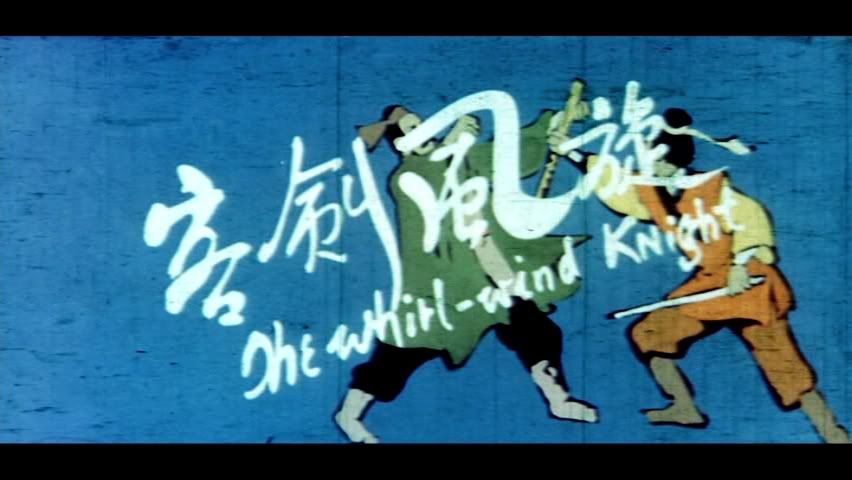
Whirlwind Knight (Sek Kin, 1969)


Whirlwind Knight reminded me of two things. The first thing was the way that Whirlwind Knight actually found itself onto a region 1 dvd, originating from a post on the Kung Fu Fandom message board. Somebody bought a truck load of film reels from Taiwan and wanted help selling them. If memory serves me correctly, the list of movies he posted had some comedies and melodramas, but most of them were either Taiwanese made wuxia films, period pieces, or ghost films. He originally wanted to sell them on eBay, but somebody quite rightly instructed him to contact potential distributors instead.

Not terribly long after that thread, Crash Cinema started announcing upcoming releases of rare films on their “Crash Masters” line. Some of them, like Flying Swordgirl, I had never heard of before, but a couple were highly sought after classics, like the Pan Lei/Jimmy Wang Yu wuxia-psychological drama, The Sword, which had circulated among collectors for years in a full screen, nth generation Korean VHS rip. Not long after that, a new company called Fusian, a division of Inspired Corporation, announced the dvd releases Taiwanese wuxia movies like Eight Immortals (Chan Hung Man), The Young Avengeress (Wong Cheuk-Hon, 1969) and King of Kings (Joseph Kuo, 1969). All of that resulted from a forum post.

Of course, none of the movies sold well enough to support Fusian or to keep the struggling Crash Cinema in business. Still, that was a nice time to be a fan and collector.

It’s interesting to actually see these films that Taiwan made in the wake of Shaw Brother’s “New Wuxia Century,” and the films of Chang Cheh and King Hu. On a narrative and thematic level, they’re far more conservative. Chang Cheh celebrated young rebels who decried the unfairness of the ancestor’s society -- a theme he continued in his youth dramas and contemporary crime films. And while King Hu certainly didn’t exhibit the same cheerful disregard for elders that Chang did, some cite him as a proto-feminist for his strong female characters that often exceed the bounds of what heroines are allowed to do in stories that follow more traditionally Confucian morality.

Whirlwind Knight tries to have it both ways. On the one hand, there is the titular knight that spends his time and skills as a swordsman attempting to build a living for himself and his estranged daughter, whose only real desire is to have her dad back in her life. He has the perfect opportunity to give up his roaming lifestyle and reunite with his daughter, but forgoes this chance in order to try and get a large sum of money out of the sadistic Golden Dragon Clan. In this story, the very Confucian value of familial loyalty is stressed, although it is a father, the paterfamilias, who has gone astray. Such a thing would be quite unusual in the more conservative wuxia films made by, say, Cathay. Nonetheless, things will eventually be set right by the end of the story, albeit after much death, the meddling of a masked bandit with exceptional martial arts, and the killing of a femme fatale in a manner too easily associated with these kinds of films -- the greatest and most punishable crime, it seems, is being a transgressive woman.

Although within the context of the narrative, she really does earn herself a killing. It’s a rather conventional, convoluted narrative.

The other thing that this movie reminded me of is Bells of Death. Yueh Feng’s spaghetti western styling affected not only the scoring and direction, but the fight scenes. Rather than following the lead of King Hu or Chang Cheh, the fight scenes in Bells of Death utilize all sorts of obtuse angles, camera work and editing. Basically, it looks like Yueh Feng wanted to shoot even his sword fights the way that Leone or Corbucci might. Now that I think about it, Pan Lei’s The Fastest Sword is similar in its experimentation. Rather than filming the fight scenes in the mid-length long shots that most others used, Pan shot the fights with lots of close ups and snappy editing that makes it look like a much more modern film than other 1960’s wuxia movies.

Whirlwind Knight has fairly standard fight choreography for 1969. Most of the fight scenes are well staged, but nothing special in terms of how they are filmed or edited. The lone exception is a fight scene in the middle of the film, taking place at night on a roof top. The most immediately striking thing about this scene is the copious reaction shots of the underlings as they get stabbed and slashed, culminating in a montage of bleeding mouths, horrified screams and death rattles. The timing is pretty rough and some of the shots would look better if they were better composed, but this could be a pretty gruesome scene in the hands of a more talented director/editor. The other thing that grabbed my attention was the lighting, which is heavily filtered with blue in the manner of Hong Kong movies from couple decades later. Isolated shots actually look like they could have come from a film made two decades later.

In spite of the rest of the film being statically filmed, under-budgeted, and stiffly acted, this particular scene is quite dynamic and shows a considerable amount of experimentation, just as Pan Lei and Yueh Feng did in their films. Such experimentation didn’t last, sadly. As kung fu movies began to dominate theaters, the camera work eventually began to standardize itself throughout the genre. Some directors still had their trademarks -- Chang Cheh punctuated his fight scenes with close ups and slow motion, usually for blood sprays; Chor Yuen filmed many of his fight scenes in long shots framed by foreground objects -- but by the seventies, fight scenes were always filmed in more or less the same manner. It makes sense, in that the sort of choreography that Hong Kong and Taiwanese film makers were famous for generally looked best when filmed in mid-length shots with minimal editing. But particularly with wuxia films, there are films throughout the seventies and eighties where cinema would have proven far more efficacious as a story telling device than kung fu. That is the reason why wuxia films like The Sword (Patrick Tam, 1980) and Duel to the Death (Ching Siu-Tung, 1983) were so much more effective, and seem so less dated, than some of their kung fu counterparts. While their competitors satisfied themelves with conventional approaches to film making -- often bad film making at that, either for lack of creativity or funding -- Patrick Tam, Tsui Hark, Ching Siu-Tung, Taylor Wong, and others attempted to make actual cinema, and found new methods of filming action sequences that are still emulated to this day.

When seeing some of the creativity that went into the Mandarin language wuxia films of this era, it really makes one wonder what the genre might have looked like if the people who made these films didn't have to reinvent the wheel every decade or so.

It was films like Whirlwind Knight about which Stephen Teo stated in Chinese Martial Arts Cinema: The Wuxia Tradition, “there is simply no critical impetus to study them due to long-held perceptions that they are too minor...” Truth be told, I disagree. Whirlwind Knight is no lost classic, but it is a fantastic tool for illustrating the weird evolution of a genre across language, national, and political barriers. Furthermore, it will probably entertain people who already enjoy these older films. It won’t be easy to come by for much longer; if you care, grab a copy before it sinks into obscurity again.

7/18/09

Yoshitaka Amano + Gene Wolfe = ?????

The first time I read Gene Wolfe’s The Shadow of the Torturer, it was for a college class on fantasy and science fiction literature taught by another author whose books and teaching method I hated in equal measure. As much as I disliked him, and the class he taught, he actually introduced me to one of my favorite authors. I spent the majority of my time in college avoiding any real work or learning, as I mostly took courses where I was at least familiar with the material. Wolfe made me feel stupid. I tried harder after that class.

Much before I went to college, I supported a brief infatuation with visual arts, spurred by my discovery of Yoshitaka Amano -- an artist who provides images for video games and anime yet quite highly esteemed by critics and fans. Neil Gaiman likes him. Neil Gaiman also likes Gene Wolfe. Yoshitaka Amano mostly draws nancy-boys and fairies and the sort of stuff that makes guys like Christian Nutt squeal in delight. Gene Wolfe writes brainy science fiction with almost transparently Catholic themes that offended a good portion of the class for which I was required to read The Shadow of the Torturer. Put em' together and tell me that you didn't just imagine something along the lines of David Bowie rocking out in Papal vestments and Star Trek make-up to a synth-rock doxology of his own writing.

It isn't that I now dislike Amano or his artwork. It's just that seeing something that I liked far more as a thirteen year old mixing with something I came to as an older, hopefully (though not likely) somewhat wiser person fills me with a certain inexpressible dread.

I’m even more terrified by how much I like the combination.
Severian looks like he came out of Final Fantasy back when Final Fantasy didn’t embarrass me so much. Writing about current Final Fantasy can make you feel like you need to assert your masculinity.

Writing about Wolfe will make you feel like you need to proof-read.

7/15/09

Dragon Pearl -- What the Hell did I just watch?

I wasn’t there when it happened, but I know that the first time that the people who paid for Dragon Pearl to be made saw the finished product, one of them stated what they all must have been thinking: “This really looked better in my head... especially the people.”
Since the video I watched had no subtitles, I proffer an admittedly inept plot summary for your enjoyment. The film follows a scholarly looking guy, a white haired, drunken guy and his servant, a constable, a mole man with inexplicably pointy facial hair, and a chick with her two maids as they wander about attacking each other and looking for a bad video effect called the dragon pearl. At least, that’s what I’m assuming, as the characters seem able to identify each other as they roam about the same couple of locations and occasionally copulate in them. Since I don’t really know anything about the plot, I can only surmise that it works in a manner similar to any other wuxia story -- where every member of the martial world knows everyone else and they all fight each other regardless of whether or not one is famed as the greatest sword fighter or dart thrower or whatever in ancient China.

The thing about most independently made Hong Kong films is that there’s very little information about them on the net, as is the case with Dragon Pearl. In spite of a mostly non-existent budget, this shot-on-video piece of crap tries for the same mix of mostly gentle sex scenes and supernatural wackiness that made Erotic Ghost Story (Lam Nai-Choi, 1990) and Yu Pui Tsuen (Ho Fan, 1986) successful after the introduction of the Category III rating. It isn’t as explicit as actual examples of Hong Kong made pornography. Thankfully, the people behind Dragon Pearl didn't think of shooting actual hardcore. They tried to make a movie like Sex and Zen or Erotic Ghost Story without having anywhere near the talent or attractive people.

It isn’t that the people involved are obscenely ugly; it’s just that they’re very ordinary. And if you haven’t learned it yet, allow me to assure you that unless you are startlingly beautiful, you do not look particularly good while having sex, much less pantomiming it with somebody for a paycheck. If everyone actually knew what they would look like having sex before they actually experienced it, human society would experience a healthy wave of guilty conscience that the Church could only dream of inducing. It would be as though the entire world had read a sex scene from a John Updike -- or better yet, Flannery O’Connor novel without the context and their name replacing that of both characters involved.

As for the movie itself, it doesn’t look much better than a typical Hong Kong television serial. Actually, it looks worse, because of unwanted nudity and none of the skilled screen fighting that was expertly staged in shows like “Reincarnated.” In fact, for every moment where the makers of Dragon Pearl successfully imitate their betters (mind you, I find it hard to believe I’m talking about Erotic Ghost Story as if it’s “better” than anything), they do something that’s either just incredibly boring or nauseatingly bad. I point out the slow motion fight scene, in which one actress attempts to move very slowly while the other guy just runs around her and acts annoying, all filmed in real time with a color-changing edge feather. Say what you will about their goals, but many Cat III films represent a tremendous amount of imagination and were made with real care and almost shocking amounts of money. By contrast, Dragon Pearl has a scene of two scrawny girls bathing in shallow water in which every badly composed shot is repeated for about eight minutes. It isn’t really weird enough to be funny, nor explicit enough for perverts to beat one off to. Troma has made more watchable fantasy/erotic/shot-on-video movies than this.


I read more than a few horror stories about Hong Kong produced porn on various forums, often in topics headed with something along the lines of, “what the hell did I just watch?” There’s one kung fu porno called Kung Fu Cockfighter, although I have not confirmed if that’s the actual title or just what some guy from “teh sc3n3” decided to call it, and another that was described as a hopping vampire porno. I’m not terribly interested in these; they are ugly curios often credited to early Hong Kong’s -- how shall we say -- laissez faire approach to entertainment, but some allege them to have been produced with either direct involvement or help from organized crime. It’s perfectly possible, although I think that organized crime in Hong Kong was more often responsible for “hardcore versions” of movies like Secret Rivals and (I hear) Seven Commandments of Kung Fu. Bits of information like that make me rather queasy about owning any of them, although I think it is fairly safe to assume that the films that were actually produced as pornography rather than kung fu movies spliced with random bits of naughtiness are commercial and not criminal products. Or maybe they are, since I was under the impression that it wasn't legal to produce hardcore pornography in Hong Kong.

It’s because there is so little information about these movies that I don’t mind writing a review of one of them, even if it is a far softer example than the others. Kung Fu Cockfighter has clips uploaded in various places on the internet, and if it’s the same movie that I read about on various forums, the hopping vampire pr0n is called Ghoul Sex Squad (Mah Wu Tu, supposedly 1991), and fairly well represented on the net. Google Dragon Pearl and you’ll be flooded with web sites about tea and otherkin. Consider this an attempt to preserve the memory of this film, and the shame that we should all feel for being of the same species as the people that produced it.

If there’s anything that I appreciate about Dragon Pearl, it’s that it isn’t as explicit as it could be. When it comes to a movie that’s only goal is to facilitate masturbation, that’s not good, and it really puts me off the idea of ever watching Ghoul Sex Squad or Kung Fu Cockfighter or who knows what other bizarre Hong Kong pornos that exist out there.


Nice kick there, Douche Lee.

7/13/09

My Favorite Movies

I don't generally approve of people making lists as a way to pass time, but I received an e-mail from a former classmate who hit up my youtube channel not long ago that read, in part, "your favorite movies are a mélange of effin' weird and... even more effin' weird." Such precise articulation deserves both repetition and response; here is my explanation, briefly, of why I adore those movies I call my favorites.

The Fall - Tarsem Singh, 2006
I saw The Fall with a friend of mine who has one of those silly celebrity specific crushes on Lee Pace. Generally speaking, when I watch movies with her, we provide running commentary for each other's amusement. Watching the film, we were both speechless. We walked out of the mostly vacant theater on a summer afternoon and turned to each other as if to say "that was the best movie of all time." Needless to say, my friend found other things to appreciate about The Fall besides Lee Pace.

I don't want to spoil any of the movie. To put it as simply as I know how: The Fall is a film about the stories we tell to ourselves and each other; about the power of imagination in the reality of the mind; about images and childhood and adulthood. It's held together by the relationship between Roy (Pace) and Alexandria (Catinca Untaru, devastatingly good for such a young actress). Roy tells Alexandria his story, and Alexandria's interpretations of Roy's fantasies are visualized for the audience. These fantasy sequences were filmed in eighteen countries, often in places that have never before been captured on film. Tarsem's inventiveness as a director, honed over years of commercial and music video direction, conspires with Colin Watkinson's cinematography to make the most beautiful of film art.

The critics who didn't like this film (many, if rotten tomatoes is anything to go by) didn't get it either. Some have compared him unfavorably to Parajanov, citing the extensively tableaux visuals that dominate their cinematographic styles. Some of that is true, but only to a point, and I point to a distinct critical laziness and an even more notable dearth of soul that fuels some of these critiques.

If I ever have literary ability up to the challenge, I'll try to properly critique this wonderful movie.

Green Snake - Tsui Hark, 1993
Perhaps less daunting to explain than The Fall, Green Snake was one of the first Hong Kong movies that I genuinely fell in love with. It certainly wasn't among the first that I had seen, mind you. I'd been watching Hong Kong genre flicks for years, mostly because I enjoyed the insane energy and bizarre, anything-goes approach of the film makers. I'd seen movies like Ebola Syndrome (Herman Yau, 1996) but had yet to really watch those Hong Kong movies that had what some snotty/stuffy people call... I don't know, merit, or something along those lines.

Green Snake didn't exactly change that per se, but it made me feel absolutely awful that I had bought it specifically to laugh about the bad special effects and Tsui Hark's idiosyncratic directorial methods. Somehow, the weirdness of Tsui's direction works incredibly well. Even the special effects and visual gimmicks that would have aged poorly if seen in a different film seem to only add to the otherworldly, noticeably artificial world the movie is set in. The cinematography relies in separate contexts on pastel lighting schemes, soft focus and saturated filtering for evocative, moody visuals. When my brother watched it, a particular scene's editing and shooting reminded him of something that might be shot by Donald Cammell circa Wild Side. Certain moments reminded me of Russ Meyer at his coyest and most fun. That's no small praise.

(a digression: I know that comparing Tsui to other film makers like that can be annoying, as it seems that it is the only way that anybody ever bothers to write about him or his films. At least give me credit, though, for not being one of those people on whose mouth the word "Godard" begins to form at first sight of a jump cut.)

Adapted by Lillian Lee (author of Farewell My Concubine, among others) from her own novelization of the Madame White Snake story, the film retells the old tale with sensuousness unusual for a film based on such a traditional story -- probably owing more to Lee's take on the story than Tsui's input as producer/director/co-writer. A few film makers have taken classic tales and tried to make them understandable to contemporary audiences, updating them without changing the setting or the story. This, along with Li Han Hsiang's 1981 Tiger Killer, are the best of these to have come from Hong Kong.

An eclectic score -- elegiac Hong Kong pop, Bollywood style Hindi music, and more expectantly, traditional Chinese music -- shows how much care went into this film compared to so many other Hong Kong films (Hong Kong's film industry was once notorious for thieving music from Hollywood productions). Maggie Cheung and Joey Wong both put in wonderfully uninhibited performances, and the special effects have a charming quality in their quaint request for the suspension of disbelief.

I've sang the praises of this movie without actually saying anything about it. That's because I think you should watch it instead of reading about it. The Tai Seng dvd is okay, but if you can get the Mei-Ah dvd, its better picture quality is worth the extra money.

Night of the Hunter - Charles Laughton, 1995
Everybody now loves this movie. It's most famous line is referenced everywhere from Spike Lee's Do the Right Thing to Bruce Springsteen's song "Cautious Man." It's up there among IMDb's top 250 films, albeit far below such cinematic perfection as Star Wars, Terminator 2, The Matrix and The Dark Knight. Congrats IMDb, on such peerless taste.

Nonetheless, Night of the Hunter was not well received at the time of its release, doing so poorly with both critics and audiences that Charles Laughton -- long respected as a consummate actor who took his roles on stage and on film quite seriously -- never tried his hand at directing film again. Robert Osbourne generally caps showings of Night of the Hunter on Turner Classic Movies by pointing out what a great loss this is, but I don't know that I agree. There's no way that anybody could top a movie like this one, and Laughton's career as a director will always be one of unequivocal success, even if retroactively rewarded success.

And the movie itself? It's a nightmare. Shot in expressionistic black and white, with highly stylized acting to accompany: attempts to understand this film in terms of psychological realism simply won't pan out so well. In fact, I think much of the fawning the film now receives comes more from the poseurs who are much too eager to seem "in the know" than they are to genuinely understand weird or unusual film texts. Certainly the weirdness of the biblical references, both the visual and narrative, might prove daunting to some, but one gets the impression that most didn't pick up on it. The carefully staged acting -- especially the freakish performance from Robert Mitchum -- is unsettling, and not at all in keeping with what audiences expected when it was released, nor anything like what contemporary audiences are accustomed to seeing from popular actors.

Night of the Hunter was a perfect storm; a once in a blue moon coalescing of talent, luck, and ill fortune. Genuinely, there's nothing else like it.

Bells from the Deep - Werner Herzog, 1995
Ugh, I should have started with this one. Herzog directs a documentary about faith and superstition in post-Soviet Russia. There's so many weird images of exorcisms, Jesus impersonators, Pilgrims roaming about on thin ice (source of one of the film's controversies), a lonely bell ringer and as many other strange expressions of faith that one could find, that I find myself more or less in awe of the strangeness of it all. Herzog directed other films about religion, but this is my favorite. It probably should have been Aguirre or Fitzcarldo or Heart of Glass that filled this slot, if I were going for cult movie nerd cred, but I can't lie. This movie speaks to me; I just don't know how to speak about it.

Anyways, there's some other movies I consider to be favorites. I think I have Satoshi Kon's Millenium Actress on that list, and possibly Wong Kar-Wai's Chungking Express or Ashes of Time. All spectacular movies, but if I were to pick only my absolute favorite movies -- the ones I would choose to preserve from nuclear apocalypse or take to that rhetorical desert island that must be quite populated with people who were asked to go there with things/people -- it's these four. Also, I hate lists. So I'm ending this one now.

7/9/09

Ong-Bak 2 (Tony Jaa and Panna Rittikrai, 2008)

When Tony Jaa burst onto the scene after Ong-Bak in 2003, I was the first to bristle. It wasn’t because of Jaa. It was because of the abundant adulation that even more mainstream movie critics were giving him along with the geekier side of the internet, which can always be counted on to make itself look silly with its unceasing praise of the deserving and undeserving alike. When I finally saw Ong-Bak, I found a handful of things that I considered flaws. The fight choreography at times jumped from being brutal and more or less realistic to repetitive and too clearly staged, like the flaming leg kick. How did just his legs end up on fire after being engulfed by an explosion?

I liked it well enough, and Tom Yum Goong -- which I saw in theaters as “The Protector,” the sort of sloppily generic one-word-with-article title that Dimension home video used to give all of Jet Li’s movies -- and had quite a good time of it. It had everything that I liked about Ong-Bak, only more of it. Ong-Bak 2, a far preceding prequel, was to be Tony Jaa’s directorial debut, adapted from a screenplay to a movie his mentor, Panna Rittikrai, unsuccessfully attempted to make, and set in eighteenth century Thailand. After having done so much to imitate Jackie Chan, it seemed like Tony Jaa decided to emulate the older kung fu film makers with a period setting that allowed for copious amounts of weaponry wielding and wanton killing without having to make up reasons for why the cops didn’t show up and put a damper on the fun. Either that or it was Jaa indulging in a huge vanity project. It ran up with all sorts of financial troubles and supposedly drove Jaa into a depressive state that halted production. It was finished with Panna Rittikrai stepping in as co-director at behest of Sahangmokol, the producing studio.

Now it’s finally out. There are legitimate dvd’s available, at least one of which has English subtitles, and a not a few people have seen it already at film festivals. Once again, the deluge of effusive critical effluvia has been mind bending -- particularly that of Harry Knowles. Allow me to quote him:
“Imagine if you will... if EXCALIBUR era John Boorman was genetically mixed with Bruce Lee and a shitload of awesome Thai badasses that nobody has ever heard of - and they created the greatest fucking CONAN movie that you've ever seen!”
That’s not even the most nonsensical thing he wrote about it either, but it’s an example of the kind of attitude that puts me and many others off. I also have to admit that watching Ong-Bak 2 at home on dvd with a couple of friends is not going to come close to the experience that Knowles had watching it with a crowd of fellow film-geeks at the South by Southwest film festival. Just know that after encountering such overblown praise, I feel compelled to approach it in a contrary manner.

I’m trying not to do that, so I’ll just tell you what I thought of the movie.

Ong-Bak 2 is shockingly good coming more-or-less from Jaa as a first time director. It’s got handsomely mounted and lensed period detail, right down to pretty much everyone sporting some perfectly un-white teeth. The display of physical ability from the cast is simply beyond phenomenal; No doubt, these are some of the most talented stunt men and fight choreographers around.

As for whether or not it is a truly great movie, it is not. There are many things that could have been better handled. The story is muddled, if not incoherent. The acting is bad. The story really doesn’t have anything going on beyond superficial revenge/redemption motif that will come to fruition in the inevitable Ong-Bak 3 (only the revenge is present in this installment), which is telegraphed so clearly by the ending that it might not be fair to critique Ong-Bak 2 without its future companion.

And you know what? That’s alright. Everything that is good about Ong-Bak 2 is exactly what you would expect from, and why you would want to go see another Tony Jaa movie. In fact, I’d say that the period setting and emphasis on traditional aspects of Thai culture -- Khon dance, in particular -- makes a much more interesting movie than the constant barrage of action scenes in Jaa’s previous vehicles. The choreography incorporates multitudinous weapons, from Thai sabers to Japanese swords to three section cudgels and rope-darts. Jaa handles them all very well, and even performs drunken boxing, hung gar, and his trademark Thai boxing. There’s a scene in the finale in which an elephant is utilized in the fight choreography. It’s incredible, audacious and dangerous action film making.

There are moments here and there where it becomes obvious that Jaa was not in complete control of. He has a fight scene with Dan Chupong which uses a great deal of wire work, similar to that seen in Panna Rittikrai’s recent Dynamite Warrior. I think it’s obvious who directed that sequence, and it’s badly out of place and kind of disappointing.

To sum it up, I liked Ong-Bak 2. I don’t think that it’s the orgasmic experience that some have described it. It will actually see release in American theaters, and if it’s playing near you, and you like these kinds of movies (if you don’t, why are you reading my blog?) it’s going to be pretty glorious to see on a big screen. Lots of movies come out that look good and expensive and offer lots of action with no story, no characters, no reason. Ong Bak 2 is the same, only the fact that real people are pulling off real stunts with real bravery and skill makes the action something worth seeing. Transformers 2 is just as dumb, but only half as fun. Be sure you see Ong Bak 2 instead, and try not to loose your pants like Harry Knowles did.