One of the nice things about unemployment is the free time.
Actually it isn't nice at all. It's boring as hell. So you find things to occupy yourself while you wait to hear back from any of the employers whom you desperately hope will give you a shot at minimum wage part-time work. Anything to get some income flowing.
Anyhow, I managed to log a few hundred hours in the Omega Force developed Samurai Warriors: Xtreme Legends during my few months of no income.
Granted, the 340 hours or so were logged over a period of years (I bought the game at least a year after its initial release), during which I was, for the majority, gainfully employed.
And here it is, the final bonus selection.
By the point that you can unlock this mode, chances are that your favorite character will be so highly levelled, and has such a powerful weapon and items that it won't make a particularly noticeable difference when you can gain additional speed or defense.
But its more of a trophy than anything else. I recorded these videos with the help of RockManXZ21 when the old gang was back together. I actually lost the footage until recently, when I was pleasantly surprised to see that he had kept the whole run-through on his hard drive.
Omega Force's games are pretty silly, and the Gold Rush mode has plenty of silly parts, like Lu Bu appearing at the very end, assuming that one has met the right conditions while playing. What he's doing a millenia or so in the future and in Japan is anybody's guess, but it's a cool moment the first time that he shows up. It's certainly unexpected.

Showing posts with label game reviews. Show all posts
Showing posts with label game reviews. Show all posts

3/27/12
Still Alive and Learning to Enjoy the SHMUP
I'm still here. For reals.
But I’ve been busy. And when I get busy, I stop doing things, even things that don’t require that I leave my home or put on pants. Hence, I stopped watching movies, and once I stopped watching them, I stopped writing about them. And now I have not yet begun to write about movies again, mostly because I haven’t actually watched one in, like, three weeks.
 The first one I tried was MUSHA for the Genesis. It’s a vertically
scrolling shooter where the player controls a giant mecha robot in a vaguely Sengoku
era Japanese setting, which is exactly the sort of silliness that contemporary
gaming eschews to its own misfortune. The technological/mythological/historical
mash-up is one of the most enjoyable aspects of the game. I mean, you’re a
giant robot in ancient Japan
shooting electrified arrows and shurikens at giant Japanese castles on tank
treads which shoot flaming oni demon heads at you. That’s definitely something.
The first one I tried was MUSHA for the Genesis. It’s a vertically
scrolling shooter where the player controls a giant mecha robot in a vaguely Sengoku
era Japanese setting, which is exactly the sort of silliness that contemporary
gaming eschews to its own misfortune. The technological/mythological/historical
mash-up is one of the most enjoyable aspects of the game. I mean, you’re a
giant robot in ancient Japan
shooting electrified arrows and shurikens at giant Japanese castles on tank
treads which shoot flaming oni demon heads at you. That’s definitely something.
But I’ve been busy. And when I get busy, I stop doing things, even things that don’t require that I leave my home or put on pants. Hence, I stopped watching movies, and once I stopped watching them, I stopped writing about them. And now I have not yet begun to write about movies again, mostly because I haven’t actually watched one in, like, three weeks.
So, what have I actually been doing in the spare time I
have? Mostly whittling it away. I developed something of a habit, recently, of
sitting in a chair across from my only television that picks up a digital
signal and playing video games on one of my analog TVs, situated nearby, which now
serves no other purpose. This usually means that I blaze through a few rounds
of Samurai Warriors Xtreme Legends while listening to the local news broadcast
before turning in for the night.
But recently I decided to actually try playing something a
bit different from my usual selection of JRPGs and Koei brawlers –
specifically, I decided to try to reacquaint myself with the scrolling shooter.
Once among the most popular genres in arcades, the seemingly simple scrolling
shooter had fallen out of favor during much of the late nineties and oughts, with
few developers (Treasure comes to mind) bothering to make them, while fans
became so desperate that they would praise even mediocre games – see Dave Halverson’s
gushing over Silpheed: The Lost Planet in Gamer’s Republic for an example. Recently, iOS ports of
Japanese arcade shooters (the genre still enjoys a profitable audience in Japan) helped
rejuvenate the interest in this very noble style of electronic game.
Unfortunately, I don’t have an iPhone. I do own a PSP, so
rather than paying for old games on a new platform, I downloaded a
Turbografx-16 emulator and a Sega Genesis emulator and a few roms so that I
could enjoy old games on relatively old platform, without paying anything at
all.
Of course, I had to choose which games I would try to play –
I say “try,” as I had not actually played a scrolling shoot-em-up since the DOS
days and Raptor: Call of the Shadows – which lead me over to Hardcore Gaming101. I eventually decided on trying out some Compile shooters, since I rather
like Puyo Pop for the Game Boy Advance.

The other thing that I liked about MUSHA was the weapon system.
The player can collect three types of weapons and get two satellite units,
which is more or less conventional. What is unusual is that the player can
actually order the satellites with the press of a button. The two smaller ships
that fly next to the giant robot can home in on enemies, or aim themselves next
to the ship to spread gunfire across the screen. The support units are
vulnerable to enemy fire, though, so it is best for the player not to simply
set them to homing and leave them to get slaughtered by incoming enemies.

It’s a hard game too. I’ve still not managed to get past the
third level, but that’s two levels farther than the first time I played. One of
the things I like about scrolling shooters is that they’re genuinely skill
based, and time spent with them is time spent learning the skills it takes to
play them. Granted, a person with exceptional hand-eye coordination is going to
be better than somebody whose fingers get tangled up when they try to type a
six word sentence, but for being simple games based on a simple concept (shoot
the enemies; don’t get shot), the best games of this type actually have a lot
of depth that the uninitiated will not see.
The other game I’ve been playing recently is a Turbografx-16
title called Blazing Lazers in the West, although in Japan it was released as Gunhed, a
tie-in product for a live-action film based on a manga by Kia Asamiya. I haven’t
seen the film and the manga doesn’t seem to be available in English, so what
relation they have to a more-or-less stereotypical space-shooter, I couldn’t
say. What I can say is that the Blazing Lazers is good simple fun.
It’s another vertically scrolling shooter, and it also has
power ups that the player can collect. There are four types of weapons, spread
shot, waves, a wide electrical current that mows down anything in its path, and
a spinning balls that protect the ship. This is about as conventional as it
gets, except that secondary power ups will change the range and spread of the
weapons. My favorite is “field thunder,” which makes the third power up shoot
out in waves that make patterns around the screen.
I didn’t think Blazing Lazers was as difficult as MUSHA, but
it’s hardly as easy as your average platformer (for me, at least, being rather
new to the genre). The sci-fi theme is not nearly so striking as MUSHA’s – no Noh
theater mask gunships to be found here – but the weapon system is quite to my liking. Comparably simpler, but the sheer number of different
combinations makes up for not being able to customize satellite support.
Compile is one of those interesting Japanese developers
whose games I have read about more often than I’ve played them. They were
extremely active on the Japanese MSX computer scene, releasing disc magazines
and games in all sorts of genres. They’re still around, sort-of, in the form of
Compile Heart, a team made of former Compile employees whose games are
published by Nippon Ichi. Compile Hearts most notable games in the US market are
Record of Agarest War and Hyperdimension Neptunia, which…
Okay, the less said about those games, the better. Still, if
they ever decide to stop pandering to creepy otaku types, there is hope that
the development team formerly known as Compile could still craft games like
MUSHA and Blazing Lazers. I may use them to whittle away my free time because I’m
too tired to do anything else, but the level of craft that went into these
games is both apparent and highly respectable.
And hopefully, I'll get around to watching some movies some time soon.
And hopefully, I'll get around to watching some movies some time soon.
1/13/12
Wizardry: Tale of the Forsaken Land

From EGM 151: “Back in the old days, there was a certain
sub-genre of RPGs that has all but died out – first-person dungeon crawls.
Dispensing with years of progress, [Wizardry: Tale of the Forsaken Land]
ascribes to this timeworn tradition. Thankfully, there are a lot of touches
that elevate the game above its ancient kin… [But] the truth is, though,
there’s a reason this sub-genre has all but perished. All Wizardry really has
to offer is a lengthy maze… Everything is built upon a rotted foundation. I
find it difficult to imagine that anybody wants an endless dungeon crawl in
this vein anymore…”
There are so many bad things about this review. Back in the
old days, dungeon crawlers were hardly a sub-genre; they were all that was
available as far as computer based RPGs were concerned, and Wizardry: Proving
Grounds of the Mad Overlord, was the progenitor in both the West and in Japan.
And as for the reviewer’s doubts as to whether anybody wants games of this
type, the recent success of the Etrian Odyssey games on the DS begs to differ.
The fact that Atlus even bothered to localize Shin Megami Tensei: Strange
Journey is a testament to the staying power of the sub-genre wrongly assumed to
have died out.
And that is all to ignore the relative presence of dungeon
crawlers on the PC made by American and European companies when EGM published
their review of Wizardry: Tale of the Forsaken Land
in 2001.
Granted, it would be six years before Etrian Odyssey made
its way into American stores, and even then, the gaming press was underwhelmed.
Not whelmed at all, if Game Informer’s review (written by the evidently
incompetent Joe Juba) is cited. And even then, games in this style appeal only to
a niche, a tiny minority of gamers who either do not like the direction of
mainstream RPGs from Japan
and the West, or who willingly play anything so long as it is actually good.
Either way, the players who enjoy this sub-genre, such as it
is these days, should look into getting a used copy of Wizardry: Tale of the Forsaken Land, as it is one of the best of its
kind, and, from my perspective, even one of the best games on the Playstation
2.
Game starts with character creation. The player’s character
is quickly pared off with three other adventurers, a human warrior and ninja,
and an elvish priestess. You can choose to create your own party members and
leave these behind, but you’ll miss out on some melodramatic, if rather
amusing, dialog if you do. I kept them in the party, and added a hobbit thief
and human mage to round out the team.
After creating the party, a nameless swordsman leaning on a
broken sword leads the player into the dungeon, a deep tunnel created after the
flash, a cataclysmic event that killed a large portion of the local town, and
reduced the castle to a heap of rubble on top of deep labyrinth. He instructs
the party to make it to the bottom of the dungeon, to figure out the cause of
the flash, and to utilize “allied actions,” tactical movements that utilize
multiple members of the party, by building trust between the members of the
party. After introducing the basics of the game, the player is then on their
own in the labyrinth, free to accept quests at the local inn to bring in money,
equipment, and experience, fighting in turn-based battles and leveling up the
party as he or she proceeds down the labyrinth.
In other words, it’s a typical dungeon crawler, but its
novelties add a great deal to an otherwise rote genre excursion, the “allied
actions” in particular, as they make battles into strategic puzzles. Say that
the player encounters a mob with multiple spell-casting enemies and a tank-like
physical attacker. If carefully selected, the allied actions can end the battle
early, with minimal damage to either the front or back rows of the party. By
utilizing the “spell cancel” action, the “double slash” action with two
characters capable of critical hits, and an individual spell from one of the
party’s mages, all three of the enemies can be taken out in a single turn.
The mobs seem to have been carefully planned out in advance
to allow the player to find the right combination of allied and individual
actions. This makes almost every encounter a “puzzle battle” so to speak, usually
a convention that the Japanese developers only employ for boss battles. It does
not mean that the battles are always easy. Aside from some trial-and-error in
finding the best strategy for dealing with a particular enemy group, the
enemies in Wizardry: Tale of the Forsaken
Land actually pose a
consistent threat. Ninjas, particularly high level groups of them, can decimate
the party with instant kill critical hits, and, when throwing projectiles from
the back row, can hit every member of the party, regardless of their placement.
Ghosts can de-level a party member with a special attack, and large groups of
spiders (as many as twenty, by my count) can throw enough poison to
status-effect the entire party.
So along with battle-by-battle planning with the allied
actions (not to mention taking into consideration the available spell points,
hit points, item inventory, and player statistics), careful pre-dungeon
planning also proves considerably important. It is important to gather
materials and find special recipes so that spell-casters and priests have
access to the abilities that will save a party from being completely poisoned
or paralyzed. It is equally important to make sure that at least one of the
warriors has an enchanted weapon to deal damage to undead enemies who are
resistant to physical attacks.
And just as the battle system is a complex of moving parts,
so too are the dungeons. Most of the dungeons are pre-planned mazes, usually
with traps or secrets or events of importance, although there are randomly
generated floors of the labyrinth. Usually large and containing (only slightly)
hidden short-cuts, each segment of the dungeon can become dangerous if the
player tarries, as the grim reaper will appear, hunt down the party, and kill
one of its members, who can only be revived at the town’s sanctuary.
This is the sort of challenge and complexity that
aficionados crave (and I have not even mentioned the party trust and moon-phase
systems). More than an “endless dungeon crawl” it offers a great deal of
customization, optimization, and challenge that was all but absent in the
majority of JRPGs on the Playstation 2 at the time, and just as absent in the
Bioware developed games that were developed for, or were eventually ported to
the Microsoft Xbox.
One thing I find particularly irritating about that EGM
review is that it implies that the game has no story or characterization. This
is incorrect; expository sequences and dialog are sparse, and somewhat
overwrought, I admit, but they are doled out appropriately and, when combined
with the graphics and presentation, add quite a lot to the experience. While
the graphics themselves are nothing special, the expert art direction helps to
create a distressed atmosphere. The town covered in fog and snow (or ash), the
warm and earthy colors of the inn and the pub. Even the art style strikes a
healthy balance between googly-eyed anime and a more western fantasy aesthetic,
for the information of the Nipponfobic out there.
Wizardry: Tale of the Forsaken Land
is an underrated gem from an underrated developer. Racjin (aka Racdym – they
changed their name to “be more pronounceable.” Lol) also developed the charming
Snowboard Kids (and its sequel) for the Nintendo 64, as well as the excellent
Trap Gunner for the Playstation. Recently, they made the Nintendo DS remake of
SaGa 2, better known here as Final Fantasy Legend 2, which was sadly not
localized for the English market.
With the release of a new Wizardry game for the Playstation
3 and IOS, and with the whole of the dungeon crawling genre gaining renewed
interest and respect, hopefully a little bit of retroactive appreciation will
be given to this unfairly maligned game.
9/14/11
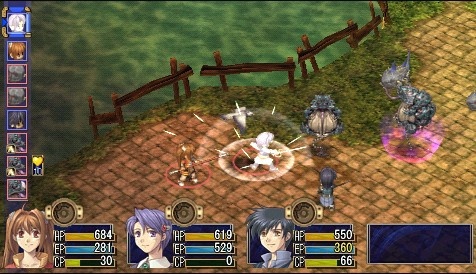
The Legend of Heroes: Trails in the Sky

Our most recent conversation about video games occurred just after I finished Persona 4 (which I’ll review later), and just as I was about to finish The Legend of Heroes: Trails in the Sky. He had just finished playing through the demo of Dragon Age 2, and we talked while he plowed his way through twelve-year-old n00bs in Halo 3 multiplayer. Our topic: are Japanese otaku more intrinsically sentimental than American nerds? Our conclusion: possibly, yes.
Few games convey that sentimentality better than The Legend of Heroes: Trails in the Sky, with its gentle J-pop theme song and its teenage heroes dancing around their veiled romantic feelings for each other. It is a game cast in the familiar JRPG model, concerned more with telling its story than with introducing the player to complicated game mechanics or micro-managed character progression. This seems, to me, slightly unusual for developer Falcom, as even their recent games, in spite of their cutesy art style, employ fairly sophisticated game mechanics. On the other hand, The Legend of Heroes series began with a fairly rote Dragon Quest clone.
But while the Falcom of old often experimented with their game design – look at their early action-RPG Sorcerian for a wild mixture of side-scrolling action with Wizardry-esque character/party building – the development team now focuses mostly on polishing conventional gameplay to mirror sheen. Ys 7 feels like it could be a remake of a classic Playstation era game, and I mean that as a compliment. Trails in the Sky, while originally released for Japanese PCs in 2004, feels like a classic game that has aged extraordinarily well.


That the characters are likable, their banter well written (and excellently translated, thanks to American publisher XSeed), and the pacing well planned help immensely. Fans have often compared playing Trails in the Sky to reading a book, which the game invites not only with heavy amounts of text, but by segmenting its narrative in chapters.

7/18/11
It Only Took Me Twelve Years
In the car, driving back from an early dinner at a favorite restaurant, RockManXZ24, my game playing friend whose obsession has provided him with a unique ability to find extra hours in the day to finish absurdly long JRPGs, asked me the same question he’s asked for about four months: “did you ever beat Final Fantasy 5?”
The question would have hung in the air had I not known it was coming. RockMan started asking about my progress about two weeks after I, on a whim, started playing it again, likely my favorite game that I never bothered to beat. RockMan reminded me that it came out nearly twelve years ago – The twelfth anniversary for Final Fantasy Anthology, the first official English release of Final Fantasy 5, is on September 30th.
Final Fantasy 5 was one of the games that set off the internet translation scene, with various groups trying their hardest to push out a fully playable, English language rom hack before the others could take credit. Derrick Sobodash, one of the key figures in that era, had an insightful, honest article about the time he spent translating video games as a very young man. It seems to have disappeared, for the time being, or I would link to it here. It would be an interesting footnote for any retrospective on the game or its series. Not only was Final Fantasy 5 a “lost gem” for fans of the series and Japanese RPGs, but the catalyst for what is now an expansive community of hobbyists who seemingly spend more time working on games than playing them.
A lot of reviewers who look at the game in hindsight get hung up on the story, which is rudimentary and filled with shonen manga clichés about the importance of friendship, bursting with deus-ex-machina solutions left largely inexplicable, a cast of orphaned children trying to please their parents. All while trying to save the world.
Those more inclined to play a game for its mechanics praise its “job system.” The player decides on a character class for each of the four party members, and learns skills that can then be used while the character learns the skills of another class. So, if the player were inclined to do so, Bartz, the lead character, could be a thief who can also cast black magic, or a ninja who can steal items from monsters, or a knight who wields two swords like a ninja. Until Final Fantasy 7, this was the most customizable game in the series, and with the job system added on top of the typical equipment management and character progression, it is easily the numerically driven player experiences developed for the SNES/Super Famicom. But it’s also recognizably a Final Fantasy title, what with the moogles, chocobos, Nobuo Uematsu music and active time battle system.
In case it isn’t obvious, I am a numbers fetishist. At least when it comes to video games, that is. Grinding my way through Etrian Odyssey is, for me, a good time. But I also like games that feel that they were made by real people rather than assembled according to a formula. These sentiments seem slightly opposed. I’ve often considered that my ineptness at mathematics maybe created the desire to play with numbers in a less daunting way than doing geometrical proofs or solving equations. Is that why I want both warmth and pure number-crunching in my games? It could very well be.
But why would I like Final Fantasy 5 so much when it is generally agreed upon as having a totally rote story and cast? I’m thinking, maybe, that the familiarity is part of why it appeals to me. It’s so purely unpretentious, so reminiscent of the sort of anime I watched as a kid, before Neon Genesis Evangelion kinda-sorta ruined anime as a whole for me, that it somehow doesn’t matter that every twist in the plot and characterization appears close to the face, rather than peaking over the horizon or hiding in the margin. I’ve said it before: if I wanted a challenging narrative, I would read a book (and I often do).
After I got home, I hooked up my Playstation, inserted the Final Fantasy 5 CD; three hours later, I had made it through the final dungeon in the “N-Zone,” and was fighting Neo X-Death, the evil tree bent on destroying the planet. Yes, the last boss is an evil, world destroying tree.
I had grinded to the point that two of my characters had learned the “mimic” battle skill. Walking about in dungeons and fighting random battles had become a sort of before-bed ritual for about a month, and it made the last boss battle rather easy. Two characters with mimic, one with Black magic and a “Red X 2” ability (two spells cast for the same turn), and two characters in the mime cast made for entire rounds of “flare” cast on all sections of the boss. Four characters, each casting flare twice, meant that my party caused around 20,000 to 24,000 damage each round. As mentioned, it was easy.
And watching the ending, with the Nobuo Uematsu’s crystal theme, the overworld theme, and the Final Fantasy fanfare playing in a medley that evoked every ounce of nostalgia in my small, cynical heart to come bursting forth in a deluge of unexpected and unwanted melancholy, I thought about how I had been playing this game for almost twelve years. It was fun. I loved it.
The only other game that I think has ever gotten an emotional reaction from me was Final Fantasy 4. Unlike its immediate, unrelated sequel, I’ve beaten that game numerous times, and on multiple systems. The world has changed a lot in the twelve years between the time I first played Final Fantasy 5 and the time at which I beat it. It’s a landmark title, for a lot of people, and for a lot of reasons. Nostalgia has a funny way of working like that.
The question would have hung in the air had I not known it was coming. RockMan started asking about my progress about two weeks after I, on a whim, started playing it again, likely my favorite game that I never bothered to beat. RockMan reminded me that it came out nearly twelve years ago – The twelfth anniversary for Final Fantasy Anthology, the first official English release of Final Fantasy 5, is on September 30th.
Final Fantasy 5 was one of the games that set off the internet translation scene, with various groups trying their hardest to push out a fully playable, English language rom hack before the others could take credit. Derrick Sobodash, one of the key figures in that era, had an insightful, honest article about the time he spent translating video games as a very young man. It seems to have disappeared, for the time being, or I would link to it here. It would be an interesting footnote for any retrospective on the game or its series. Not only was Final Fantasy 5 a “lost gem” for fans of the series and Japanese RPGs, but the catalyst for what is now an expansive community of hobbyists who seemingly spend more time working on games than playing them.
A lot of reviewers who look at the game in hindsight get hung up on the story, which is rudimentary and filled with shonen manga clichés about the importance of friendship, bursting with deus-ex-machina solutions left largely inexplicable, a cast of orphaned children trying to please their parents. All while trying to save the world.
Those more inclined to play a game for its mechanics praise its “job system.” The player decides on a character class for each of the four party members, and learns skills that can then be used while the character learns the skills of another class. So, if the player were inclined to do so, Bartz, the lead character, could be a thief who can also cast black magic, or a ninja who can steal items from monsters, or a knight who wields two swords like a ninja. Until Final Fantasy 7, this was the most customizable game in the series, and with the job system added on top of the typical equipment management and character progression, it is easily the numerically driven player experiences developed for the SNES/Super Famicom. But it’s also recognizably a Final Fantasy title, what with the moogles, chocobos, Nobuo Uematsu music and active time battle system.
In case it isn’t obvious, I am a numbers fetishist. At least when it comes to video games, that is. Grinding my way through Etrian Odyssey is, for me, a good time. But I also like games that feel that they were made by real people rather than assembled according to a formula. These sentiments seem slightly opposed. I’ve often considered that my ineptness at mathematics maybe created the desire to play with numbers in a less daunting way than doing geometrical proofs or solving equations. Is that why I want both warmth and pure number-crunching in my games? It could very well be.
But why would I like Final Fantasy 5 so much when it is generally agreed upon as having a totally rote story and cast? I’m thinking, maybe, that the familiarity is part of why it appeals to me. It’s so purely unpretentious, so reminiscent of the sort of anime I watched as a kid, before Neon Genesis Evangelion kinda-sorta ruined anime as a whole for me, that it somehow doesn’t matter that every twist in the plot and characterization appears close to the face, rather than peaking over the horizon or hiding in the margin. I’ve said it before: if I wanted a challenging narrative, I would read a book (and I often do).
After I got home, I hooked up my Playstation, inserted the Final Fantasy 5 CD; three hours later, I had made it through the final dungeon in the “N-Zone,” and was fighting Neo X-Death, the evil tree bent on destroying the planet. Yes, the last boss is an evil, world destroying tree.
I had grinded to the point that two of my characters had learned the “mimic” battle skill. Walking about in dungeons and fighting random battles had become a sort of before-bed ritual for about a month, and it made the last boss battle rather easy. Two characters with mimic, one with Black magic and a “Red X 2” ability (two spells cast for the same turn), and two characters in the mime cast made for entire rounds of “flare” cast on all sections of the boss. Four characters, each casting flare twice, meant that my party caused around 20,000 to 24,000 damage each round. As mentioned, it was easy.
And watching the ending, with the Nobuo Uematsu’s crystal theme, the overworld theme, and the Final Fantasy fanfare playing in a medley that evoked every ounce of nostalgia in my small, cynical heart to come bursting forth in a deluge of unexpected and unwanted melancholy, I thought about how I had been playing this game for almost twelve years. It was fun. I loved it.
The only other game that I think has ever gotten an emotional reaction from me was Final Fantasy 4. Unlike its immediate, unrelated sequel, I’ve beaten that game numerous times, and on multiple systems. The world has changed a lot in the twelve years between the time I first played Final Fantasy 5 and the time at which I beat it. It’s a landmark title, for a lot of people, and for a lot of reasons. Nostalgia has a funny way of working like that.
4/24/11
Evil Zone 封神領域エルツヴァーユ
Japanese developer Yukes had one thing (a cynical lot would say only one thing) at which they excelled, and that thing was fast-paced, cinematic fighting games whose appeal lies more in their personality than their actual fighting systems. “Gamers” in the USA probably know them best as developers of the original WWF Smackdown, a pro-wrestling simulator which boasted (you guessed it) a fast-paced, cinematic engine.
But Yukes also made one of the few games that I genuinely like to watch more than play: Evil Zone, or, if you pretend to know Japanese, Eretzvaju. Evil Zone caught my attention and that of others because it embellishes so much of its visuals and presentation with the conventions of Japanese animation, all genres more or less represented. And really, it’s almost difficult to explain just how enmeshed Japanese animation and Japanese video game fandoms were in the nineties, especially in the west, where video game magazines like Die Hard Game Fan and Gamer’s Republic featured whole sections devoted to anime news and reviews. This is the second draft of this post; the first included, around this point, a nearly eight-hundred word digression on this subject.
You, the readers, have been spared the torment of a ramble about decades old anime for the sake of brevity. So we jump straight into the problems – oh, the problems. The fighting system utilizes only the directional pad and two buttons, one for attack and one for defense. Which attacks the fighters use are based on distance and which directional button the player presses. Attacking at close distance usually results in three hit melee combo, and at a distance, the standard attacks are all projectiles. Pressing a directional button while attacking will usually send a projectile that either stuns or knocks the opposing character to a distance. Pressing “down” while attacking executes a trapping attack that will result in a brief cinematic sequence, which generally does a good bit of damage. The fights generally boil down to each character blocking until somebody either gets caught in the trapping attack or one of the characters manages to launch an effective stunning projectile, which generally opens up an opportunity for that trapping attack or maybe a throw.
The player can also hold the attack button to charge. The charge bar is actually the length of the player’s current health, so the lower the player’s health, the faster the charge. The charge can be used in one of two ways. The player can throw a slow moving projectile that, if it connects, will initiate another cinematic attack that causes absurd amounts of damage, but the player can also use the charge to boost a regular projectile. Again, the strategy for this is roughly the same as executing the trapping attacks.
The fighting system is quickly mastered and is fairly dull. When I first played Evil Zone, I tried to do evasion attacks and rushes, neither of which are really as effective as throwing projectiles and waiting for the opposing fighter to make a mistake. The melee fighting is ineffective, for the most part, and the characters all play the same since they all have projectiles that stun and trapping attacks. The only differences come from which directional key causes the stun attack. Character preference stems mostly from the character designs.
But what character designs they are! As mentioned, I really like Evil Zone when I’m watching it. The presentation here is incredibly fun. The story mode is actually done as anime, each fight representing a new episode, and each story mode featuring some hilariously dead-on parody of the animation genres associated with the characters. Danzaivar, the tokusatsu hero, utilizes everything from ultimate attacks to henshin code words to satellite laser guns that shoot enemies during charge and trapping attacks. Every character introduces new episodes and the game even collects the world-building and character data in an encyclopedia for the player’s perusal.
It’s uncanny how closely the game imitates the tropes of various anime. The story for Setsuna, the magical school-girl, even includes some vaguely sapphic overtones that would have been unusual in a localized game in 1999 (though the localization team at Blue Sky software changed her age from 14 to 21, understandably), and the character themes resemble anime themes in all ways except the lack of vocals. The best story line is actually for Keiya, an onmyoji who fulfills the bishonen badass archetype to a tee, whose “episodes” take the form of a write-in advice show. The characters he fights write in before each episode with some ludicrous problem or other, Keiya renders his advice with deadpan snark. The voice actor for Keiya, Chris Wilcox, stands out from the rest; his delivery is pitch-perfect.
The whole idea of a context sensitive fighting system is cool, and I like a lot of the attack animations. And the graphics were great for a 1999 Playstation game. Unfortunately, the fighting engine is underdeveloped. There are also some problems with the localization. Voices often fail to sync with the animation, leading to some very odd timing during the in-game conversations, and translating what were originally English, German, Latin and Welsh words from Katakana leads to some very odd spellings. “Cocytus” becomes “Cocotus” and “Claiomh Solais” becomes “Klau Solas.” If that’s nit-picky, well, I’m a nit-picker. If you like vintage anime and video games, Evil Zone is an enjoyable diversion, even if it’s a mediocre game whose charm will be lost on the uninitiated. Yukes seems to have used the basic idea for their recent licensed titles, but those really don’t have the same personality or tongue-in-cheek appeal of Evil Zone.
But Yukes also made one of the few games that I genuinely like to watch more than play: Evil Zone, or, if you pretend to know Japanese, Eretzvaju. Evil Zone caught my attention and that of others because it embellishes so much of its visuals and presentation with the conventions of Japanese animation, all genres more or less represented. And really, it’s almost difficult to explain just how enmeshed Japanese animation and Japanese video game fandoms were in the nineties, especially in the west, where video game magazines like Die Hard Game Fan and Gamer’s Republic featured whole sections devoted to anime news and reviews. This is the second draft of this post; the first included, around this point, a nearly eight-hundred word digression on this subject.
You, the readers, have been spared the torment of a ramble about decades old anime for the sake of brevity. So we jump straight into the problems – oh, the problems. The fighting system utilizes only the directional pad and two buttons, one for attack and one for defense. Which attacks the fighters use are based on distance and which directional button the player presses. Attacking at close distance usually results in three hit melee combo, and at a distance, the standard attacks are all projectiles. Pressing a directional button while attacking will usually send a projectile that either stuns or knocks the opposing character to a distance. Pressing “down” while attacking executes a trapping attack that will result in a brief cinematic sequence, which generally does a good bit of damage. The fights generally boil down to each character blocking until somebody either gets caught in the trapping attack or one of the characters manages to launch an effective stunning projectile, which generally opens up an opportunity for that trapping attack or maybe a throw.
The player can also hold the attack button to charge. The charge bar is actually the length of the player’s current health, so the lower the player’s health, the faster the charge. The charge can be used in one of two ways. The player can throw a slow moving projectile that, if it connects, will initiate another cinematic attack that causes absurd amounts of damage, but the player can also use the charge to boost a regular projectile. Again, the strategy for this is roughly the same as executing the trapping attacks.
The fighting system is quickly mastered and is fairly dull. When I first played Evil Zone, I tried to do evasion attacks and rushes, neither of which are really as effective as throwing projectiles and waiting for the opposing fighter to make a mistake. The melee fighting is ineffective, for the most part, and the characters all play the same since they all have projectiles that stun and trapping attacks. The only differences come from which directional key causes the stun attack. Character preference stems mostly from the character designs.
But what character designs they are! As mentioned, I really like Evil Zone when I’m watching it. The presentation here is incredibly fun. The story mode is actually done as anime, each fight representing a new episode, and each story mode featuring some hilariously dead-on parody of the animation genres associated with the characters. Danzaivar, the tokusatsu hero, utilizes everything from ultimate attacks to henshin code words to satellite laser guns that shoot enemies during charge and trapping attacks. Every character introduces new episodes and the game even collects the world-building and character data in an encyclopedia for the player’s perusal.
It’s uncanny how closely the game imitates the tropes of various anime. The story for Setsuna, the magical school-girl, even includes some vaguely sapphic overtones that would have been unusual in a localized game in 1999 (though the localization team at Blue Sky software changed her age from 14 to 21, understandably), and the character themes resemble anime themes in all ways except the lack of vocals. The best story line is actually for Keiya, an onmyoji who fulfills the bishonen badass archetype to a tee, whose “episodes” take the form of a write-in advice show. The characters he fights write in before each episode with some ludicrous problem or other, Keiya renders his advice with deadpan snark. The voice actor for Keiya, Chris Wilcox, stands out from the rest; his delivery is pitch-perfect.
The whole idea of a context sensitive fighting system is cool, and I like a lot of the attack animations. And the graphics were great for a 1999 Playstation game. Unfortunately, the fighting engine is underdeveloped. There are also some problems with the localization. Voices often fail to sync with the animation, leading to some very odd timing during the in-game conversations, and translating what were originally English, German, Latin and Welsh words from Katakana leads to some very odd spellings. “Cocytus” becomes “Cocotus” and “Claiomh Solais” becomes “Klau Solas.” If that’s nit-picky, well, I’m a nit-picker. If you like vintage anime and video games, Evil Zone is an enjoyable diversion, even if it’s a mediocre game whose charm will be lost on the uninitiated. Yukes seems to have used the basic idea for their recent licensed titles, but those really don’t have the same personality or tongue-in-cheek appeal of Evil Zone.
2/16/11
I've Never Seen Such - Such Beautiful Pixels Before
I’ve talked a bit about retro games here, and, looking back, I think my tone on the subject of new games designed with 8-bit graphics and gameplay skews towards ambivalence. I predicted that the fad would die out quickly and was wrong. My antipathy for F. Scott Fitzgerald has not made an appearance on my blog, for the sole reason that it doesn’t fit. I’m as vociferous a detractor of Fitzgerald’s as anyone else, I assure. My reaction to reading The Great Gatsby in high school ran towards something along the lines of “no shit,” and I winced at Pilgrim’s then girlfriend comparing me with Gatsby, which was probably more true at the time than I’d like to admit even now. And “The Curious Case of Benjamin Button” is a horrific, awful story that I hate, hate, hate.
A teacher whose acquaintance I recently made introduced me to this little game, the project of a couple of amateur developers who happen to adore Fitzgerald. She plans to use the game when teaching Gatsby to her students, and, to my surprise, I think it a brilliant instructional tool. No other game captures so well the key scenes of a novel, or so humorously. The 8-bit, Ninja Gaiden-esque cinema sequences of Nick watching Gatsby gazing at the green light at the end of Daisy’s dock or Daisy wondering at the magnificence of Gatsby’s “beautiful shirts” are funny as hell and come more or less verbatim from the text.
The game itself resembles a later era, post-Mario 3 NES platformer. The player scrolls from left to right as Nick Carraway, throwing his hat at drunken party guests, snooty butlers, and dancing flappers at Gatsby’s party, and even meets Owl Eyes in an pixilated rendering of Gatsby’s library. The mechanics are all fairly tight. The jumping physics are easy to handle and Nick’s hat travels like a boomerang when thrown. It’s very well put together as a game, albeit a bit short. There are only four levels, but the player will encounter, among others, the eyes of T. J. Eckleburg in the Valley of Ashes (they shoot lasers at Nick) and Meyer Wofesheim with the New York Yankees as end-level bosses.
The game can be played for free on its website, itself a thing of nerdy beauty. The developers have gone full out with the presentation, claiming that they found their product as an unreleased cart sold at a yard sale, the localized version of a Japanese game called "Doki Doki Toshokan: Gatsby no Monogatari,” which means something along the lines of “Thump-thump Townhouse: The story of Gatsby.” They even include a magazine ad and a mocked up manual with an enemy list, all of which resemble actual NES era documents. The attention to detail permeates the game, as the color palette resembles that of the actual Nintendo hardware, and the credits include special thanks to H. Sakaguchi, N. Uematsu, and Y. Amano, Final Fantasy fans will be pleased to know.
What a fun little time-waster, and clever to boot. It’s been tweeted about 11,000 times as of this writing, and shared on facebook by over 60,000. Other games have taken classic literature as their inspiration, most recently the awfully stupid Dante’s Inferno, but it was not wholly unheard of even in the 8-bit era. Bandit Kings of Ancient China is a strategy title based on The Water Margin, and I cannot even begin to list all of the games based on Journey to the West, or the number of RPGs and action titles that take characters and events from Greek mythology. If it means anything to programmer Charlie Hoy, his Great Gatsby Game would have been the best adaptation of classic literature on the system had it only been made twenty years ago, and the most unexpectedly good. He should expand it and get it released on Nintendo’s Wii/Dsi Ware, Microsoft’s Xbox Live Marketplace, and Sony’s Playstation Network.
Or the reader can just play the four existing levels for free, on their site. Really, play this game. This is what an intentionally retro-game ought to be like.
1/3/11
Ys 7 (イースVII) -- Thank You Falcom; Thank You Xseed
I cannot express too much my joy in publisher XSeed’s decision to license not one, but six Falcom games for the PSP. As mentioned in my review of Cladun: This is an RPG, the PSP is a challenging system due to both rampant piracy and consumer disinterest. I bought the special edition of Ys 7 in thanks, and listen to the bonus soundtrack CD at ear-damaging volume while on the road, with the windows rolled down for the benefit of my fellow drivers, who tend to look at the large, bearded man in a tiny Ford Focus head banging to Japanese synth-rock with looks of dismay and confusion.
I am also a fairly recent convert to the tiny cult of dedicated Falcom fans. The Ys series received only sporadic releases in the United States, the most impressive on relatively obscure consoles, with much fanfare regarding the incredible soundtracks. Not being one of the two people I have ever known who owned a Turbografx-16, nor having played Ys III (the other game in the series released in America, a much wider one at that), I remained generally ignorant about Falcom until a friend bought Ys: The Ark of Napishtim for the Playstation 2. Since then, I’ve played through the majority of the virtual console port of Ys 1&2 on RockManXZ24’s Wii, downloaded Vantage Master Online for free (legally), given up on Gurumin for the PSP, and toyed with Sierra’s port of Sorcerian utilizing DOSBox emulation. Ys 7 is sadly the first only Falcom game I own on physical media for its platform of origin. As such, it holds a special place in my collection of nerd-memorabilia. I stopped just short of actually putting the cloth map that came with the deluxe edition on my wall.
 Geeking out over the game would be pointless, though, if it sucked. Ys 7 is a good game with some minor flaws, the growing pains of a very conservative series attempting new things. For the past decade, Falcom developed almost exclusively for Japanese PCs, where their original development started, not coincidentally, and for a relatively niche audience. For the first time since 1995’s Ys 5 for the Super Famicom, the developers at Falcom have designed a game specific to a console system, and a portable one at that (another first for the series). For the first time in the series, the player controls a party of characters rather than series protagonist Adol alone, and the game provides a considerably larger amount of traditionally Japanese RPG elements: weapons, equipment, party customization and dialogue sequences.
Typically, in an Ys game, the player controls series protagonist Adol through a tightly woven adventure. From a cursory view, the series seems similar to Nintendo’s earlier Zelda games, with minimal equipment and items, but Ys adds stat-levelling and adrenaline raising, arcade style boss fights that require analysis of attack patterns and weak points. The hybridization proved itself a strong point of the series, especially in the recent PC titles, for which Falcom designed a fast-paced, fluid combat system.
 Ys 7, while still quite linear compared to, for instance, a Bethesda title, adopts a lot of looser mechanics. Aside from controlling three characters, the inventory has expanded due to a crafting system. The player can now make new weapons, armor, equipment and items from materials collected either from killing enemies or from drop points on the map. To make this worthwhile, there’s a large amount of equipment, much of it specific to one or two characters. The boss battles also lose some of their difficulty from the party mechanic, if one of the characters dies, healing items can revive them, and even without an item, two other characters remain to continue the fight.
The sheer amount of dialogue gets in the way too. Ys 7 does what makes a number of Tri-Ace games infuriating: it forces the player to explore a town environment and sit through an almost mind-numbing set-up before actually getting to the actual gameplay (before any Tri-Ace fans get upset, I happen to account at least two Tri-Ace games among my favorites). The last portion of the game even brings all the characters together for a tedious excursion in back-tracking.
If these complaints sound peculiar, it is because the Ys series (and Falcom as a developer) has peculiarly avoided them while many other Japanese developers wallow in such dated conventions. But for all that, Ys 7 is not only a good game; it’s one of the best in a genre now largely indistinct: the action RPG.
Ys 7 plays as though games like Magic of Scheherazade and Beyond Oasis continued on a steady course through the previous two console generations. The battle system is something of a marvel; the three party characters have speed, power and balance attacks, all of which move quite fast, and switching between characters at the press of a button makes the fighting both breezy and hectic. The addition of a “dash” button speeds up not only the combat, but exploration, and the party AI also works quite well, with the non-player characters behaving properly (i.e. actually attacking nearby enemies). The dungeons expand on themselves with simple “collect item/use item” puzzles that make the most of the environments spatial relations.
And the music is fucking great, a considerable boon to the player, given how often he or she will be hearing the tracks. Falcom made its name amongst a lot of players because of that specialty, rightfully so, though they also deserve credit for their actual art design. Other reviewers have noted that the developer has not pushed the PSP hardware graphically, which is true, but the actual art direction is peerless. Altago, the game's setting, is analogous to ancient Carthage in the Ys milieu, and the game's environments display an appropriately fantastic rendering of old Mediterranean architecture and scenery. Even with the general sloppiness of the pacing (and some of the writing), the story feels like it came right out of a mid-80’s OVA, hardly as overwrought as many of its peers, and a often a good deal more charming (the self-awareness in much of the dialogue does no hurt either).
And that’s Falcom’s gift. Ys 7 is one of their most recent titles, and it makes more concessions to contemporary design than most of their other games, but it still feels like a classic title made by people blissfully unaware of what people say about how games are supposed to be these days. And what a relief that is. Games that feel as though people made them rather than automated factories come by less and less often these days.
I am also a fairly recent convert to the tiny cult of dedicated Falcom fans. The Ys series received only sporadic releases in the United States, the most impressive on relatively obscure consoles, with much fanfare regarding the incredible soundtracks. Not being one of the two people I have ever known who owned a Turbografx-16, nor having played Ys III (the other game in the series released in America, a much wider one at that), I remained generally ignorant about Falcom until a friend bought Ys: The Ark of Napishtim for the Playstation 2. Since then, I’ve played through the majority of the virtual console port of Ys 1&2 on RockManXZ24’s Wii, downloaded Vantage Master Online for free (legally), given up on Gurumin for the PSP, and toyed with Sierra’s port of Sorcerian utilizing DOSBox emulation. Ys 7 is sadly the first only Falcom game I own on physical media for its platform of origin. As such, it holds a special place in my collection of nerd-memorabilia. I stopped just short of actually putting the cloth map that came with the deluxe edition on my wall.
 Geeking out over the game would be pointless, though, if it sucked. Ys 7 is a good game with some minor flaws, the growing pains of a very conservative series attempting new things. For the past decade, Falcom developed almost exclusively for Japanese PCs, where their original development started, not coincidentally, and for a relatively niche audience. For the first time since 1995’s Ys 5 for the Super Famicom, the developers at Falcom have designed a game specific to a console system, and a portable one at that (another first for the series). For the first time in the series, the player controls a party of characters rather than series protagonist Adol alone, and the game provides a considerably larger amount of traditionally Japanese RPG elements: weapons, equipment, party customization and dialogue sequences.
Typically, in an Ys game, the player controls series protagonist Adol through a tightly woven adventure. From a cursory view, the series seems similar to Nintendo’s earlier Zelda games, with minimal equipment and items, but Ys adds stat-levelling and adrenaline raising, arcade style boss fights that require analysis of attack patterns and weak points. The hybridization proved itself a strong point of the series, especially in the recent PC titles, for which Falcom designed a fast-paced, fluid combat system.
 Ys 7, while still quite linear compared to, for instance, a Bethesda title, adopts a lot of looser mechanics. Aside from controlling three characters, the inventory has expanded due to a crafting system. The player can now make new weapons, armor, equipment and items from materials collected either from killing enemies or from drop points on the map. To make this worthwhile, there’s a large amount of equipment, much of it specific to one or two characters. The boss battles also lose some of their difficulty from the party mechanic, if one of the characters dies, healing items can revive them, and even without an item, two other characters remain to continue the fight.
The sheer amount of dialogue gets in the way too. Ys 7 does what makes a number of Tri-Ace games infuriating: it forces the player to explore a town environment and sit through an almost mind-numbing set-up before actually getting to the actual gameplay (before any Tri-Ace fans get upset, I happen to account at least two Tri-Ace games among my favorites). The last portion of the game even brings all the characters together for a tedious excursion in back-tracking.
If these complaints sound peculiar, it is because the Ys series (and Falcom as a developer) has peculiarly avoided them while many other Japanese developers wallow in such dated conventions. But for all that, Ys 7 is not only a good game; it’s one of the best in a genre now largely indistinct: the action RPG.
Ys 7 plays as though games like Magic of Scheherazade and Beyond Oasis continued on a steady course through the previous two console generations. The battle system is something of a marvel; the three party characters have speed, power and balance attacks, all of which move quite fast, and switching between characters at the press of a button makes the fighting both breezy and hectic. The addition of a “dash” button speeds up not only the combat, but exploration, and the party AI also works quite well, with the non-player characters behaving properly (i.e. actually attacking nearby enemies). The dungeons expand on themselves with simple “collect item/use item” puzzles that make the most of the environments spatial relations.
And the music is fucking great, a considerable boon to the player, given how often he or she will be hearing the tracks. Falcom made its name amongst a lot of players because of that specialty, rightfully so, though they also deserve credit for their actual art design. Other reviewers have noted that the developer has not pushed the PSP hardware graphically, which is true, but the actual art direction is peerless. Altago, the game's setting, is analogous to ancient Carthage in the Ys milieu, and the game's environments display an appropriately fantastic rendering of old Mediterranean architecture and scenery. Even with the general sloppiness of the pacing (and some of the writing), the story feels like it came right out of a mid-80’s OVA, hardly as overwrought as many of its peers, and a often a good deal more charming (the self-awareness in much of the dialogue does no hurt either).
And that’s Falcom’s gift. Ys 7 is one of their most recent titles, and it makes more concessions to contemporary design than most of their other games, but it still feels like a classic title made by people blissfully unaware of what people say about how games are supposed to be these days. And what a relief that is. Games that feel as though people made them rather than automated factories come by less and less often these days.
12/3/10
Cladun: This is a Review
Earlier this year I made a list of six games that I wanted to play (in English, legally, on physical media) that I doubted would ever see release in the US. Two of them, both published by NIS America, actually did make it to the English language market, but only one of them made it onto store shelves. My voracious gamer friend, RockManXZ24, assures me that ZHP is awesome, but for purely financial reasons, I haven’t played it. Rather, I’ve made do with Cladun: This is an RPG, the other NIS America dungeon crawler which got left in the lurch as a downloadable game on the Playstation Network.
 Thankfully, Cladun has enough content and customization that I haven’t grown bored with it since its release in September. It’s the very definition of niche: retro graphics, optional retro soundtrack (like 2009’s The Dark Spire), noticeably Japanese aesthetics, video game meta-humor, randomized gameplay elements (mainstream critics and gamers seem to hate these) and a focus on number-crunching customization and dungeon crawling. PSP exclusivity does Cladun no favors; the system does quite well in Japan, maintaining a reputation as a gamer’s system, but American gamers never took to it, except for those who bought it with the intention of installing custom firmware (ie tech-savvy software pirates and software pirates with tech-savvy friends). It almost feels like the game was tailored precisely to my tastes, since I share an affinity with the misunderstood and underappreciated as all nerds do.
The game starts off with lots of talking. A girl named Pudding, suffering from a terminal disease, runs off to the magical world of Arcanus Cella, a sort of personal universe for its creator, Despina the witch. Her childhood friend, Souma, follows her there to try to protect her, but she wants to go treasure hunting, while new characters frequently show up to act as merchants and party members. The story ends whenever the player decides to leave Arcanus Cella, with the resulting conclusion depending on how much progress the player has made. I started to skip the story sequences early on, as I don’t play a game like this for story. Of the writing, I faintly remember references to JRPG and anime tropes -- cosplay and "Dragon Ball" and loathsomely young heroes -- some of which I assume the localization team contributed.
 I’m too busy creating characters and making runs on the 99 level randomly generated dungeon to really care that much about the catatonic story-telling or the goofy dialogue that presents it. Much like From Software and Atlus’ recent PS3 title, 3D Dot Game Heroes, Cladun offers a sprite editor, which has prompted people to come up with some brilliant facsimiles of anime and video game characters in faux 8-bit pixel art. I can’t resist character creation, which was enough to save even the broken Soul Calibur series, at least in my eyes.
There are a number of classes, each of which have different level up bonuses depending on whether they are the main character, or a sub-character placed on the “magic circle.” The magic circle is Cladun’s approach to character customization, in which characters are equipped like items on a grid, which often bequeaths special bonuses to them as they gain experience. The actual gameplay is in real-time (unlike the average turn-based roguelike or dungeon crawler), so the player controls one character and equips that character with shields, weapons (swords, axes, or staves), and armor, as well as deciding on which magic circle to use and which characters to place on it. While the characters on the magic circle earn experience and bonuses, depending on which magic circle the player picks, and what area he places the character, the main character receives bonuses and protection from the characters on the magic circle. Sub-characters can equip artifacts that might increase the main characters attack, defense, or skill abilities, while also absorbing damage for the main character.
 Outside of customization and party builds, the gameplay feels something like Diablo by way of The Legend of Zelda. The game derives its momentum from the promise of number-crunching, level-grinding mathematical progression, but the actual dungeons feature real-time combat that necessitates attention. Running around and slashing enemies with wild abandon will get your character killed off fast, as the enemies can do considerable damage and there are traps littering the floors of every dungeon. The combat itself is fun, but it has the added benefit of rare loot drops. The real meat of the game is its character and party building.
I hate that NISA relegated Cladun to a PSN download. I recognize the difficulty in releasing physical media on a console as plagued by piracy and indifference as the PSP, but Cladun is a really fun game that genuinely deserves better. As much as the faux-retro fad irks me, I think that Cladun: This is an RPG actually transcends the obnoxiousness of its retro persona. It is a perfectly good game, and would be regardless of graphics. It might not be as visually creative as 3D Dot Game Heroes, or as deftly nostalgic as Retro Game Challenge, or as thematically coherent as Half Minute Hero, but, ignoring the retro-graphics and music, Cladun is something that some of us can’t get enough of: a number-crunching grind-fest that appeals to the inner OCD at the heart of, I believe, anybody willing to play video games into their adult years. There are so many options for character customization, and then to customize characters by using previously customized characters and adding to them rare items culled from runs in the randomly generated dungeon.
 Cladun: This is an RPG caters to the sensibilities of retro-gamers in terms of its graphics and music, but the actual gameplay system is as complex as anything else published (or developed) by Nippon Ichi or its American branch. It’s part of a recent revival of interest in genuinely challenging games, and might have reached a wider audience if not for the digital distribution, a double edged sword that cuts manufacturing costs while ensuring that nobody but the devoted will discover the product. It’s a shame. Cladun is a fast paced, deep, and easily understood dungeon crawler.

The game starts off with lots of talking. A girl named Pudding, suffering from a terminal disease, runs off to the magical world of Arcanus Cella, a sort of personal universe for its creator, Despina the witch. Her childhood friend, Souma, follows her there to try to protect her, but she wants to go treasure hunting, while new characters frequently show up to act as merchants and party members. The story ends whenever the player decides to leave Arcanus Cella, with the resulting conclusion depending on how much progress the player has made. I started to skip the story sequences early on, as I don’t play a game like this for story. Of the writing, I faintly remember references to JRPG and anime tropes -- cosplay and "Dragon Ball" and loathsomely young heroes -- some of which I assume the localization team contributed.

There are a number of classes, each of which have different level up bonuses depending on whether they are the main character, or a sub-character placed on the “magic circle.” The magic circle is Cladun’s approach to character customization, in which characters are equipped like items on a grid, which often bequeaths special bonuses to them as they gain experience. The actual gameplay is in real-time (unlike the average turn-based roguelike or dungeon crawler), so the player controls one character and equips that character with shields, weapons (swords, axes, or staves), and armor, as well as deciding on which magic circle to use and which characters to place on it. While the characters on the magic circle earn experience and bonuses, depending on which magic circle the player picks, and what area he places the character, the main character receives bonuses and protection from the characters on the magic circle. Sub-characters can equip artifacts that might increase the main characters attack, defense, or skill abilities, while also absorbing damage for the main character.

I hate that NISA relegated Cladun to a PSN download. I recognize the difficulty in releasing physical media on a console as plagued by piracy and indifference as the PSP, but Cladun is a really fun game that genuinely deserves better. As much as the faux-retro fad irks me, I think that Cladun: This is an RPG actually transcends the obnoxiousness of its retro persona. It is a perfectly good game, and would be regardless of graphics. It might not be as visually creative as 3D Dot Game Heroes, or as deftly nostalgic as Retro Game Challenge, or as thematically coherent as Half Minute Hero, but, ignoring the retro-graphics and music, Cladun is something that some of us can’t get enough of: a number-crunching grind-fest that appeals to the inner OCD at the heart of, I believe, anybody willing to play video games into their adult years. There are so many options for character customization, and then to customize characters by using previously customized characters and adding to them rare items culled from runs in the randomly generated dungeon.

11/1/10
Shui Hu Feng Yun Zhuan 水浒风云传
Some people online distribute the rom to this impressive post-mortem (released in 1999!) Genesis/MegaDrive beat-em-up under the title “Beneath the Clouds.” I’d guess that these people got that from putting the Romanized characters into babelfish. If you’re sort who reads my blog, you might recognize Shui Hu Zhuan as one of the great literary accomplishments written in the classical Chinese vernacular, or you might better recognize it under its English title, The Water Margin. You might also recognize "Feng Yun" as the Chinese title for the comic book/film series we English speakers call "The Storm Riders." What does any of that trivia have to do with the game? Nothing, really. Maybe I’ll email Lightwing23’s wife and beg her to translate the title into something that makes sense, then lord it over the rom distributors and reviewers who have referred to this game as “Beneath the Clouds” for about three years.
I love beat-em-ups only a bit less than I love console/computer role playing games. The two genres seem diametrically opposite in terms of design, and might really have been back when the side scrolling beat-em-up was a viable genre, munching up quarters in arcades and pizza parlors and Wal-Mart lobbies. But I also know that you can beat Kingdom Hearts 2 by pressing the “X” button over and over again, at least according to RockManXZ24, who claims to have done that (and he actually likes the Kingdom Hearts series), which puts it in the same vein as the more mindless beat-em-ups. In fact, I think that the recent, torrid affair between Japan and Capcom’s Monster Hunter shows the greatest marriage of the two forms. There’s no lock-on feature for combat, the games really don’t play well outside of co-op, and the difficulty can be utterly insane. At the same time, the amount of equipment and customization rivals that of Diablo 2, the champion of grindfests.
 One could also point to small games like Castle Crashers and Scott Pilgrim vs. the World (both of which feature character levels and inventory systems) as more likely successors to the beat-em-up -- they undoubtedly are -- that also adopt conventions from the broader role-playing genre. But I think these are too clever for their own good. "Scott Pilgrim," though I liked the movie and what little I’ve played of the game, is overexposed, and watching the animals crapping in Castle Crashers is only funny until, like, the 9000th time you see it. I miss the earnest goofiness of the fantasy themed brawlers from the late eighties and early nineties.
 I also love kung fu movies, but the Chinese themed brawlers made by Capcom (Dynasty Wars, Tiger Road) just aren’t as good as their later games, like the immensely goofy Knights of the Round. The good thing about the recent proliferation of unlicensed Chinese game ROMs is that they developed beat-em-ups that directly imitate the better Japanese games, sometimes competently, while adapting historical events and pulp literature. Shui Hu Fung Yen Zhuan apes Knights of the Round, with similar characters, animations, enemies and gameplay. The player can hit treasure and health power-ups to split them into smaller pieces, as in Capcom’s Arthurian brawler, and the there is a balanced broadsword wielder, a speedy fighter who uses a saber, and a battle-axe brandishing tank. The characters walk from left to right, beating whatever enemies get in the way, then fighting an end boss.

 Shui Hu Fung Yen Zhuan provides only a few levels, but they’re long, and the game adds some inventory management in the form of Gaunglet-esque magic items that the will do massive damage to all enemies on screen. Cut scenes in between levels tell a story in early Tecmo style, which I couldn’t follow because I don’t know Chinese. I breezed through the whole game rather easily (the game gives nine credits and extra lives come easy), but the animation and graphics being a cut above, for example, The Yang Warrior Family made for an enjoyable, if mindless experience.
 The real fun of beat-em-ups is their complete lack of fairness. Unlike a rougelike, which screws with the player’s expectations to the point that it’s unfair, the beat-em-up is unfair in spite of being straightforward, making progress its own reward. Of course the constant flow of enemies will kill the player, and of course the items that can save him or her from certain death will be scarce. If the game doesn’t offer cool graphics and enemies it doesn’t work -- the player needs some motivation to continue walking right and pressing “a” -- but this one actually offers some of the best looking environments on the Genesis, rivaling the SNES ports of King of Dragons and Knights of the Round, and the boss sprites are huge, detailed, and also ripped off from Capcom games.
This is not the pinnacle of the genre on consoles, that honor belongs to Treasure’s Guardian Heroes for the Saturn. This is still a really fun game. It’s hard to believe that it was released the same year that the Dreamcast debuted and a real shame that there are so few of its kind developed these days.
I love beat-em-ups only a bit less than I love console/computer role playing games. The two genres seem diametrically opposite in terms of design, and might really have been back when the side scrolling beat-em-up was a viable genre, munching up quarters in arcades and pizza parlors and Wal-Mart lobbies. But I also know that you can beat Kingdom Hearts 2 by pressing the “X” button over and over again, at least according to RockManXZ24, who claims to have done that (and he actually likes the Kingdom Hearts series), which puts it in the same vein as the more mindless beat-em-ups. In fact, I think that the recent, torrid affair between Japan and Capcom’s Monster Hunter shows the greatest marriage of the two forms. There’s no lock-on feature for combat, the games really don’t play well outside of co-op, and the difficulty can be utterly insane. At the same time, the amount of equipment and customization rivals that of Diablo 2, the champion of grindfests.


This is not the pinnacle of the genre on consoles, that honor belongs to Treasure’s Guardian Heroes for the Saturn. This is still a really fun game. It’s hard to believe that it was released the same year that the Dreamcast debuted and a real shame that there are so few of its kind developed these days.
9/8/10
Game Review -- Bushido Blade 2
It’s a shame that so few people take the time to look back at the company that SquareSoft was before it merged with Enix. I think the last time I saw people discussing Square’s older output was after Threads of Fate became available for download on the PSN, but that game is more notable for being the last of what many of us once referred to as an “Action RPG” on the Playstation than an example of SquareSoft acting against type.
Square’s prolific publishing and development on that system, unfortunately, seems largely reduced to its three Final Fantasy titles, the Final Fantasy Tactics spinoff, Xenogears, and, among those who fancy themselves connoisseurs, Vagrant Story and maybe Parasite Eve. You would think that the company developed and published RPGs exclusively during the mid-to-late nineties, but, in fact, the company’s output became more varied on the Playstation than it had been since their early days publishing for the Famicom and Japanese home computers. They developed and published an excellent horizontal scrolling shooter, Einhander, experimented with mascot themed cart-racing, and released a gaggle of fighting games by developers Dream Factory and Lightweight.
Fighting games at the time were about as far removed from RPGs as you could get (unless you actually liked Culture Brain’s Flying Warrior series) and the ones that Square published were esoteric even by the standards of fighting games. Tobal No. 1 and Tobal 2 by Dream Factory required split second timing to perform combos, and Bushido Blade and its sequel actually attempted something I don’t think had ever been done before: they tried to simulate actual sword fighting.
Lightweight, the developer of the Bushido Blade series, had only one idea, and it was actually pretty interesting. It also has the added benefit of being original. I have not played the first game, and have very little desire (or money) to track it down. But I do have a copy of Bushido Blade 2.
The first thing that I notice after booting the game is the hilariously goofy “FMV” (that’s the 90’s era game nerd acronym for “Full Motion Video” as opposed to, y’know, video that isn’t full motion), rendered in above-average-at-the-time CGI. The direction is almost unbearably cheesy, matched by an equally silly electric guitar score and some of the ugliest character design on the Playstation. Ostensibly set in contemporary Japan, Bushido Blade 2 features characters who wear Edo-era Japanese attire, cowboy outfits, purple leisure suits, Victorian-era dress suits, and underwear to wage a centuries old war between rival feudal clans -- a conflict that somehow transplanted itself into rival martial arts schools in contemporary Japan. The incongruous character design and nonsensical story are almost typical of lower-tier Japanese games of the time, though one character in particular, a jive talkin’ black man with an improbably large afro, purple suit, and bling, is tin-eared even by those standards.
But then, games of this era were in the middle of an awkward creative adolescence, moving from being fairly simple forms of entertainment to incredibly complicated multi-media pieces. When appraised only as a game, Bushido Blade 2 is one of the most interesting fighters of the time. The developers attempted to make an actual simulation of sword fighting, with character movement based on actual martial arts techniques (clearly motion captured by people who understand their functions). The animations actually emulate the inertia of a chunk of metal swung into or drug across somebody’s corpus in a way that at least feels accurate relative to the player’s role behind a controller. The only other fighting game that attempted “realism” at the time was Virtua Fighter, but even that game had health bars and, perhaps, slightly more questionable kinesiology than Bushido Blade 2. But then, Bushido Blade 2 also allows characters to jump around like they're on wires.
Each weapon has three stances, high, low, and mid-guard, and to score a killing hit, the player has to pass the guard. Scoring a hit is not that easy, particularly against opponents with long weapons like Yari spears, Naginata, or No-Dachi. Selecting a weapon appropriate for your character is critical. Obviously, physically weak characters do not perform well with heavy broadswords; less obvious is that certain characters have special stances when using certain weapons. With a good character/weapon combo, the fights are just a matter of timing and strategy. I won most of the matches by attacking during the up or downswing of the opponent’s attack.
The matches start out with the player fighting generic “ninja” enemies before fighting playable characters, which generally put up a better challenge. These matches are great fun by themselves, and the gimmicky modes (first person mode being the worst) superfluous to the experience they offer. The basic fighting game could work exceptionally well as a quickly played online game for portable systems, but with Square Enix as focused as it is on expanding their market share in the west and original developer Lightweight seemingly defunct, that isn’t likely to happen.
Lightwing23 cajoled me into this review with an e-mail in which he mentions the existence of a game based on Spike TV’s embarrassing television series, "Deadliest Warrior." I would rather play Kabuki Warriors, Lightweight’s infamously bad follow up to Bushido Blade 2, than anything that will encourage Spike TV to continue making episodes of that rancid series. The characters in the "Deadliest Warrior" video game can kill each other with a single good hit, which I guess reminded Lightwing23 of Lightweight’s early output, but, from what I can tell based on YouTube videos and reviews, the fighting system better compares to Dream Factory’s Ehrgeiz. The game also looks bland, artless, and crass, which means that it’s nothing if not a faithful adaptation of its source material.
Both Bushido Blade games could be described similarly. But at least they've got personality.
Square’s prolific publishing and development on that system, unfortunately, seems largely reduced to its three Final Fantasy titles, the Final Fantasy Tactics spinoff, Xenogears, and, among those who fancy themselves connoisseurs, Vagrant Story and maybe Parasite Eve. You would think that the company developed and published RPGs exclusively during the mid-to-late nineties, but, in fact, the company’s output became more varied on the Playstation than it had been since their early days publishing for the Famicom and Japanese home computers. They developed and published an excellent horizontal scrolling shooter, Einhander, experimented with mascot themed cart-racing, and released a gaggle of fighting games by developers Dream Factory and Lightweight.
Fighting games at the time were about as far removed from RPGs as you could get (unless you actually liked Culture Brain’s Flying Warrior series) and the ones that Square published were esoteric even by the standards of fighting games. Tobal No. 1 and Tobal 2 by Dream Factory required split second timing to perform combos, and Bushido Blade and its sequel actually attempted something I don’t think had ever been done before: they tried to simulate actual sword fighting.
The first thing that I notice after booting the game is the hilariously goofy “FMV” (that’s the 90’s era game nerd acronym for “Full Motion Video” as opposed to, y’know, video that isn’t full motion), rendered in above-average-at-the-time CGI. The direction is almost unbearably cheesy, matched by an equally silly electric guitar score and some of the ugliest character design on the Playstation. Ostensibly set in contemporary Japan, Bushido Blade 2 features characters who wear Edo-era Japanese attire, cowboy outfits, purple leisure suits, Victorian-era dress suits, and underwear to wage a centuries old war between rival feudal clans -- a conflict that somehow transplanted itself into rival martial arts schools in contemporary Japan. The incongruous character design and nonsensical story are almost typical of lower-tier Japanese games of the time, though one character in particular, a jive talkin’ black man with an improbably large afro, purple suit, and bling, is tin-eared even by those standards.
But then, games of this era were in the middle of an awkward creative adolescence, moving from being fairly simple forms of entertainment to incredibly complicated multi-media pieces. When appraised only as a game, Bushido Blade 2 is one of the most interesting fighters of the time. The developers attempted to make an actual simulation of sword fighting, with character movement based on actual martial arts techniques (clearly motion captured by people who understand their functions). The animations actually emulate the inertia of a chunk of metal swung into or drug across somebody’s corpus in a way that at least feels accurate relative to the player’s role behind a controller. The only other fighting game that attempted “realism” at the time was Virtua Fighter, but even that game had health bars and, perhaps, slightly more questionable kinesiology than Bushido Blade 2. But then, Bushido Blade 2 also allows characters to jump around like they're on wires.
Each weapon has three stances, high, low, and mid-guard, and to score a killing hit, the player has to pass the guard. Scoring a hit is not that easy, particularly against opponents with long weapons like Yari spears, Naginata, or No-Dachi. Selecting a weapon appropriate for your character is critical. Obviously, physically weak characters do not perform well with heavy broadswords; less obvious is that certain characters have special stances when using certain weapons. With a good character/weapon combo, the fights are just a matter of timing and strategy. I won most of the matches by attacking during the up or downswing of the opponent’s attack.
The matches start out with the player fighting generic “ninja” enemies before fighting playable characters, which generally put up a better challenge. These matches are great fun by themselves, and the gimmicky modes (first person mode being the worst) superfluous to the experience they offer. The basic fighting game could work exceptionally well as a quickly played online game for portable systems, but with Square Enix as focused as it is on expanding their market share in the west and original developer Lightweight seemingly defunct, that isn’t likely to happen.
Lightwing23 cajoled me into this review with an e-mail in which he mentions the existence of a game based on Spike TV’s embarrassing television series, "Deadliest Warrior." I would rather play Kabuki Warriors, Lightweight’s infamously bad follow up to Bushido Blade 2, than anything that will encourage Spike TV to continue making episodes of that rancid series. The characters in the "Deadliest Warrior" video game can kill each other with a single good hit, which I guess reminded Lightwing23 of Lightweight’s early output, but, from what I can tell based on YouTube videos and reviews, the fighting system better compares to Dream Factory’s Ehrgeiz. The game also looks bland, artless, and crass, which means that it’s nothing if not a faithful adaptation of its source material.
Both Bushido Blade games could be described similarly. But at least they've got personality.
7/18/10
Map a Labyrinth; Lose Your Friends

Doesn’t that sound silly? If you read any of my other posts about video games you’ll probably know that I really love this series and actually have a strong affinity for the whole “dungeon crawler” sub-genre of RPGs. In fact, you might expect me to heap scorn upon those who clearly didn’t understand the game or just generally wrote twaddle about how it wasn’t what they expect from a game made in 2007. I have a habit of liking games that, for example, Game Informer hates. I really, really liked Nightmare of Druaga, and I still consider it the best example of the Japanese take on the Roguelike (I haven’t played Shiren 3; I don’t have a Wii) that developer Chun Soft has been tooling with for years. I also used that review as an opportunity to heap scorn on the reviewers who didn’t get it. Mistakes were made, and I can admit that. I can also admit that you probably already know what I think about Etrian Odyssey.

Talking about Etrian Odyssey 2 will sound remarkably like talking about its predecessor; the differences between the two are so slight. Etrian Odyssey sees the player’s guild of adventurers traversing a thirty tiered labyrinth buried deep in the earth. Its sequel actually has the guild travelling up the equivalent of the Yggdrasil. The first game involves a meter that builds in battle which will allow the characters to boost their stats for one turn when full, while the second has a similar meter, but it allows for the use of a special skill when full. Otherwise the games are the very much the same in terms of how they really play.
You’ve got a group of adventurers whose classes you decide, and a labyrinth that you chart on the DS’ touch screen. That sums up the majority of the game. This series is part of a sort of Renaissance among Japanese developers that’s happened almost entirely on the handhelds. Quite unlike the majority of the gaming journalists (professional and amateur) out there, I think that RPG development in Japan is actually healthier, more varied, and more interesting than what’s going on here in the west, owing to renewed appreciation for classic gameplay tailored to contemporary tastes. Etrian Odyssey and its sequel capture the sense of danger that made older computer role playing games so addicting by not holding the player’s hand. You have to be careful; you don’t know when a super-powered enemy (called FOE’s in Etrian Odyssey) will pop out and chase your party down. Planning, character development and party build are all vital aspects that are fun in and of themselves. If you don’t like these elements, you don’t really like genre. But at the same time, each game rewards players for experimentation. None of the classes are useless if one keeps in mind how they will work with the other members of the party.
I think it’s more than just pretend cartography that made EO into a cult property. Etrian Odyssey and its sequel boast music by fan favorite Yuzo Koshiro. The graphics are well rendered and the character designs are probably somebody’s idea of cute, although I think most of them are weird looking and a few border on creepy (the shop keeper in the second game is a full on moe-blob with simpering dialogue to match). But those things are incidental to the series’ success. Simple mechanics triumph, particularly when the games are balanced in the player’s favor. There are challenging aspects (including post-game content) but Etrian Odyssey is really quite easy to figure out.
The DS brims with role playing games of every possible variety, and most of them try to stroke the nostalgia that resonates so strongly with video gamers. Etrian Odyssey hearkens back further than any of them (The Dark Spire excepted), with no angst ridden teenage heroes or malevolent planet-sized evil that became de rigueur on the SNES and (especially) the Playstation, and no item creation systems or dating simulation segments. It doesn’t need those things to entrance the player with its promise of further progression. People think that Japanese RPGs are games designed to be interactive stories, because the term “JRPG” has come to mean Dragon Quest/Final Fantasy 7 clone. But with both Etrian Odyssey and its sequel, the game is the game (and for the record, the earliest Japanese language RPG, The Black Onyx, is a first person dungeon crawler). The medium has freed itself of the message -- a relief after suffering through so many stories about spiky haired teenagers saving the world from some analog for the Christian God or Catholic Church.
The upcoming Etrian Odyssey 3: The Drowned City looks to be even more intimidating, including a customizable ship for seafaring and character classes with even more specialized abilities, which will make party formation that much more critical. But it also looks to have the same inviting, colorful art direction, and the same promise of simple gameplay done right. Some people don’t like that, but there are plenty of games for them on the consoles.
I also have to express my gratitude that neither game records the hours spent playing, as my cumulative time in hours easily reaches into the hundreds.
Subscribe to:
Posts (Atom)