Showing posts with label The Internet Makes You Stupid. Show all posts

2/1/12

I'm not the Genre Police

It’s not so much that Lightwing23 and I have a bad relationship so much as we have a great love-hate relationship that manifests itself, in practical terms, as mutual annoyance. If you have not read his overview of Christopher Paolini’s Inheritance series, I can give you an idea of how he appraises it by telling you that I gave him the final book as a Christmas gift. He gave me a copy of David Gaider’s latest opus, Dragon Age: Asunder.

Lightwing23 was also present for a number of pivotal events in my life, like my discovery of Asian cinema, kung fu and wuxia movies particularly. One of the things he enjoys is making me rage by telling stories about people who spout off things that are completely wrong about subjects that interest me, and he knows that few things interest me more than my favorite genre films.

So when he e-mailed me a link to an IGN article titled, “AsianCinema's 20 Greatest Fight Scenes,” I expected to rage. He expected me to rage on my blog for his amusement.

Of the list, I have a few things to say. I find the listing a bit odd. Lacking entirely in Japanese cinema – the author excluded the region for the “purposes of focusing more on martial arts battles,” which is about as perplexing as it gets – the list is hardly a good representative of Asian cinema as a whole. It was nice to see a couple of Korean films make the list, although I would not have chosen the two that made it. I was even happy to see Invincible Armor, which has an expertly choreographed and performed finale. That almost made up for the lack of attention to the films of Lau Kar-Leung, Ching Siu-Tung, Chang Cheh, Kenji Misumi, and a great number of others I could rattle off were I up to it.

But I’m not up to it. I cannot really even get worked up about the assumption that all of the best fight sequences in Asian cinema would be “martial arts battles,” or that fairly recent films comprise the majority of the list. I cannot even be bothered to go off on a writer proclaiming with certainty that the finale to Drunken Master 2 is “the very best depiction of Zui Quan (a.k.a. Drunken Boxing) ever caught on film.”

I can’t get myself in a tizzy over this because it really is not that bad of a list. Granted, it is not a particularly good list; I can think of a number of people who could compile better, more comprehensive lists, myself included. But I was not asked to write it, and the audience for whom this article was written would likely have no truck with many of the films I would pick. It is easy for somebody who subscribes to a historical view to want to discuss the influential aspects of the finale to Zatoichi Monogatari, or the tea-house scene in King Hu’s Come Drink with Me. For the student of martial arts, there is probably a desire to highlight the very carefully constructed depictions of Hung Gar in Lau Kar-Leung’s Martial Club. For the fan of spectacle, it would be hard to top the finale to Ong-Bak 2, or the chaos of John Woo’s Hard Boiled.

But for the average reader of IGN, whose interest in Hong Kong cinema likely extends no further than what is readily available on DVD, and whose knowledge of Asian cinema likely does not extend beyond martial arts movies, this is probably a series of excellent recommendations. Not everyone is likely to become a collector, let alone a historian, critic, or aficionado.

I’m not the genre police. None of us are, really. And while there is a presumptuous edge to this list that I do not appreciate, I can actually get behind the author’s enthusiasm for lesser seen films, like the Indonesian film Merantau. You still cannot spell ignorance without IGN, but for even mentioning a few underappreciated films, I have to give the writer props.

Oh, and, for the record, I actually got all of my rage out the way in the e-mail I sent to Lightwing23 yesterday.

6/20/11

Bioware Fandumb

Indeed, nobody at all believes that I wrote that review of Dragon Age: The Stolen Throne for any reason other than to troll Bioware fanboys. If I am a troll, I am one of the rare, righteous ones. I troll with the truth; it is super effective.

I logged onto blogger a couple of days ago to see a huge spike in views and an incoming link from Bioware’s forums. David Gaider has new book, Dragon Age: Asunder, the third of his Dragon Age novels, now set during the same time frame as Dragon Age 2. I haven’t finished reading Gaider’s other novel, Dragon Age: The Calling. In fact, I’ve only just started to read it. David Gaider’s comments in that thread will likely receive due attention when I get around to reviewing The Calling, where my remarks will likely be more pertinent (and pointed). To my surprise, the rest of the responses in that forum thread actually got me thinking.

I posted a response to all of the negative attention my review of The Stolen Throne received not long after it went online. It’s been linked on Bioware’s forums before, to similar reactions, and most of the negative comments accuse me of either being “pretentious” or not having played the games; I admit to the latter in the text of my review, while the former is actually incorrect (few of these people seem to understand what that word means). When I wrote that first response, I thought that the fans were taking issue with the fact that I did not like The Stolen Throne. I was wrong; they do not like that I wrote out the reasons why I disliked it.

There’s a certain line of thinking that runs through many of these posts, a way of viewing things common, at least from what I’ve observed, amongst younger fans of certain media, especially amongst fans of video games. It’s an attitude that informs many of the arguments in the evergreen “video games and art” debate. It revolves around the term “subjective.”

The fanboy/girl’s typical defense of their half-formed thoughts or opinions or appraisals goes like, “well that’s just my opinion,” as if it could be anything else. Another one: “well I liked it.” Yeah. Likely nobody would tell you otherwise. Often they invoke subjectivity directly, under the false impression that if something has a subjective element, that all criticism that surrounds it is inherently subjective as well. Take, for instance, the following post from Imported Beer, in response to my review:


I’m only going to address that last part, as it serves to illustrate my point, and I will try to refrain from snarking at the repeated use of the term “personal construct.” Imported Beer makes two claims in this paragraph. The first is that prose aesthetics are subservient to narrative. The second is that all criticism is subjective, and only personally useful. Basically: “I don’t care what you think, and it doesn’t matter what you think.”

That people of this mindset would denigrate criticism – but only negative criticism aimed at the objects of their fanaticism – is unsurprising. Another Bioware forum-goer, nedpepper, contributed what he calls an old cliché: “Writers write because they can, critics critique because they can't write.” I suppose he’s unaware of how many professional writers of fiction publish criticism of their peers; I suppose he’s also unaware of the semi-colon.

Of course, if everything about fiction is subjective, their evaluations of Gaider’s work do not matter either. They think that they have marginalized an outspoken critic; they have attempted to do so by marginalizing an entire media, the liberal arts, and those who study them. And they do so -- I think -- unwittingly.

Few things in the world are purely subjective. Fiction, for instance, is not. The text is an object. An evaluative critique is based on observations of that object.

Fuckin’ duh.

The only person to respond to the review rather than react to it (sorta) was RosaAquafire, who would later accuse me of “rocking a big dumb bias.” Disregarding that second post, I appreciate that she both read my review and expressed disagreement with points I made rather than accusing me of “elitism” and “snobbery.” But then, she didn’t actually respond in the comments. In fact, none of the posters bothered to write a comment on my blog, in spite of my comments remaining open, even to anonymous posters. Bravely done, fellas.

7/29/10

WingerDinger Dead

In a recent article for the National Review titled “Gated or X-Rated,” Jonah Goldberg and Nick Schulz liken the internet to the Wild West, an image of almost unparalleled romance for a subsection of conservatives who get a tingle up their collective leg when listening to the recorded speeches of Ronald Reagan. The article is a decidedly naïve and typically old-media series of observations in support of Apple’s model of internet access -- heavily regimented for consumers who want their internet filtered through pre-fab applications -- and an argument for the creation of a “.kids” domain name. Mr. Goldberg and Mr. Schulz believe this to be constructive and non-restrictive way of setting up a safe zone for kids who want to enjoy the internet without stumbling into an “I’m twelve and what is this?” sort of situation.

Now, I actually like Goldberg (rote disclaimer: even though I don’t always agree with him), at least in print, and I’m not familiar with Schulz. But however much their writing entertains me with its sentimental view of the internet as a vast expanse of open information frontier that nourishes libertarian spirit, their proposal of a new domain is a really, really terrible idea.

Perhaps it isn’t as obvious to them, because, unlike me, they have real lives and don’t venture far past the right wing political blogs with which they agree and left wing political blogs to which they publicly take exception. Being more internet savvy than I would like to be, I have seen more than one instance of that Wild West encroaching like a band of cattle rustlers (or perhaps more like raiding Visigoths) into the gated communities (their terminology, not mine) already set aside for children. The Habbo Hotel raids would be a good, though relatively harmless and funny example. Less easy to appreciate are the posting of flashing gifs on an epilepsy support forum.

Less funny and more than a little disturbing is the recent explosion of interest in “Jessi Slaughter” (Google if you must) an eleven-year-old “crunkcore” fan whose antics brought her more attention than she knew how to handle -- attention that she actively sought. Not only did she taunt her online bullies (before her videos were posted to image boards, many of the online detractors were about her own age), she posted highly suggestive pictures, and is possibly involved in a scandal involving the lead singer of some shit band called Blood on the Dance Floor, who currently faces allegations of sexual assaulting a sixteen year old girl.

But that’s the internet.

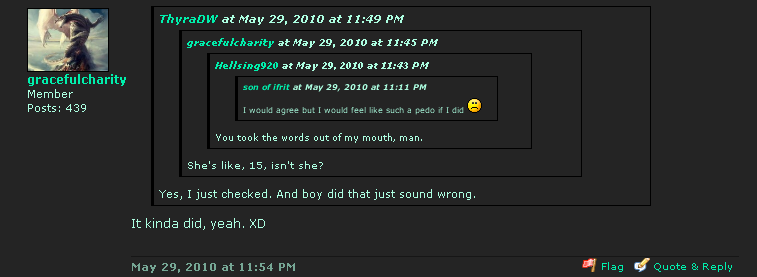
So, WingerDinger Productions. This site was the subject of two previous posts, both of which covered the hopelessly silly nature of their discussion. The sight was recently trolled, its owner, Hellsing920 (Emer Prevost IRL), driven off YouTube by false DMCA notices and its community exiled to a new forum. The original site, a cheap .webs domain, was “hacked,” and was redirecting to “last measure,” then the hacker’s own YouTube channel. The bandwidth now used up, WingerDinger’s initial incarnation is gone. There were two major problems that converged with WingerDinger that will afflict any sort of .kids site that allows children to interact on the internet. The first is that kids are stupid and the other is that kids are easy targets.

Target.
It isn’t hard to figure out that WingerDinger’s userbase was comprised mostly of people under or around the age of eighteen, and like any comprised of socially awkward kids, the community was prone to navel-gazing (they wrote their own article on TVTropes), cheerful displays of ignorance, and an utter disregard for nuance, critical thought, precise expression and good humor. The website’s owners and creators of its actual content were mostly older -- Hellsing920, I believe, is only a few years shy of thirty -- but they attracted, due to the nature of their videos and webcomic, an audience of kids who were no more prudent than their online idols. Granted, imprudence is to be expected from those who have a ways to go before they’re a few years shy of thirty.

Part of the issue here is what the internet has evolved into and why a wider range of people, including kids, want to use it. Hellsing920 raised the ire of a lot of YouTube users in videos where he would spew incorrect information in as loud and obnoxious a manner as he could muster, and when people responded to correct him, he would accuse them of being petty and pat himself on the back for having gotten a rise out of them.. In a lot of ways, this is the internet equivalent of showing somebody your dick and then calling them queer. This made him a hero to a seemingly impossible number of less than clever kids.

In a brief conversation we had before YouTube finally suspended his channel, Hellsing920 told me that his internet “persona” was based on all of his “negativity and cynicism” and claimed that he was successful based on how often he “pissed off people.” He also agreed with me when I told him that his fans were stupid, but didn’t seem especially open to the idea that his videos and persona attract the sort of fan -- young, male, insecure and not especially bright -- that rewarded his ignorance with attention and praise (in his defense, I hardly stated this explicitly)..

This is the nature of YouTube, many message boards, and most social networking sites -- and practically every site attempts to “network” its users these days -- an attention whoring competition. Emer had over nine thousand (no meme intended) subscribers before YouTube banned his account; his fans equated that “success” with his “negativity and cynicism” and hoped to emulate it with their own online personas. One of the trolls, while discussing the then upcoming raid on the WingerDinger site, asked something basically along the lines of “is there anything these kids don’t hate?” It was a reasonable question given how many threads consisted of “_______ is so overrated” or “_______ needs to die.” In response to an earlier post on the subject, WingerDinger member KBMadhouse actually pointed out that the forum was overwhelmingly negative.

Between the brittle egos, the stupid videos, and the desperately negative forums, it was inevitable that WingerDinger would eventually get trolled. It just happened that they caught the attention of some unusually competent ones who worked them over pretty well.

A .kids domain would eventually attract the same kind of attention, especially one that allows any sort of interaction. There are plenty of High School Musical and Twilight fans whose eyes were assaulted by Goatse and Tub Girl over the years who can attest to that. Furthermore, even if adults, the predatory and puckish alike, could be kept off of a “.kids” domain, children would still be exposed to the stupidity of other children (do you want your kids talking to Jessi Slaughter?). Of course, one gets the impression that Jonah Goldberg and Nick Schulz think of the internet as something through which actual content is accessed. If they want to limit their kids to accessing only the sites that provide real information and keeping them away from all of the things for which people actually use the internet -- gossip, porn, and ego-wanking -- well, I hate to say it, but: there’s an app for that. Buy Apple.

But that isn’t why most kids want to use the internet. I’m not saying that WingerDinger deserved to get hacked; but that “for all intensive purposes,” it’s a great example of the role that internet plays for the kids that use it. They aren’t looking for irregular Latin verb conjugations; they're desperately seeking attention and validation, often through shared hatred or brand idolatry. The best way to prevent children from experiencing the lawless frontier of the internet will always be to keep them from playing on it.
The Last WingerDinger Image I'll Ever Post.

3/6/10

Could this be your EMT?

I'm trying to comfort myself, so tell me which scenario is less awful: did an instructor find this too funny to not share, did somebody flunk a quiz on purpose for the lulz, or is this entirely fake?

None of those possibilities are really doing the trick.

2/13/10

Best VG Novelization Ever -- Eat that David Gaider!

Marketing perversity reaches new levels of silliness.

Actually, the new Dante's Inferno game has been bringing out all sorts of stupid. I recall seeing somebody on IMDb's Video Game board refer to The Divine Comedy as "Christian propaganda," which makes one wonder when something like The Hitchhiker's Guide to the Galaxy will be labeled "naturalist propaganda" or if such a person would refer to Shakespeare's histories as "Tudor propaganda" under the impression that it's a relevant or unique observation.

The translation that's being used for this printing of The Inferno deserves much better than the fugly video game screenshot plastered on its cover. Since I don't own an Xbox 360 or a PS3, I won't be playing the Dante's Inferno game, which is probably for the best since it looks (honestly) hopelessly mediocre. Desecrating important literature that the developers and their audience probably don't understand is just an added bonus of being Electronic Arts, I suppose.

It'll provide plenty of opportunities for video gamers to show their intellectual and literary muscle on GameFAQs and IMDb's Video Game board, though. Oh, how I cannot wait.

1/23/10

I Devote a Category to General Snobbery for a Reason

Nobody will believe me, but I didn’t write that review of Dragon Age: The Stolen Throne to troll Bioware fanboys. That people actually bothered to comment on it surprised me, especially hyrulehistorian, who got burned in the review but commented with a dignity that seems lost throughout much of the digital buzz that is the internet. A good example of somebody without said decorum is J, who called me a pretentious twat and told me to go re-read Tolstoy. (In his defense, he apologized for the name calling soon after)

I admit to having left comments on other blogs that might be read as inflammatory, insulting, and rude, but generally, I take a person’s whole internet corpus into consideration before doing so. After all, my own blog contains writing that’s embarrassingly bad, or fails to convey the points that I thought I was making. Since the Dragon Age: The Stolen Throne review doesn’t fit that description, it’s safe to assume that J’s comments were based on the single post that he probably read only in part. Would a blogger on the order of J’s description of a pretentious twat (Tuesdays with Morrie, Tolstoy, Heller, etc.) devote part of his blog to reviewing video games or movies like Amazons, Pagan Love Song, or anything directed by Hisayasu Sato?

My blog, my criticism, and my interests are thoroughly middle-brow. But my academic background is in literature, film and theatre (in that order), and I could write a review about Synecdoche, New York critiquing the interplay of formal and thematic elements. I don’t want to. I might do the same for the kung fu movies I review as well, but I generally don’t spend too much effort since there isn’t really that much there to critique. In a sense, kung fu movies share a cultural demarcation with those generic fantasy books that get dumped on in my Tomoe Gozen review. They take mythical, even archetypical icons, images, and stories, often unique to the geography from which they come, and genericize them. The difference is that I usually like kung fu movies.

Writing about things that I like is immensely fun as long as I’m explaining why I like them. Could I show how Chang Cheh is only about as technically skilled as a B-rate Hollywood film maker of the same era? Sure, but there’s no point in that. I could just as well point out Robert E. Howard’s repetitious vocabulary, but I think that it’s forgivable in the context of what and where he wrote.

Is it pretentious to like just anything? Not as long as you keep it in perspective. If somebody wrote an ignorant screed about Night of the Hunter I would comment to tell such a person that they were wrong, not because Night of the Hunter is a favorite of mine, but because the critique itself was ignorant. If somebody were writing about Tsui Hark’s Green Snake and didn’t care for it because its special effects are unconvincing and the pacing spastic and the acting distinctly hammy, I might not even care. I don’t love Green Snake because it is a great movie (although as far as I’m concerned it is a great movie).

I don’t look down on people who like Dragon Age: The Stolen Throne for whatever reason. The review was an excuse to rant about the unpleasant relationship between fanboys, franchises, and literature, as well as get some kicks out of Gaider’s poor prose. On some level, it must be strange to see somebody advocating an unjustly ignored Gene Wolfe novel, making fun of IGN for being tasteless, and writing a few hundred words on a Taiwanese wuxia movie based on a pulp novel all within a period of about ten days. The mere fact that I like some popularly derided things doesn’t mitigate that I like others that are more commonly considered sophisticated; neither does an appreciation of complexity prevent my enjoyment of simple things. That is the highly subjective concept of “taste,” and on a blog devoted to talking about various media, some of it not well represented and some of it viciously defended, it must be understood.

You must decide yourself why you like what you like. I am thoroughly unprepared to tackle such an issue in a broader social or psychological perspective. I do consider taste a useful social construct, but neither my blog, nor anything else I do online is about actually proving my credibility in that area.