Showing posts with label Hollywood's Kung Fu Movies. Show all posts

4/17/15

Mortal Kombat (Paul W. S. Anderson, 1995)

Well, it was on my mind because of my (relatively) recent review of Robert Tai’s Death Cage, and the new Mortal Kombat X debuts this week, and it’s almost the twentieth anniversary of its release, so I watched Mortal Kombat today.

It’s tempting just to post the Cinema Sins youtube video here and call it a day, but I think there are actually some interesting aspects to Paul W. S. Anderson’s first of many video game movies. I grant that the story and dialog are preposterous, the fight choreography generally mediocre, and that it fails to really bring to the cinema screen what really made the games so entertaining: the absolutely senseless and incredibly silly gore and violence.

It was also that profoundly entertaining element that made Mortal Kombat, in both game and movie form, one of the forbidden fruits from my admittedly odd early years. My parents did not allow me to play the games or see the movie. I managed to play them anyway, usually waiting until they were out of sight when at the pizza parlor arcade to play it, an occasion rare enough that I became pretty good at the Fighting Vipers machine next to it in the narrow corridor that held the arcade games. Kids would gather around to see how far I would get on one credit (usually a match or two away from the final boss), while I would be looking over my shoulder to see if my mom or dad was still watching by the door so I could spend a couple of quarters on a game of Ultimate Mortal Kombat 3. Helicopter parents. They certainly made some mundane childhood shit seem like an adventure.
And it’s that nostalgia that you have to have in order to enjoy anything in the Mortal Kombat feature film. You have to like that era of awful looking nineties CGI effects and forget all about the Hong Kong movies that were being made at the same time. The aesthetic is very much a product of a time when Hong Kong movies were even less a mainstream thing than they are now, and anime and manga and other Asian media too. So you get this weird mix of western fantasy elements, kung fu movie tropes and imagery -- “Bruce Lee” (scare quotes necessary) and ninjas particularly -- run through a silly ass game of telephone, and American action movie and comic book cliches to make up not only an aesthetic but a diegetic melange.

And this applied then to both the games and the movie and the sequel and the cartoon and the comics and etc. And even now, to the games and to the fan films and licensed media and etc.
See what I mean?
So the movie follows the story of the first game, with the focus mostly on Liu Kang (Robin Shou), Sonya Blade (Bridgette Wilson), and Johnny Cage (Linden Ashby), falling into the titular fighting tournament that will determine whether Shao Khan gets the right to invade Earthrealm. The ruler of Outworld must win ten consecutive mortal kombat tournaments to gain the permission of the elder gods to invade, and his team has won nine. Liu Kang wants to fight Shang Tsung (Cary Hiroyuki-Tagawa, devouring the scenery), while Sonya hunts down Kano (Trevor Goddard), who killed her partner, and Johnny Cage wants to prove he’s not a fake. They get help from Raiden (Christopher Lambert) and Kitana (Talisa Soto, too beautiful to actually matter) as they fight against Shang Tsung’s incompetent guards. They defeat iconic characters from the games, like Goro, Sub-Zero, Scorpion and Reptile. And there’s a handful of incidental characters not from the games, like Art.
Art gets killed by Goro, it’s a big deal to everyone except the audience; we’ve seen him once before, briefly.
And it goes how you’d expect it to. Lots of talk about destiny, about how the characters need to “face the enemy, face yourself, face your greatest fear.” All of it’s meaningless. We just wanna see the fights damnit! Movies like this don’t need a plot or a story. They need a premise. Thankfully Mortal Kombat has it, and mostly delivers.

At least eighty percent of this movie is fight scenes. And I believe it was Seanbaby who first pointed out that in Mortal Kombat, the shortest distance between two points is not a straight line, but a backflip. The cgi effects are dated. Characters randomly appear in deserted orchards or cliff sides to duel. There’s some funny death scenes (all of them, really). And the set design is very much that weird blend I went through some length describing above.

If you like this sort of thing at all, it’s pretty glorious. 
And part of why it’s glorious is that the cast is pretty game for it. Linden Ashby, in particular, seems to be having a really great time as a non-martial artist playing a martial artist who makes movies while being accused of being a non-martial artist. “You can’t fake those moves...” Art says in the only scene he figures into before getting killed by Goro. Well no, no you can’t. He’s performing them all right. Doing them on a resisting opponent though...

Ashby gets to deliver some actually funny lines to: “What if the legends were true!” breathlessly exclaims Robin Shou as Liu Kang. “What legends?” Ashby’s Cage responds.

Christopher Lambert and Cary Hiroyuki-Tagawa are on opposite ends of the awful spectrum. Hiroyuki-Tagawa is well into so-bad-it’s-good territory, relishing lines like “flawless victory” and “your soul is mine” with such hammy delight that it’s hard not to smile. Paul W. S. Anderson even mentions in one behind-the-scenes featurette that the crew was constantly imitating him. Christopher Lambert is just awful. But he’s always awful. He’s even worse in the sequel. Brigette Wilson doesn’t seem to be in on the joke, which makes her perfect.
Some of that great Pat Johnson fight choreography
And Robin Shou? He’s there to be a badass. And he is. And here’s the interesting thing about his presence: this is one of the movies that came out before The Matrix that really tried to capture some of the Hong Kong action magic in a Hollywood package. There’s a handful of these from the nineties which vary pretty widely in succeeding at that goal , but I think it worked out perfectly for Mortal Kombat because Mortal Kombat was never a very good imitation of the kung fu genre that partly inspired it.

Pat Johnson’s fight choreography is pretty staid Hollywood stuff, for the most part. You can see some guys from the periphery of martial arts cinema in bit parts. Hakim Alston (of “WMAC Masters” fame, lol) gets a nice fight scene with Robin Shou, for instance. Pat Johnson’s choreography does shine when performed by these guys though, which probably has far more to do with them than it does with him.

So Mortal Kombat is incredibly silly, badly dated, and just utter nonsense, but if it’s your kind of nonsense, then it’s only gotten better -- more fetid really -- with age. And with the new game coming out and its twentieth anniversary a few month away, it’s a perfect time to enjoy it. And dat theme song!

2/17/15

Kickboxer (Mark Disalle and David Worth, 1989)

At the beginning of my review of the odd Toby Russel/Robert Tai feature Death Cage, I listed off a bunch of movies that I remembered. Surprisingly enough, I failed to recall Kickboxer, Jean-Claude Van Damme’s follow up to his (I assume) biggest film, Bloodsport (Newt Arnold, 1988). Come to think of it, I didn’t even think of Bloodsport, initially. The similarities between Kickboxer and Death Cage are pretty striking, actually. Both feature location shooting in Thailand by non-Thai crews and Thai characters played by non-Thai actors. Even the martial arts choreography featured in both are
less than representative of actual Thai kickboxing.

Kickboxer tells the story of Kurt Sloan (Van Damme), the brother and corner-man of cocky kickboxing champ Eric Sloan (Dennis Alexio, an actual heavyweight kickboxing champ), who learns Muay Thai from Xian Chow (Hong Kong actor Dennis Chan), in order to avenge a crushing defeat of his brother at the hands of Tong Po (Michel Qissi) which has left him a paraplegic. Of course, the Thai boxing promotion is corrupt, with crime bosses exercising control over local territory with threats and violence. They don’t really want to see Kurt Sloan beat their guy, so they resort to underhanded methods, like kidnapping Xian Chow’s niece Mylee (Rochelle Ashana) and raping her, and holding Eric hostage. How this makes more sense than just shooting Kurt and killing him makes little sense (he will later die offscreen by this method in one of the sequels).

Kickboxer is quite risible. Structurally, it resembles its Hong Kong peers, setting up its simple revenge premise early, devoting a large portion of its run-time to training sequences, complicating the circumstances surrounding the final brawl, albeit according to some very Hollywood action movie conventions (raped girlfriends and whatnot were not the go to plot point for the Hong Kong martial arts genre) and ends the whole thing cleanly with a victory for the protagonist.

That’s not what makes it laughable. The humor comes from different sources, mostly related to the writing. There is some incredibly leaden expository dialog from the brothers Sloan, explaining why one of them has a Belgian accent, which resembles a real conversation between actual people the way that Van Damme and Michel Qissi’s fight choreography resembles actual Muay Thai. The acting by non-actors Van Damme and Alexio is, to put it nicely, quite apt for the writing here.

There’s also a typical Hollywood Black Guy named Winston (Haskell Anderson), who introduces Sloan to Xian, and mostly jabbers about how he doesn’t want to get involved. Mylee is eye-candy and designated love interest, who also has the important job of getting raped to provide extra motivation for Slaon, but since she doesn’t tell him before the fight, and he only gets angrier upon finding out, even this seems like it was pretty damn unnecessary. Why let her go after the fact? Wouldn’t it make more sense to keep her hostage if they wanted to mess with Sloan’s performance?

In spite of the fact that audiences and US film makers are far more sensitive about this sort of thing in the 2010’s than they ever were during the 1980’s, these character types are still relatively prevalent. We still get the typical Hollywood Black Guy and still have pretty designated inter-racial girlfriends. We even still have wizened Asian martial arts masters of indeterminate nationality and age. What we don’t usually have is the slope-browed antagonist played by an actor literally against genetic type. Michel Qissi’s character and performance would be accused of being horrifically racist caricature there days. And there would probably be more people describing Kickboxer that way if it weren’t for the fact that the whole thing is so endlessly silly that to take it seriously...

Let’s just say you can’t.

I actually really enjoy these earlier Jean-Claude Van Damme films. The fight scenes are preposterous, as are the training sequences. But while the fight choreography and even the shooting and editing might compare poorly to the same from Hong Kong during the same period (keep in mind that Jackie Chan was making films like Police Story 2 and Miracles around this time), the training sequences are definitely fun to watch.

I think the most interesting thing, when comparing Kickboxer to Death Cage, is that Death Cage apparently saw release in advance of Kickboxer. In other words, it isn’t a rip-off, one presumes. And a lot of the similarities can be accounted for by the nature of the productions. Each feature a Thai setting and Muay Thai, but neither utilize the local stunt talent, which, given the talent of Panna Rittikrai's crew even at this point, probably prevented them from being sorely upstaged. Smart move there. And so that may be why each feature so much ersatz Chinese martial arts in the training sequences. But at least Death Cage tells the audience that Mark Long is teaching Robin Shou Chinese Boxing. Kickboxer just throws in some Tai Chi looking stuff and calls it a day.

All said, I liked Kickboxer well enough. It’s hilarious to watch now, so transparent and goofy, that even the cornucopia of politically incorrectness can’t possibly be considered offensive by (the following word is important to read) normal people. As said, the fight choreography, which was once the film’s raison d’etre, is part of its unintended humor. But that's the appeal. And although he's no Roy Chiao, Dennis Chan is a plays a pretty grand martial arts master. And we get plenty of the rest of that dated, goofy appeal that make Van Damme so watchable. Like him doing the splits and dancing. Dancing seems to be a common denominator in movies I enjoy these days. Good times.

7/14/10

The Last Airbender (M. Night Shyamalan, 2010)

M Night Shyamalan’s adaptation of Nickelodeon’s “Avatar: The Last Airbender” animated series is both his worst movie yet and this year’s equivalent of DragonBall: Evolution. Eyebrows becom raised as soon as the casting was announced, a not-inconsiderable number of fans wanting to know one very particular thing: “where are all the Asians?
This was something that happened with DragonBall: Evolution as well. When the casting of Justin Chatwin as Goku disseminated throughout the fandom, message boards became battle grounds, every topic strewn with rhetorical land mines. Any assumption, any viewpoint taken as axiomatic with regards to race, or its depiction in anime, or even about the nature of race relations in Japan and America was pounced on by those who held contrary viewpoints as axiomatic; no forum thread remained safe from the bickering about whether Goku was “white or azn.” I was there for this, trolling both sides on the IMDb board, where the arguments are still going a year after nearly everyone stopped caring.
This screen cap was taken today.
The reason why attention migrated from DragonBall: Evolution so quickly was because it was an awful film. A camcorder job leaked onto the internet probably hurt ticket sales more than any negative review or argument over inappropriate (and racist, some would argue) casting. It was a terrible adaptation and a terrible movie.
An example of the erudite discussion on the IMDb board for The Last Airbender
Shyamalan’s The Last Aribender actually takes the opposite approach, slavishly adhering to the plot of the first season of its source, cramming twenty twenty-two minute episodes’ worth of content into a single hundred minute movie. The plot, roughly stated, is that the fire nation is warring against the earth and water nations, after having eradicated the air tribe. The Avatar, the one person capable of communicating with the spirits and controlling all four elements, has been missing. Katara and Sokka, two members of the water tribe, find a young boy encapsulated in ice, Aang, who is the avatar, frozen in ice for, like, a century or something. Accepting the role of the avatar, Aang must bring about peace, while being pursued by the fire nation’s Prince Zuko, who must regain his honor by capturing the avatar.

It sounds exciting, sure, but the constant exposition, told in dowdy voice-overs that sometimes narrate things as they happen on screen, sucks anything resembling energy or emergency from the narrative. The characters are flat, and the few times that they actually interact with each other, the lack of personality becomes painfully noticeable. This is amplified by the casting of a relative new-comer and total unknown for the major roles. Noah Ringer is not an actor, but a black-belt in Tae Kwon Do who the casting directors scouted during an open call in Texas. If you thought that the martial arts films of the 70’s had wooden acting, you will likely walk away from The Last Airbender with your preconceptions in check.

It’s actually really hard to figure out what was going on with Shyamalan during the filming of this mess, much less the writing and editing, beyond self-satisfaction and hubris. There’s a particular scene in which the fire nation emperor, Ozai, is filmed in a manner rather reminiscent of Dr. Claw. But we, the audience, have already seen his face. We have already seen how he humiliated and dishonored his son. We know what he did to the air tribe. There’s no reason to shoot dialogue like that -- no tension to be built and no characterization to be furthered. It’s the scene that made me wonder what happened in the editing room. The best visuals in the film are the ones that render the cartoon in live action, and that work was done by ILM.

Shyamalan also bragged about how he would film in long takes, because anyone can film with multiple cameras and construct a scene with editing. This is fine, except that the camera work during the fight scenes is either bad -- the choreography taking place out of frame (an early fight scene where Dev Patel’s character, Zuko, spars with four guards is especially bad in this regard) -- or the choreography itself fails to synch with the special effects. Compare this to the Pang Brothers’ The Storm Warriors, which has similar special effects shots that are comparatively more interesting to watch. More often, the choreography just isn't that good.

A director known for slow burning thrillers, Shyamalan has no business adapting an anime-inspired martial arts cartoon show. Worse, he seems to have finally come unhinged. Either he thought that doing a summer blockbuster would reestablish his name as a director of technical skill or he genuinely thinks that he is a visionary who can do no wrong. There’s some evidence that Shyamalan has a huge, though very fragile ego, recorded (albeit adoringly) in Michael Bamberger’s The Man Who Heard Voices, an account of the tumultuous filming of Lady in the Water, the film which really turned Night’s career for the worst. Shyamalan fails to do right by the fans who would have been the film’s biggest supporters, changing little things that actually matter (the script used for writing in the film is gibberish, the cartoon used actual Chinese letters), while not reworking the plot to actually fit a one hundred minute film. The whole of it is mystifying.
Granted, making a "Last Airbender" film in live-action would be a no-win scenario for anybody. It isn’t possible, with an American adaptation of anime or an ersatz Asian themed cartoon show, to please one part of the audience without alienating another. The Last Airbender will eventually be forgotten, like DragonBall: Evolution, by all except the righteously indignant. A year from now, I’ll check the relevant IMDb board, and were I a betting man, place money on there being at least one thread in which people fight with each other over racism, perceived or otherwise, in relation to the film and its casting.

Typically, when reviewing an American attempt at a kung fu or wuxia/fantasy movie, I comment on the way that it distorts the milieu or themes normally found in authentic films. It’s difficult to do that with The Last Airbender because of everything that’s happening around it. I cannot watch it without wondering about its director, who is capable of great work, making such an ugly, cheesy film. I can’t watch it without wondering how many people in the audience find the casting curious, if not inappropriate or offensive. I can’t help but laugh about how angry the fans of the show must be that they spent money on the 3D showing.

This "review" spun out of control and became a long rant. But that’s because the movie really is that bad. It has the worst writing this side of George Lucas. Lines like “this is our chance to show them that we believe in our beliefs as much as they believe in their beliefs” sound like place fillers in an unfinished draft.

6/29/10

Your Parents' Money Makes Way for Itself (Talent Optional)

Let’s get the most important, relevant issue out of the way first: a movie like The Karate Kid has no business being 140 minutes long.

Yes, that is more important than anything that has to do with race, or culture, or class, or the (not) subtle influence of China’s state run production company on the film. Because while I can accept that Mr. and Mrs. Jada Pinkett Smith were going to craft a vanity project for their son and that the Chinese government would only cooperate with such a project if it projected the image of China that they want the world to see and that it would more or less cash in on an old franchise because that’s just what movies do these days, I cannot accept such a tired premise dragged out for so long.

And the worst aspect of the length is how much of it could have been pared down were it not from the imagined necessity of fitting in tourist locations for scenes that transparently fulfill that purpose and none other. It has probably the wildest sense of tonal dissonance in any of Hollywood’s contemporary Chinoserie films. During one of the numerous training sequences, Jackie Chan solemnly intones that “everything is Kung Fu.” The film then exchanges everything that is everyday, ordinary life for the extraordinary and state-approved-for-filming glories of The Great Wall and Wudang Mountain. If “everything is Kung Fu” why do you have to travel several hundred miles to teach its most important lessons?

The bloated length of The Karate Kid is not its only problem, but it is the one that I can’t stand and it is the one that could be fixed. The direction was always going to be hackish, because the director is a hack. Jaden Smith was always going to be just on the cusp of actually acting, because he’s only eleven and hasn’t really grasped the core principles of acting. Very few eleven year old kids really do, much less ones who are handed lead roles by executive producers mom and dad.

And really, the story hasn’t changed much since the original Karate Kid unless one wants to read further into its portrayal of race and culture than I care to delve in a blog post. This really is the same “new kid gets beat up, meets grumpy aloof teacher, gets pounded on by grumpy aloof teacher, self-actualizes through teacher’s training, wins” storyline that easily fit into a twenty two minute South Park episode (RockManXZ24 and I hummed “You’re Gonna Need a Montage” so, so many times). So why? Why one hundred and forty minutes?

My friend Lightwing23 quite liked this one, but issued a reservation I like to think was inspired by me: “Easily recommended for anyone except Asian cinema aficionados...” Actually, there’s things going on that only serious fans of kung fu movies will really appreciate, like Yellow River Fighter star and Shaolin Temple villain Yu Chenghui in a cameo as a judge at an audition for the Beijing Academy of Music. I could recognize that beard anywhere. Okay, that’s a rather esoteric observation by most any standard. But if anything held my interest in The Karate Kid it was kung fu legends Jackie Chan and Yu Rongguang, who played the role of “bad coach.” Yu has been playing a bad guy since the beginning of his career (although he’s best known for playing the lead in Iron Monkey) but Chan has finally done something that I thought he never would: he’s playing the master.

Chan’s major star turn was in Yuen Woo-Ping’s 1978 kung fu comedy, Drunken Master, a film that was gloriously disrespectful of elders and teachers. It’s hard to imagine Chan, who spends most of that film ducking responsibility, hitting on girls, stealing food and picking fights, suddenly playing a reserved kung fu master with such reverence. He does it well too. And it doesn’t hurt that his first fight scene in the movie is classic Chan choreography to go along with an atypical Chan performance. Chan is so good that he elevates Smith during an emotional scene in which both of them hit the right notes (it’s the only scene where Smith does). They have really good chemistry, and it really sucks that cheesy direction makes it feel like a Lifetime movie.

But this director also thought that the movie needed to be well over two hours long. Never are real issues with Beijing (smog, crime, aids riddled prostitutes) actually mentioned, resembling something along the lines of the martial arts and action films Chinese directors produced in the eighties. Zwart also films many of the fight scenes in an unpleasantly typical way, obscuring the choreography with a shaking camera in close up. Hong Kong directors of the late seventies and early eighties filmed intricate choreography in mid and long shots with long takes because it looks best that way. The filming, particularly during the final tournament, is cheesy and bland and a disservice to the exceptionally talented Chinese performers as well as Smith, who seems to have at least trained pretty hard to actually perform martial arts.

The Karate Kid (yes, I find the title annoying myself, what with it being a movie about Kung Fu) really misses the mark with its portrayal of Beijing, of China, of very early adolescent pre-sexual relationships (watching twelve year old kids kiss is incredibly icky) and it really does itself no favors by not policing its fortune cookie sayings a little bit better. Its one redeeming element is Chan, who having actually come from nothing, deserves better than this.

4/30/09

Movie Review -- Warriors of Virtue

It's hard to take yourself seriously when you review a children's movie like Warriors of Virtue (Ronny Yu, 1997). It's even harder when your criticism revolves around such portentous and at times contentious themes as cultural imperialism and genre hybridization. With Warriors of Virtue, the problem is compounded: even with with a Hong Kong director and a screenplay written by Hong Kong expatriates, it's still a great example of how diluting Hong Kong style martial arts film with Occidental fantasy narrative is a compromise that leaves nobody satisfied. That and it's just not a very good movie.

Ryan is some kid who is friends with Ming, a hot shot cook who does some pretty kick ass kung fu while frying up rice and noodles at the local Chinese restaurant. Ryan also has a gimped leg, a crush on a girl, and a desire to impress the quarterback of the football team. After telling the quarterback which play to use in order to win the big game, Ryan and his token black friend are invited to hang out with the cool kids, who apparently spend their time hanging out by a sewage treatment facility covered in graffiti. Grabbing some food from Ming before he goes to spray paint the walls around basically a giant commode, Ryan receives a manuscript of Chinese philosophy from his older friend. When he gets to the... whatever it's supposed to be, the quarterback dares him to walk across the pipe that goes over the giant basin as the deep water below him swirls, threatening to pull him under should he fall. Unsurprisingly, he falls, and ends up in the world of Tao. Of course, there's an evil warlord causing trouble in Tao -- the reptilianly named Komodo -- who is also looking for the manuscript, as it is the key to the spring of life. But there's also a set of heroes, the Warriors of Virtue, who protect Tao for the sake of Master Chung and some chick named Elysia.

Much like Rob Minkoff's The Forbidden Kingdom, Warriors of Virtue seems to take its cues from The Neverending Story (Wolfgang Petersen, 1984). The difference between the two is that The Forbidden Kingdom was far too lacking in ambition, especially given the way that international audiences have taken to the two stars; Warriors of Virtue has pretense beyond the humble genre it fits so well. One of the things that I strongly disliked about The Forbidden Kingdom is the intimation that the fantastical China-wonderland that the protagonist goes to is actually a China-wonderland, as opposed to metaphysical space created by his mind while unconscious. While that might not sound like a big deal, that single plot point makes China into the oriental magic-land where nerdy white kids learn how to stick up for themselves (it gets goofier still when the protagonist uses his new kung fu fightin' skills to beat the shit out of the improbably awful bullies). Warriors of Virtue avoids this pitfall by making the fantasy world purely a fantasy world, albeit with obvious influences of Asian -- specifically Chinese -- culture. Of course, the screenplay here is smart enough to keep what's going on in the fantasy world roughly within the realm of what might happen in an unimaginative thirteen year old's fantasy -- although I suppose that would make the screenplay less than smart, even if it is a good instinct on the screenwriter's part.

What's the point of the fantasy world though? Why can't this kid learn to stand up for himself and be confident without fortune cookie advice from a Chinese man? The story of a child going to a fantasy world of swords and magic to learn tools for living in the contemporary world has been filmed countless times, and written even more. The only film maker to have done anything interesting with it of late has been Tarsem Singh with The Fall, and even then, it's only because the fantasy sequences are so closely tied to the "real world" narrative that his film works. One wishes that the screen writers hadn't used this scenario again, as it adds nothing and doesn't really require that the characters do kung fu or spout pseudo-Taoism. I still have no idea what the "spring of life" is really for, why the warriors are divided by the elements, or why there are Kangaroo people. They're just there to be there.

And of course, we get the worst aspect of the movie: the one which killed it's chances at the box office. The "roos." Obviously short for "Kangaroo" (because kids can't be bothered to pronounce a three syllable word) the roos are the humanoid kangaroo kung fu fighting warriors of the land of Tao. There are five, each one standing for one of the five Taoist elements. These are worse than the predictable story, the nearly offensive tokenism, the evil little person, the bland over-acting of the villains, the fortune cookie wisdom and bastardized Tao Te Ching references. While all those are bad, the roos are just obnoxious. They immediately remind one of a certain group of anthropomorphic ninjas that were popular in the eighties, and when combined with the predictable story, nearly offensive tokenism etc. the whole thing just wreaks of trying too hard with too little talent. How exactly did they intend to write a primer in Taoism for American children that both made sense, and was fun, and commercial, and provided opportunities for kick-ass fight scenes? The idea alone is awful.

And if it weren't for the obnoxious furry-bait, the visuals might have helped to save the movie. Unlike The Forbidden Kingdom, which looked like the Hollywood idea of what a kung fu movie trying to be a Hollywood movie would look like, Warriors of Virtue kind of looks like the real deal, even if the story reads like a badly written deviation of the two disparate genres it combines. While both movies share Peter Pau as cinematographer, director Ronny Yu also brought with him David Wu (frequent collaborator) and fight choreographer Tsui Siu Ming (director and fight choreographer for the wild 1984 mainland Chinese film Holy Robe of Shaolin) along with stunt men and set decorators from Hong Kong. Reuniting three of the major forces behind the visuals for the impressively wacky The Bride with White Hair, it shouldn't be too surprising that Warriors of Virtue looks like a Hong Kong movie in a very good way, making use of many of the same tricks from their first collaboration (falling leaves, silhouette, weird lighting and color schemes, soft focus). With some impressive wushu performed by Tsui's stunt team in those awful kangaroo costumes and expensive set design by Oscar winning Eugenio Zanetti, this is really very nice looking fantasy film making.

I was pretty young when Warriors of Virtue made it into theaters, and was immediately turned off by the kangaroos. I eventually saw it much later on television, willing to sit through it because it was Ronny Yu's Hollywood debut, and I had to believe that it would be a better showcase of his talents than Bride of Chucky or Freddy vs. Jason. It is in some ways, but the movie itself is just not very good. If the writers had come up with something better than the token black kid ("let's make like Tom and Criuse!"), the giant toilet bowl, the generally nonsensical platitudes and mysticism, and (worst of all) kangaroo furries it might have been a decent generic fantasy film. As it is, it's a bad film with some incongruously interesting elements.

And as much as I've compared it to The Forbidden Kingdom, I have to say that both are far more interesting than DragonBall: Evolution, which didn't manage to do anything right. None the less, Warriors of Virtue is a noble failure. But oh God is it ever a failure.

3/19/09

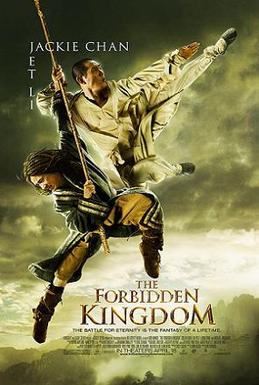
The Forbidden Kingdom - Also bad, but not as bad as DB:E


In my review of DragonBall: Evolution, I commented on the film from the perspective of a genre fan who was tired of mainstream studios crafting pale imitations of the pop-art, culture, and entertainment that I enjoy. The things I expressed reminded me that I had felt the same way (although not hardly in the same abundance) almost exactly a year ago, with the release of Rob Minkoff's The Forbidden Kingdom. Being far more interested in Kung Fu movies, Hong Kong films and Chinese literature than anime and poorly made fighting games, it would not have been imprudent of me to think that DragonBall: Evolution would prove the less obnoxious of these two attempts by Hollywood to co-opt martial arts movie aesthetics and fantastical kung fu for their own purposes. But for all it does wrong, The Forbidden Kingdom actually manages to do some things right.

For starters, it has Jet Li and Jackie Chan in their first (pray not their last) film together. That alone engenders enough good will to make it worth a look.

When I saw it, I was not only a huge fan of Jet Li and Jackie Chan's films, not only of Hong Kong and Chinese cinema in general, but greatly immersed in The Journey to the West for reasons that are best left unstated for the moment. Going into the film, I knew that it was directed by Rob Minkoff, whose other films were family features like 1999's Stewart Little, and that neither Jet Li nor Jackie Chan actually played the lead roll, deferring to a young actor named Michael Angarano. The film is about Jason Tripitakas, a frequently bullied Boston teenager obsessed with old Kung Fu flicks, who gets sent back in time to a mythical China after getting knocked off the roof a local Chinatown import story during an attempted robbery. While there, he meets various fighters looking to overthrow the Jade Warlord who has imprisoned the Monkey King and is looking for his magical staff, which can set the Monkey free. So Jason goes off with Lu Yan, Golden Sparrow and the Silent Monk to put an end to the Jade Warlord's corruption.

The film starts off with an ugly sequence shot in front of a green screen in which Jet Li as the Monkey King uses his magical abilities to beat up a group of heavies. It's revealed to be a dream of the protagonist -- his wall is platered with classic Shaw Brothers movie posters (which would be absurdly rare if they were real and definitely too expensive to just stick on a wall) and the old Ho Meng-Hua film, Monkey Goes West (1966) plays on a nearby television. This segues into my favorite part of the movie: the opening credits sequence.

The opening credits are played against an animated montage of Shaw Brothers and classic Kung Fu movie posters, including everything from The 36th Chamber of Shaolin to Come Drink with Me to Drunken Master. It's animated and the images are tweaked and it entirely looks like some design kiddie ran a bunch of low quality images through Photoshop and slapped himself on the back for his creativity, but I love it. I was naming the movies as the posters popped up -- which might have been annoying except the friend I was watching it with was keeping up right along with me. Nothing else in the film (save one particular scene) really pinged my nostalgia radar like that lone sequence.

But then, the movie itself started.

From the very beginning, it isn't hard to guess what scene is going to happen next. It follows the same plot as every fantasy film about a present-day child escaping into an other-world. It's obvious that Michael Angarano's Jason Tripitikas will be the "chosen one," that he'll have an exotic love interest, that he'll eventually learn kung fu, and so on. It isn't so much a problem that the plot is predictable, but that it chose the wrong ready-made, boxed and frozen plot.

One of the things that is frequently missed (or possibly willfully ignored) by those trying to parody or pay tribute to them is that it is very rare -- even among the most fantastical of the genre -- to have a "chosen one" as a protagonist. Characters with a destiny to be fulfilled, with special authority over the fate of a nation (or even world) or preternatural aptitude for heroics are common in neither wuxia nor kung fu films. Even though he starts out weak, Jason is going to eventually become a master. But it isn't because he's totally dedicated to making the most of himself and his training that the audience knows he will; it's because he's the protagonist. The whole China wonderland exists solely to give him some backbone, and possibly provide a cute Asian girlfriend to go with his new found kung fu powers. It may not be the usual setting, but there is little question that this is going to be a narrative firmly set in the occidental fantasy mold.

And this is the problem with the film. It's predictability isn't anywhere near as frustrating as its hypocrisy. Why do occidental audiences need a protagonist that looks like them and a fantasy version of China that panders to their every whim in order to appreciate and relate to Chinese culture? If the folks that made this film really cared so much about the genre, why not actually try to get the real deal into the public eye? A good portion of the genre itself is languishing in film canisters in warehouses and garages and basements, turning pink or disintegrating. Even the films that have been remastered or collected by the HKFA aren't necessarily easy to obtain; many are downright impossible to find outside of dvdr and avi file sharing. And yet more inconvenience: almost all of the old Cantonese serials are unavailable on anything other than vcd and even fewer are subtitled in English. Surely making the genre itself available would be a better way to pay tribute to the wuxia, kung fu, and Chinese fantasy films than making a film that imitates their themes and aesthetics in the most shallow way possible.

For one thing, as an adaptation of The Journey to the West, it's awful. There's no real reason for why it had to have a Journey to the West theme anyway, although it is the screenwriter (John Fusco) who receives the blame for those major details made disappointingly minor. The Monkey King could be anything -- he could be the fabled Chinese poo-monster, if the film makers wanted -- because the relation of his characterization to the actual themes is mostly non-existent. It's like Fusco figured "well, this character is cool" and just wrote them into the script. Golden Swallow from King Hu's Come Drink With Me, Lian Ni-Chang from Liang YuSheng's Bai Fa Mo Zhu (by way of the film adaptation), and Lu Yan of the Eight Taoist Immortals are all given this treatment. What's the point of this? Sun Wukong, Zhu Bajie, and Sha Wujing's characterizations weren't just high points of Wu Cheng'En's novel, but were deeply connected to the intent -- to the soul -- that the author was trying to convey. These characters pilfered from other sources could be anything; they make no difference.

Hearing characters say "Come drink with me!" or Michael Angarano geeking out over various movies that one would think an obsessive collector would already own are examples of reference that are nowhere near as clever as John Fusco seems to think. But to his credit, he at least doesn't treat martial arts as an assortment of tricks for fighting. And for the most part, the fight scenes are very amusing, handled by Yuen Woo-Ping who has made himself into the most sought after fight choreographer in the world by working on so many high profile Hollywood films (that pale in comparison to the micro budget work he's done in Hong Kong). Michael Angarano received much undeserved anger from fanboys for being the magic whitey in The Forbidden Kingdom, but he clearly worked hard on the film and isn't actually that bad. And at least Rob Minkoff and John Fusco knew enough to not try and have him show up his co-stars. Liu Yifei may not be able to act, but she sure is cute. And Li Bing Bing absolutely rocked the white wig she wears in tribute to The Bride With White Hair (Ronny Yu, 1993) -- the subject of more than a couple of visual references, of which the entire character Ni Chang is one. The lead bully, played by martial arts expert Morgan Benoit, is... embarrassing, but still entertaining, if only unintentionally.

Really though, Chan and Li fighting each other is what makes this film. They are the Fred Astaire and Gene Kelly of kung fu movies. Their fight scene might not look like much to those who don't watch these films, but for those with a calibrated eye, it's exceptional. The length of the takes, the fluidity of the choreography, the timing; it's almost everything that could be reasonably expected from this kind of movie and from these actors at this point in their careers. It isn't perfect (no doubt, there will be fans who are disappointed) but it's the other high point of this movie. It's good enough that it elevates the rest, making it watchable.

And watchability is what makes The Forbidden Kingdom a better film than DragonBall: Evolution. They still share the same flawed idea. If they were rip-offs -- if their most significant flaws were being derivative -- it would be forgivable. There is a difference between derivative and ersatz; between imitation and counterfeit; between homage and pastiche. Films like these are supposedly tributes. They are, in fact, replacements. And as such, they are often unsatisfying to many who have deep connections to the films and themes whose place is being usurped.

Perhaps even worse: these synthetic products continue to befuddle the lazy mainstream film critics who have made strides to contextualize everything from the torture-porn strain of horror films and Italian westerns to 1950's science fiction and mostly ad-libbed comedies. Films like this are what causes some to continue to assume that the genre is little more than fight scenes. In spite of its otherwise amiable Never Ending Story-in-China plot, it's another example of how Hollywood film makers are still just not doing it right.

If anything, it's about as bad (although it's also just as good) as Ronny Yu's ill fated entry into Hollywood, Warriors of Virtue. At the very least, both of these are better than DragonBall: Evolution. But the assault of poseur films is not over. M. Night Shyamalan is going to be filming The Last Airbender this year, which has fans of "Avatar" in a fit. This might just be an attempt to quarter off market share (US studio makes genre entertainment normally provided by non-US studio, audience starts watching US offering and forgets about the foreign) and if so, I will solve the problem on my end and simply stop watching the imitations -- even if it means I'll miss another one of Shyamalan's hilarious train wrecks.

3/17/09

Dragonball: Evolution - It Really Is that Bad

James Wong's DragonBall: Evolution premiered last week in Asia. It's been a long road for that film. Not only was it delayed for a full year, but the not-inconsiderable amount of leaked information -- from merchandising promotionals to a camcorder job of the film being dropped on youtube yesterday -- has drawn a great deal of ire from fans on the English language web. Even the reviews coming from Asian web sites have been mostly negative, as have the comments showing up on IMDb. One web article (in Chinese, sorry) actually asserts that some audiences in China fealt "deeply hurt" by how the movie was handled. How is it that emotions could get so heated over a movie like this?

On the one hand, it would be easy to dismiss these reactions as yet more fanboyish prattle; however, the frustration of fans of the manga and anime has simmered for a long time, and has now transformed into full-blown resentment. That resentment manifests itself in everything from ineffectual online petitions to very serious discussions of race and the portrayal of ethnicity in American film. This isn't just about a bad adaptation of a mediocre (if well-liked and broadly appreciated) anime series. This disappointment required decades to build, and it isn't just anime fans that have gotten screwed over.

As for the movie itself, it will eventually debut in American theaters, fifty minutes longer according to fandango.com. The eighty-nine minute cut that's been released in Asia is the subject of this review. Most of my criticisms can not be assuaged by lengthening the film.

Strictly as a movie -- not as an adaptation, nor as an adherent to genre convention -- DragonBall: Evolution is a decidedly bad film. The film is rushed. Dialogue is traded in short spurts without any meaningful dramatic arc. Scene after scene rushes by but rarely do the characters display any sort of energy or even any real personality. The two-dimensional, cartoon characters of the anime and manga do not translate well in live action, but even if they could, the script here gives them so little in the way of motivation and intent for why they act the way they do that it's downright infuriating. Why is it that Goku is picked on? He doesn't look or dress so differently from the popular kids in school. Why is Goku so goofy? Presumably he's been going to school his whole life -- or at least there's no given reason to assume he hasn't -- so why is socializing a problem beyond his Grandpa not letting him go to parties? Why does he not fight when attacked at the party? One might assume because Grandpa Gohan told him not to, but he's already breaking one of Gohan's rules by running off. Why is one more important to follow than the other?

The script gives no indication, and while actors can often do things with inflection and body language to show the intentions behind some of these, the cast either wasn't given enough direction from Wong, or they were just as baffled as I am. Joon Park's Yamcha, for instance, has character traits that make little sense within the context of the film. A desert bandit talking with a cliche surfer-dude accent makes no real sense. Joon Park is not an actor by trade (he's a Korean musician) and while he deserves recognition for getting the "surfer" accent down pretty well, neither he nor the script gives much of a reason for it. His performance is one note, as is Chow Yun-Fat's, as is Emmy Rossum, who appears to have totally given up throughout the movie. Again, I blame the screen writer. The laziest excuse for an unconventional or "strong" female character is the now ubiquitous "tough chick." DragonBall: Evolution gives us three, two of them martial arts fighting dragon ladies to boot. These are characters drawn in gesture, populating a film that rushes to arrive at nowhere in particular.

As an adaptation of Akira Toriyama's original story, the film fares even worse. Dragon Ball started as a silly re-imagining of Wu Cheng'En's The Journey to the West before Toriyama got tired of that and turned it into a never ending saga of martial arts fights, alien invasions and ever-escalating power levels. Throughout, the character of Goku stayed more or less the same. He is an innocent, over powered, and thoroughly obsessed with making himself the best fighter he possibly can.

James Wong and screenwriter Ben Ramsey (likely at the behest of the studio producing, 20th Century Fox) have tried to shoehorn what was never an American styled super-hero story into the generic structure of the recent film adaptations of such. Here we have a teenage Goku who is concerned with girls more so than with fighting and making himself better at fighting. It worked in the manga because of his origins. The Goku of the manga lives in the wilderness alone after the death of his grandpa before Bulma comes along and takes him with her to find the dragon balls. Living away from society made him innocent, it made him unaware of how freakish his physical abilities really were, and the fact that his name, appearance and accoutrement were references to Sun WuKong of Chinese Literature hinted to readers that his personality would be fittingly monkey-boyish.

Not only does the film make Goku smug and generally obnoxious as a character, it removes an essential part of his motivation for his adventures -- the constant desire to be a better martial artist. Roshi's interest in Goku has changed from being impressed by his skill to a desperate need for his assistance in saving the world, creating a motivating force behind their master-student relationship that was never intended to be there. For some reason, Yamcha doesn't know martial arts, in spite of an early rivalry with Goku being a plot point in the original. Even the setting has been changed to some sort of indistinct, boring, pseudo-futuristic and multi-ethnic North America. It's a far cry from the fantasy China with smatterings of science fiction technology and anachronistic cultures that Toriyama basically pulled from his back end. At least his had a bit of personality to it. Krillin is not in this film. Aside from the names of the characters and the searching for seven dragon balls that will grant wishes, this is not similar to Dragon Ball.

And finally, as a martial arts flick, DragonBall: Evolution is a monumental failure. From the opening scene of Goku fighting Gohan, it is evident that no real creativity or care went into designing the fight sequences as they apply to the plot and characters. Goofy exposition is given to the concept of "ki," but it never really defines nor makes of it an interesting plot point. It serves only to allow for silly Karate Kid plattitudes and sets up the "kamehameha." The actual fight scenes are dreadful. That boring slow motion effect that's used for every dodge and every moment that contact is made had worn out its welcome years ago -- and every action scene finds a use for it. A pressbook claimed that softer, internal styles of wushu were used for choreographing Chow Yun-Fat's scenes, but I see no real evidence of this. Fight scenes are also surprisingly short. Do not expect to see long takes, creative filming and editing, intricate choreography in which the actors move in coordination with each other, or creative juxtaposing of styles that used to make Hong Kong action and martial arts films the most exciting films of their type. The editing is awful, the camera work obscures the movement of the bodies (likely to hide doubling) and the special effects are perfunctory.

Perhaps the worst part is that any philosophy of martial arts is drowned by the incessant need to move to the next set piece. James Wong actually attempted to show characters reflected in their own use of martial arts with his other martial arts film, The One. One has to wonder why he didn't bother to actually have a training sequence or a depiction of master-student dynamic between Goku and Roshi in this film. If it had added actual character to the film, it could have only helped. As a result, it doesn't even meet the requirements of passable genre entertainment (and it's nowhere near the level of entertaining camp like Taylor Wong' s similarly energetic though far superior 1983 film, Buddha's Palm, or Andrew Lau's 1998 big-hair-and-frilly-costume camp classic The Storm Riders).

Dragon Ball by Akira Toriyama captured the attention of kids all over the world with its hyper-violent (by the standards of the time) tale of martial artists fighting to become better than each other as entire worlds were exploded underneath their godlike battles. For some reason, that was turned into a generic, lazy story of a high school kid who has to save the world because he's special and has wise old Asian guys to give him advice along the way. DragonBall: Evolution is cynical in its attempt to milk the franchise. It panders to the lowest rung with its type-casting, it's indulgence in the stereotypes and perpetuation of the fetishistic portrayal of East Asian culture (and women). It exploits fans expecting something that they will not get, like quality.

In spite of Dragon Ball being a hugely popular IP that's still selling merchandise because of the nostalgia felt by millions of people to whom it appeared a unique and exotic import, somebody at Fox thought that it would work better if the unique and exotic elements were stripped away, replaced by the common, the mundane, and the vacuous. They also gave it a $30-something million budget and put a group of mostly competent craftsmen behind the camera to make it work. The result is a compromise that leaves nobody happy.

To think Chow Yun-Fat gave up the fantastic Red Cliff for this.

As a matter of fact, I'm going to go out on a limb and say that Dragon Ball: The Magic Begins (Chan Jun-Leung, supposedly 1989) and the live action, South Korean Dragon Ball (Wang Ryong, supposedly 1990) are just as good, and probably many times more entertaining.That's my awesome MS Paint skills at work there.