Some people online distribute the rom to this impressive post-mortem (released in 1999!) Genesis/MegaDrive beat-em-up under the title “Beneath the Clouds.” I’d guess that these people got that from putting the Romanized characters into babelfish. If you’re sort who reads my blog, you might recognize Shui Hu Zhuan as one of the great literary accomplishments written in the classical Chinese vernacular, or you might better recognize it under its English title, The Water Margin. You might also recognize "Feng Yun" as the Chinese title for the comic book/film series we English speakers call "The Storm Riders." What does any of that trivia have to do with the game? Nothing, really. Maybe I’ll email Lightwing23’s wife and beg her to translate the title into something that makes sense, then lord it over the rom distributors and reviewers who have referred to this game as “Beneath the Clouds” for about three years. I love beat-em-ups only a bit less than I love console/computer role playing games. The two genres seem diametrically opposite in terms of design, and might really have been back when the side scrolling beat-em-up was a viable genre, munching up quarters in arcades and pizza parlors and Wal-Mart lobbies. But I also know that you can beat Kingdom Hearts 2 by pressing the “X” button over and over again, at least according to RockManXZ24, who claims to have done that (and he actually likes the Kingdom Hearts series), which puts it in the same vein as the more mindless beat-em-ups. In fact, I think that the recent, torrid affair between Japan and Capcom’s Monster Hunter shows the greatest marriage of the two forms. There’s no lock-on feature for combat, the games really don’t play well outside of co-op, and the difficulty can be utterly insane. At the same time, the amount of equipment and customization rivals that of Diablo 2, the champion of grindfests.
One could also point to small games like Castle Crashers and Scott Pilgrim vs. the World (both of which feature character levels and inventory systems) as more likely successors to the beat-em-up -- they undoubtedly are -- that also adopt conventions from the broader role-playing genre. But I think these are too clever for their own good. "Scott Pilgrim," though I liked the movie and what little I’ve played of the game, is overexposed, and watching the animals crapping in Castle Crashers is only funny until, like, the 9000th time you see it. I miss the earnest goofiness of the fantasy themed brawlers from the late eighties and early nineties.
I also love kung fu movies, but the Chinese themed brawlers made by Capcom (Dynasty Wars, Tiger Road) just aren’t as good as their later games, like the immensely goofy Knights of the Round. The good thing about the recent proliferation of unlicensed Chinese game ROMs is that they developed beat-em-ups that directly imitate the better Japanese games, sometimes competently, while adapting historical events and pulp literature. Shui Hu Fung Yen Zhuan apes Knights of the Round, with similar characters, animations, enemies and gameplay. The player can hit treasure and health power-ups to split them into smaller pieces, as in Capcom’s Arthurian brawler, and the there is a balanced broadsword wielder, a speedy fighter who uses a saber, and a battle-axe brandishing tank. The characters walk from left to right, beating whatever enemies get in the way, then fighting an end boss.
Shui Hu Fung Yen Zhuan provides only a few levels, but they’re long, and the game adds some inventory management in the form of Gaunglet-esque magic items that the will do massive damage to all enemies on screen. Cut scenes in between levels tell a story in early Tecmo style, which I couldn’t follow because I don’t know Chinese. I breezed through the whole game rather easily (the game gives nine credits and extra lives come easy), but the animation and graphics being a cut above, for example, The Yang Warrior Familymade for an enjoyable, if mindless experience.
The real fun of beat-em-ups is their complete lack of fairness. Unlike a rougelike, which screws with the player’s expectations to the point that it’s unfair, the beat-em-up is unfair in spite of being straightforward, making progress its own reward. Of course the constant flow of enemies will kill the player, and of course the items that can save him or her from certain death will be scarce. If the game doesn’t offer cool graphics and enemies it doesn’t work -- the player needs some motivation to continue walking right and pressing “a” -- but this one actually offers some of the best looking environments on the Genesis, rivaling the SNES ports of King of Dragons and Knights of the Round, and the boss sprites are huge, detailed, and also ripped off from Capcom games.
This is not the pinnacle of the genre on consoles, that honor belongs to Treasure’s Guardian Heroes for the Saturn. This is still a really fun game. It’s hard to believe that it was released the same year that the Dreamcast debuted and a real shame that there are so few of its kind developed these days.
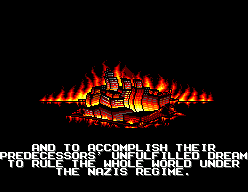
Did you think that Sangokushi 3 was kind of strange, being an unlicensed South Korean Master System cartridge with lots of English dialogue? That was rather unexpected but it doesn’t even compare to Jang Pung 3 (장풍3), which tells the story of the world’s best fighters getting together to hold a tournament which will determine who is a good enough martial artist to fight against an evil robot named Sell, created by Nazi cultists to destroy the world. It’s pretty difficult to believe what you’re seeing when the text scroll begins after starting the game, although it’s story isn’t really that bizarre by the standards of video games, particularly games in the fighting genre. The strange thing is to see references to Nazism and the Third Reich in relation to a fighting cyborg and a martial arts tournament. Fighting games, even with contemporary settings, tend to not tether themselves to anything as real as the Nazis. That’s a good thing, actually. Putting something as serious as the Nazis in a game about badass karate experts fighting each other to decide who will fight an evil robot actually makes it way harder for me to take it seriously. But as a game, Jang Pung 3 is an improvement over Sangokushi 3. The character selection is larger and there seems to be a little bit more difference in how the characters play. One of the problems with Sangokushi 3 and other poorly made fighting games are that the characters are almost interchangeable; the converse is unbalance to the point that all but a few characters are completely useless. The characters in Jang Pung 3 are still a bit too similar, all having similar jump heights and damage ratios, but at least some of the characters have moves that have different applications. And the character designs are pretty funny, particularly the evil clown.
If Jang Pung 3 and Sangokushi 3 are not made by the same people, they are clearly derived from the same code, as they share graphics and even English phrasing for the post fight messages (the same in both games, the same after every fight). I haven’t played Jang Pung 2, but it’s out there (no word on Jang Pung 1), and I imagine that it’s probably running on the same engine.
It’s worth noting that these games are a result of the popularity of Street Fighter 2 in South Korea. Making video games to compete with Street Fighter 2 was nothing unusual, American companies made more than a few, and there was an American film adaptation, and then a game adaptation of the movie. But when it comes to strangeness, nothing really beats Nazi robots, or for that matter, early nineties South Korean television, as we shall see very soon.
There’s only one thing about twitter that I like, and that is official announcements. Etrian Odyssey 3: The Drowned City -- confirmed for the US! I'm a happy nerd.
But that’s neither here nor there. Hardcore Gaming 101 has just opened a new section for “Games of the World,” which quite obviously catalogs the way that people around the world amuse themselves with electronic playthings. The user who goes by “Derboo” posted the most impressive series of articles so far, and including his enormous thread on their forum and an upcoming mega-article, probably the most comprehensive look at gaming in South Korea ever seen in any language besides Korean.
Looking at my blog, I feel bad that I’ve written so little about entertainment of a Korean origin. But until fairly recently, Korean film and video games were something of a blank slate in my mind. In the west, Korean cinema was fairly low profile with few exceptions (Why Has Bodhi-Dharma Left for the East? comes to mind), although that started changing in the early 2000’s when Shiri and Bichunmoo and other Korean action movies started popping up on DVD in the US. And it really wasn’t until recently that Korean games received mainstream attention, and even then, most people don’t really seem too concerned over the fact that a game like Magna Carta 2 cannot rightly be called a “JRPG.”
So I’ve decided to write a few entries over the next couple of weeks on the (South) Korean entertainment that I enjoy and some that I recently and fortuitously discovered. For instance, there is a not inconsiderable number of unlicensed Korean games for the Sega Master System, and as with nearly all obscure gaming-related stuff, there’s plenty of people dedicated to dumping ROMs for our enjoyment. Sangokushi 3 (삼국지 3) is the first game that I’ve tried, which was difficult, since the ROM doesn’t run in Kega Fusion (it runs in Meka, in case you’re dying to try it out).
I guess that I decided to play it safe with this one, as Sangokushi 3 is a fighting based on Romance of the Three Kingdoms, which is a pretty familiar subject. That's not the only thing about the game that might be familiar to some players though. The sprites seem to be ripped right out of the Taiwanese game, Sango Fighter, and many of the interstitial screens bear a striking resemblance to those from another fighter called Jang Pung 3 (same developer... I think), and the health bar/ timer looks almost exactly like the one in Street Fighter 2.
It’s a standard 8-bit fighter, which means it sucks because there are no good 8-bit fighting games, and yes, you are welcome to prove me wrong. Besides the novelty of seeing Korean transliterations of Chinese names transliterated into English (why is there so much English in this game?), Sangokushi 3 is fun to play if only to see where it tries to reference the historical and literary Three Kingdoms. For instance when I fought Guan Yu (Kwan Woo) as Zhao Yun (Jou Woon), it was against the background of a burning ship, a reference to the battle of Chi Bi. For you purists who got pissed at John Woo’s Red Cliff, feast your eyes on Shu’s best engaging each other in a senseless fight to the death as Cao Cao’s fleet burns in the background. Madness.
Speaking of Cao Cao, irony of ironies, he’s not there (what's the Korean transliteration for 说曹操,曹操到?). In fact, it looks like only Shu generals made it into the game. I guess that’s to be expected with seven playable characters. This is the shallow end of the Korean fighting game pool. Jang Pung 3 has more characters and is, to be frank, incredible -- incredible as in hard to believe, that is. We'll be looking into that one soon, as I attempt to write for a whole week about Korean games and movies without making snarky comments about Starcraft, Park Chan-Wook, internet cafes, Kim Jong-Il (I make no promise on this one) or cheaply licensed MMOs made for Japanese franchises.
For more on the Sega Master System, be sure to check out the great resources at SMS Power.
It's nice to be surprised by a game that's better than it has any right to be. In the case of Final Fantasy X: Fantasy War, it quite literally has no right to be, because it's a pirate. I first saw a video of this on the now defunct CrashManExe Youtube account, which had a semi-regular series called "pirate rom hunt," which featured a number of wacky pirates from various companies. Final Fantasy X caught my attention by not only looking quite nice (especially in comparison to the side-scrolling Famicom and Game Boy Color pirate games that were featured) but also looking like it would be fun to play.
Having actually played it, now, I wish that Square had actually thought of making a side-scrolling Final Fantasy brawler for the Game Boy Color. This is easily the best of the pirate games that I've played. First off, the graphics are actually quite nice. The animation is surprisingly fluid, the character sprites look more or less like Final Fantasy characters, or at least Final Fantasy characters from before Tetsuya Nomura ruined the series and Square (I'm only bein half-sarcastic here) . The backgrounds are colorful, if not especially creative. I do like the boss stages, in particular. They look like you're running around in space with the big crystal in the background. The enemies are a bit confusing though. Antlion is there, but otherwise, the enemies are a boring bunch of skeletons, goblins, and slimes, with Frankenstein's monster being one of the bosses. The soundtrack, I've been informed, was ripped almost entirely from the GBC remake of SNK's King of Fighters '94. It sounds pretty good. The music in pirate games made by Waixing and Shenzhen can only be described as insidious pain that infects through the ear.
As for the gameplay itself, it's mediocre by the standards of professionally developed titles, but very good for an unlicensed Game Boy Color game. You walk your character to the right and attack the enemies that come onscreen. There's a jump button that you'll never use; pressing on a direction twice will cause your character to run and attacking while running will cause a lunge attack; pressing down-forward like in Street Fighter or Mortal Kombat will get your character to perform a special move. Your character levels up after killing enemies, which will increase his stats, although the only stat that really seems to increase much is the health bar. There's four characters to play as, a fighter, mage, thief and chocobo. I like the fighter best. The chocobo is awful, I think. The game gives unlimited continues, which makes it pretty easy to breeze through if you've got no pride.
All of these features are pretty standard beat-em-up features. If Square had actually made a game like this, they could have added character or even party customizability (multiplayer would be fun) and weapon upgrades to go with it. Given what they put together with Dissidia: Final Fantasy, I could see them incorporating customizable move sets as well. Square Enix should make this game on the DS or PSP in 2d, with wi-fi play. I could actually see it looking not unlike Odin Sphere or Muramasa: The Demon Blade, possibly giving it some solid old-school appeal that Sqare Enix -- in spite of being a company with over twenty years of contributions to video game culture and millions of die hard fans -- usually lacks, even in their most "fan service-y" games. If they don't like the idea of making a new Final Fantasy themed beat-em-up, how about making one with the "Mana" series? Those games have sucked for years now.
But since that will never happen, Final Fantasy X: Fantasy War is a good enough substitute. The GBC cart used to be pretty common on Ebay, but seems to have been snapped up by most of the obscure video game collectors. Most people will experience this game through emulation, which also makes it a free alternative to the game that Square Enix will never bother making (even though they should). Kudos to the developers of this particular pirate game. It's awesome.
The world of gaming -- especially "hardcore" gaming -- is a strange and often fickle place. Favored developers are quickly forgotten, and if not forgotten, often maligned. Arguments between fanboys rage all over the internet, debating PC gaming versus consoles, Xbox 360 versus Playstation 3, JRPGs versus Western RPGs, games as "art" versus games as games, and (my personal favorite) hardcore versus casual gaming. One might see a member of youtube or GameFAQs praising Bioware and Bethesda as though they were their first sexually active girlfriend, and then return a week later to find that same user derriding them as if they were their first sexually active girlfriend that gave them monthly sores and violently burning trips to the restroom. Of course, you're still alowed to like Baldur's Gate -- heaven help us should popular opinion ever turn against that game the way it has with others -- but bringing up Jade Empire or Mass Effect is just asking for trouble. And I hate Mass Effect.
Which is why I avoid those discussions, or try to. My opinions on anything doubtlessly annoy somebody, possibly anybody, even more likely everybody. Fact: I don't like Might and Magic. Another fact: I do like Ys I&2. Fact 1 + Fact 2 = somebody calling me "fag," or one of the many variations, like "newfag" or "console fag" or "weeaboo." (I don't know why this terminology has caught on in seemingly every geek-centric hobby that has a presence on the internet, but it has. I blame 4chan, like we all should.) It's inevitable, but that only makes me want to avoid it. Because of this, I've sought out territories of video gaming that are so stupidly obscure that the interested parties don't really have any reason to start inane fights with each other. Some of these are arcade games -- because nobody ever has a major debate on which 2D beat-em-up game is a "true" or "hardcore" example of the genre -- and truly obscure Japanese RPGs -- and I don't mean stuff like Etrian Odyssey, I'm talking about games like Sorcerian. But that's not what this review is about. This review covers pirate software developed by Chinese programmers called The Yang Warrior Family. A couple of points need to be addressed before I get to the review of the game. First off is the state of consoles and console games in China. It's easy to laugh at the developers of the People's Republic and their attempts to makeFinal Fantasy 7 into a Famicom game, or any number of the strange and badly programmed games linked to developers from Hong Kong, Taiwan and China, like the Famicom Chrono Trigger port and the oft-ranted-over Somari. But beyond the weeaboos crying out "Kusoge!" at badly dumped roms on their youtube channels, there are some genuinely interesting, and sometimes even fun games that have been made by Chinese developers. Outside of the badly programmed and designed ports, there have been several very impressive RPGs for both PC and the console. (and even in the sucky ports, brilliance occasionally can be found, occasionally) One of the first unlicensed games developed originally by Chinese developers (ie not a hack, pirate, or port of a Japanese title) was an RPG called Tale of the Holy Flame, released in 1991 and based on a Jin Yong novel (a movie based on it is reviewed here). There are even people devoted to getting these games released in the US. Which is another point that needs to be made: not every Chinese developed game is/was a pirate. The Genesis was released in Taiwan, and that's the origin of Legend of Wukong and Beggar Prince -- the Genesis games now being released on cartridge in the US. All this is to say that while I think The Yang Warrior Family is a pirate, I can't honestly say that I'm sure it is.
The second thing that needs to be explained is the backgrounds in which many of these games are set. Legend of Wukong is a very loose and intentionally weird rendering of The Journey to the West, and there are games based not only on the pulp novels of Jin Yong, but on the classics of Chinese literature, including various RPGs and strategy games adapting The Romance of the Three Kingdoms, The Water Margin, and The Creation of the Gods. Now, Koei has also made games based on all three of those Chinese classics, but they have yet to adapt anything by Gu Long, JinYong or Liang Yusheng. (A brief aside: we should also be thankful that Koei shut down their "eroge" branch, otherwise we might have ended up with an unfortunate Jin Ping Mei or Yu Pui Tsuen based strategy RPG) What you get when you play a Chinese game is an example of how the Chinese repackaged popular stories and gave them back in a new format. It's one of the few ways in which games legitimately transcend their status as play things and time wasters, and that alone makes these somewhat interesting.
Which brings us to The Yang Warrior Family. Based on the same folk tale as Shaw Brothers classics The 14 Amazons (Cheng Kang and Tung Shao-Yung, 1972) and Eight Diagram Pole Fighter (Lau Kar Leung, 1984), this game recalls the brave Yang nobles as they defend Sung dynasty China from invading Mongolians. This translates into gameplay that's basically Final Fight, but this time in China instead of America, the future, or Camelot. Much like those Capcom brawlers, The Yang Warrior Family uses only a few buttons: one to attack, one to jump, and one to do a more powerful attack that drains health. The characters are a bit unusual. The main protagonist is a young guy in blue with a sword -- all signs of the "balanced" character. There is a female who wields tiny daggers, finishing her two hit combo (lol) by throwing at a pathetic trajectory that makes it look like the little knife must weigh a good thirty pounds. Still, the range is a huge bonus. There's an old guy who -- by the fact that he's old and that he wields the famous Yang family halberd so often depicted in films and television -- I assume to be the Yang patriarch. He has range, but his attacks are boring. He just jabs. My favorite character is the one that doesn't fit. He's a big brute that fights bare handed and has a pro-wrestler drop kick as his jumping attack. Of all the characters, I've gotten furthest in the game with him. The game scrolls from left to right and your character beats on fat guys, sword and spear carrying soldiers, muscly Mongolian wrestlers, metal clawed lizard men and bomb juggling, sexy ladies. The AI isn't anything special, so as long as you're capable of controlling your character, you'll be capable of avoiding most of the enemies. An amusing aspect of the combat system is knocking enemies into each other. The second hit of your character's two hit combo (lol) always sends the enemy flying, and you can grab enemies by walking into them while they're not attacking, allowing for a throw. This means you can toss enemies into each other and keep from being surrounded rather easily, and it also means that you can take out enemies quickly if you find them grouping together. At the end of the level, you fight a boss (surprising no? /sarcasm) and while the first one is a push over, the rest have four health bars, making it an almost ridiculous challenge to beat a boss if you don't have full health and all of your lives by the time you make it to the end of the stage. I was also slightly disappointed that there are no power ups. Sure, you can eat food that's lying on the ground to regain health, and there are a (very) few items to pick up to add to your score. These are a paltry pittance compared to the wealth of mounts, extra weapons, magic potions, and miscellaneous score boosters to be found in superior examples of the genre, like Sega's 1989 arcade game, Golden Axe. The graphics are decent. The Genesis doesn't have the most expansive color palette (at least not compared to the SNES) but compared to the Famicom pirates, these Genesis games look brilliant. The backgrounds are repetitive, and the animation is stilted, which really makes it seem less impressive, almost like a botched arcade port. And that raises another question: why an arcade style beat-em-up? The game only has five sprites on screen at any given time, although that might have been a wise decision since there's rarely any slowdown. The Yang Warrior Family throws enemies at the player like an arcade game trying to eat up quarters, and allows the player three lives and three continues. As far as I know, this isn't an actual arcade port, so I'm flummoxed as to why the developers chose not to take advantage of the console's sit-and-play nature and give a bit more thought to stage design and combat system beyond imitating Capcom's arcade beat-em-ups. Because when you get right down to it, the fun of a beat-em-up wanes rather quickly, especially outside of the atmosphere of a dimly lit, smelly arcade. That said, this is a decent Final Fight knock-off with a fun theme and mediocre graphics. Since practically nobody owns these games and the only people who play them do so in emulation, it would probably be fun to speed through with a friend over netplay. Still, this is a good example of the kind of quality that Chinese developers were capable of outside of really awful Pokemon and Final Fantasy themed hacks and pirate games and multi-carts.