3/19/09

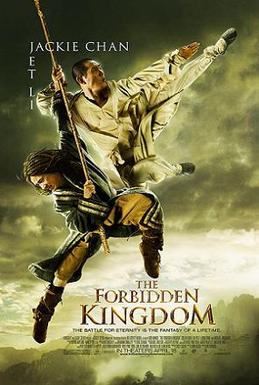
The Forbidden Kingdom - Also bad, but not as bad as DB:E


In my review of DragonBall: Evolution, I commented on the film from the perspective of a genre fan who was tired of mainstream studios crafting pale imitations of the pop-art, culture, and entertainment that I enjoy. The things I expressed reminded me that I had felt the same way (although not hardly in the same abundance) almost exactly a year ago, with the release of Rob Minkoff's The Forbidden Kingdom. Being far more interested in Kung Fu movies, Hong Kong films and Chinese literature than anime and poorly made fighting games, it would not have been imprudent of me to think that DragonBall: Evolution would prove the less obnoxious of these two attempts by Hollywood to co-opt martial arts movie aesthetics and fantastical kung fu for their own purposes. But for all it does wrong, The Forbidden Kingdom actually manages to do some things right.

For starters, it has Jet Li and Jackie Chan in their first (pray not their last) film together. That alone engenders enough good will to make it worth a look.

When I saw it, I was not only a huge fan of Jet Li and Jackie Chan's films, not only of Hong Kong and Chinese cinema in general, but greatly immersed in The Journey to the West for reasons that are best left unstated for the moment. Going into the film, I knew that it was directed by Rob Minkoff, whose other films were family features like 1999's Stewart Little, and that neither Jet Li nor Jackie Chan actually played the lead roll, deferring to a young actor named Michael Angarano. The film is about Jason Tripitakas, a frequently bullied Boston teenager obsessed with old Kung Fu flicks, who gets sent back in time to a mythical China after getting knocked off the roof a local Chinatown import story during an attempted robbery. While there, he meets various fighters looking to overthrow the Jade Warlord who has imprisoned the Monkey King and is looking for his magical staff, which can set the Monkey free. So Jason goes off with Lu Yan, Golden Sparrow and the Silent Monk to put an end to the Jade Warlord's corruption.

The film starts off with an ugly sequence shot in front of a green screen in which Jet Li as the Monkey King uses his magical abilities to beat up a group of heavies. It's revealed to be a dream of the protagonist -- his wall is platered with classic Shaw Brothers movie posters (which would be absurdly rare if they were real and definitely too expensive to just stick on a wall) and the old Ho Meng-Hua film, Monkey Goes West (1966) plays on a nearby television. This segues into my favorite part of the movie: the opening credits sequence.

The opening credits are played against an animated montage of Shaw Brothers and classic Kung Fu movie posters, including everything from The 36th Chamber of Shaolin to Come Drink with Me to Drunken Master. It's animated and the images are tweaked and it entirely looks like some design kiddie ran a bunch of low quality images through Photoshop and slapped himself on the back for his creativity, but I love it. I was naming the movies as the posters popped up -- which might have been annoying except the friend I was watching it with was keeping up right along with me. Nothing else in the film (save one particular scene) really pinged my nostalgia radar like that lone sequence.

But then, the movie itself started.

From the very beginning, it isn't hard to guess what scene is going to happen next. It follows the same plot as every fantasy film about a present-day child escaping into an other-world. It's obvious that Michael Angarano's Jason Tripitikas will be the "chosen one," that he'll have an exotic love interest, that he'll eventually learn kung fu, and so on. It isn't so much a problem that the plot is predictable, but that it chose the wrong ready-made, boxed and frozen plot.

One of the things that is frequently missed (or possibly willfully ignored) by those trying to parody or pay tribute to them is that it is very rare -- even among the most fantastical of the genre -- to have a "chosen one" as a protagonist. Characters with a destiny to be fulfilled, with special authority over the fate of a nation (or even world) or preternatural aptitude for heroics are common in neither wuxia nor kung fu films. Even though he starts out weak, Jason is going to eventually become a master. But it isn't because he's totally dedicated to making the most of himself and his training that the audience knows he will; it's because he's the protagonist. The whole China wonderland exists solely to give him some backbone, and possibly provide a cute Asian girlfriend to go with his new found kung fu powers. It may not be the usual setting, but there is little question that this is going to be a narrative firmly set in the occidental fantasy mold.

And this is the problem with the film. It's predictability isn't anywhere near as frustrating as its hypocrisy. Why do occidental audiences need a protagonist that looks like them and a fantasy version of China that panders to their every whim in order to appreciate and relate to Chinese culture? If the folks that made this film really cared so much about the genre, why not actually try to get the real deal into the public eye? A good portion of the genre itself is languishing in film canisters in warehouses and garages and basements, turning pink or disintegrating. Even the films that have been remastered or collected by the HKFA aren't necessarily easy to obtain; many are downright impossible to find outside of dvdr and avi file sharing. And yet more inconvenience: almost all of the old Cantonese serials are unavailable on anything other than vcd and even fewer are subtitled in English. Surely making the genre itself available would be a better way to pay tribute to the wuxia, kung fu, and Chinese fantasy films than making a film that imitates their themes and aesthetics in the most shallow way possible.

For one thing, as an adaptation of The Journey to the West, it's awful. There's no real reason for why it had to have a Journey to the West theme anyway, although it is the screenwriter (John Fusco) who receives the blame for those major details made disappointingly minor. The Monkey King could be anything -- he could be the fabled Chinese poo-monster, if the film makers wanted -- because the relation of his characterization to the actual themes is mostly non-existent. It's like Fusco figured "well, this character is cool" and just wrote them into the script. Golden Swallow from King Hu's Come Drink With Me, Lian Ni-Chang from Liang YuSheng's Bai Fa Mo Zhu (by way of the film adaptation), and Lu Yan of the Eight Taoist Immortals are all given this treatment. What's the point of this? Sun Wukong, Zhu Bajie, and Sha Wujing's characterizations weren't just high points of Wu Cheng'En's novel, but were deeply connected to the intent -- to the soul -- that the author was trying to convey. These characters pilfered from other sources could be anything; they make no difference.

Hearing characters say "Come drink with me!" or Michael Angarano geeking out over various movies that one would think an obsessive collector would already own are examples of reference that are nowhere near as clever as John Fusco seems to think. But to his credit, he at least doesn't treat martial arts as an assortment of tricks for fighting. And for the most part, the fight scenes are very amusing, handled by Yuen Woo-Ping who has made himself into the most sought after fight choreographer in the world by working on so many high profile Hollywood films (that pale in comparison to the micro budget work he's done in Hong Kong). Michael Angarano received much undeserved anger from fanboys for being the magic whitey in The Forbidden Kingdom, but he clearly worked hard on the film and isn't actually that bad. And at least Rob Minkoff and John Fusco knew enough to not try and have him show up his co-stars. Liu Yifei may not be able to act, but she sure is cute. And Li Bing Bing absolutely rocked the white wig she wears in tribute to The Bride With White Hair (Ronny Yu, 1993) -- the subject of more than a couple of visual references, of which the entire character Ni Chang is one. The lead bully, played by martial arts expert Morgan Benoit, is... embarrassing, but still entertaining, if only unintentionally.

Really though, Chan and Li fighting each other is what makes this film. They are the Fred Astaire and Gene Kelly of kung fu movies. Their fight scene might not look like much to those who don't watch these films, but for those with a calibrated eye, it's exceptional. The length of the takes, the fluidity of the choreography, the timing; it's almost everything that could be reasonably expected from this kind of movie and from these actors at this point in their careers. It isn't perfect (no doubt, there will be fans who are disappointed) but it's the other high point of this movie. It's good enough that it elevates the rest, making it watchable.

And watchability is what makes The Forbidden Kingdom a better film than DragonBall: Evolution. They still share the same flawed idea. If they were rip-offs -- if their most significant flaws were being derivative -- it would be forgivable. There is a difference between derivative and ersatz; between imitation and counterfeit; between homage and pastiche. Films like these are supposedly tributes. They are, in fact, replacements. And as such, they are often unsatisfying to many who have deep connections to the films and themes whose place is being usurped.

Perhaps even worse: these synthetic products continue to befuddle the lazy mainstream film critics who have made strides to contextualize everything from the torture-porn strain of horror films and Italian westerns to 1950's science fiction and mostly ad-libbed comedies. Films like this are what causes some to continue to assume that the genre is little more than fight scenes. In spite of its otherwise amiable Never Ending Story-in-China plot, it's another example of how Hollywood film makers are still just not doing it right.

If anything, it's about as bad (although it's also just as good) as Ronny Yu's ill fated entry into Hollywood, Warriors of Virtue. At the very least, both of these are better than DragonBall: Evolution. But the assault of poseur films is not over. M. Night Shyamalan is going to be filming The Last Airbender this year, which has fans of "Avatar" in a fit. This might just be an attempt to quarter off market share (US studio makes genre entertainment normally provided by non-US studio, audience starts watching US offering and forgets about the foreign) and if so, I will solve the problem on my end and simply stop watching the imitations -- even if it means I'll miss another one of Shyamalan's hilarious train wrecks.

3/17/09

Dragonball: Evolution - It Really Is that Bad

James Wong's DragonBall: Evolution premiered last week in Asia. It's been a long road for that film. Not only was it delayed for a full year, but the not-inconsiderable amount of leaked information -- from merchandising promotionals to a camcorder job of the film being dropped on youtube yesterday -- has drawn a great deal of ire from fans on the English language web. Even the reviews coming from Asian web sites have been mostly negative, as have the comments showing up on IMDb. One web article (in Chinese, sorry) actually asserts that some audiences in China fealt "deeply hurt" by how the movie was handled. How is it that emotions could get so heated over a movie like this?

On the one hand, it would be easy to dismiss these reactions as yet more fanboyish prattle; however, the frustration of fans of the manga and anime has simmered for a long time, and has now transformed into full-blown resentment. That resentment manifests itself in everything from ineffectual online petitions to very serious discussions of race and the portrayal of ethnicity in American film. This isn't just about a bad adaptation of a mediocre (if well-liked and broadly appreciated) anime series. This disappointment required decades to build, and it isn't just anime fans that have gotten screwed over.

As for the movie itself, it will eventually debut in American theaters, fifty minutes longer according to fandango.com. The eighty-nine minute cut that's been released in Asia is the subject of this review. Most of my criticisms can not be assuaged by lengthening the film.

Strictly as a movie -- not as an adaptation, nor as an adherent to genre convention -- DragonBall: Evolution is a decidedly bad film. The film is rushed. Dialogue is traded in short spurts without any meaningful dramatic arc. Scene after scene rushes by but rarely do the characters display any sort of energy or even any real personality. The two-dimensional, cartoon characters of the anime and manga do not translate well in live action, but even if they could, the script here gives them so little in the way of motivation and intent for why they act the way they do that it's downright infuriating. Why is it that Goku is picked on? He doesn't look or dress so differently from the popular kids in school. Why is Goku so goofy? Presumably he's been going to school his whole life -- or at least there's no given reason to assume he hasn't -- so why is socializing a problem beyond his Grandpa not letting him go to parties? Why does he not fight when attacked at the party? One might assume because Grandpa Gohan told him not to, but he's already breaking one of Gohan's rules by running off. Why is one more important to follow than the other?

The script gives no indication, and while actors can often do things with inflection and body language to show the intentions behind some of these, the cast either wasn't given enough direction from Wong, or they were just as baffled as I am. Joon Park's Yamcha, for instance, has character traits that make little sense within the context of the film. A desert bandit talking with a cliche surfer-dude accent makes no real sense. Joon Park is not an actor by trade (he's a Korean musician) and while he deserves recognition for getting the "surfer" accent down pretty well, neither he nor the script gives much of a reason for it. His performance is one note, as is Chow Yun-Fat's, as is Emmy Rossum, who appears to have totally given up throughout the movie. Again, I blame the screen writer. The laziest excuse for an unconventional or "strong" female character is the now ubiquitous "tough chick." DragonBall: Evolution gives us three, two of them martial arts fighting dragon ladies to boot. These are characters drawn in gesture, populating a film that rushes to arrive at nowhere in particular.

As an adaptation of Akira Toriyama's original story, the film fares even worse. Dragon Ball started as a silly re-imagining of Wu Cheng'En's The Journey to the West before Toriyama got tired of that and turned it into a never ending saga of martial arts fights, alien invasions and ever-escalating power levels. Throughout, the character of Goku stayed more or less the same. He is an innocent, over powered, and thoroughly obsessed with making himself the best fighter he possibly can.

James Wong and screenwriter Ben Ramsey (likely at the behest of the studio producing, 20th Century Fox) have tried to shoehorn what was never an American styled super-hero story into the generic structure of the recent film adaptations of such. Here we have a teenage Goku who is concerned with girls more so than with fighting and making himself better at fighting. It worked in the manga because of his origins. The Goku of the manga lives in the wilderness alone after the death of his grandpa before Bulma comes along and takes him with her to find the dragon balls. Living away from society made him innocent, it made him unaware of how freakish his physical abilities really were, and the fact that his name, appearance and accoutrement were references to Sun WuKong of Chinese Literature hinted to readers that his personality would be fittingly monkey-boyish.

Not only does the film make Goku smug and generally obnoxious as a character, it removes an essential part of his motivation for his adventures -- the constant desire to be a better martial artist. Roshi's interest in Goku has changed from being impressed by his skill to a desperate need for his assistance in saving the world, creating a motivating force behind their master-student relationship that was never intended to be there. For some reason, Yamcha doesn't know martial arts, in spite of an early rivalry with Goku being a plot point in the original. Even the setting has been changed to some sort of indistinct, boring, pseudo-futuristic and multi-ethnic North America. It's a far cry from the fantasy China with smatterings of science fiction technology and anachronistic cultures that Toriyama basically pulled from his back end. At least his had a bit of personality to it. Krillin is not in this film. Aside from the names of the characters and the searching for seven dragon balls that will grant wishes, this is not similar to Dragon Ball.

And finally, as a martial arts flick, DragonBall: Evolution is a monumental failure. From the opening scene of Goku fighting Gohan, it is evident that no real creativity or care went into designing the fight sequences as they apply to the plot and characters. Goofy exposition is given to the concept of "ki," but it never really defines nor makes of it an interesting plot point. It serves only to allow for silly Karate Kid plattitudes and sets up the "kamehameha." The actual fight scenes are dreadful. That boring slow motion effect that's used for every dodge and every moment that contact is made had worn out its welcome years ago -- and every action scene finds a use for it. A pressbook claimed that softer, internal styles of wushu were used for choreographing Chow Yun-Fat's scenes, but I see no real evidence of this. Fight scenes are also surprisingly short. Do not expect to see long takes, creative filming and editing, intricate choreography in which the actors move in coordination with each other, or creative juxtaposing of styles that used to make Hong Kong action and martial arts films the most exciting films of their type. The editing is awful, the camera work obscures the movement of the bodies (likely to hide doubling) and the special effects are perfunctory.

Perhaps the worst part is that any philosophy of martial arts is drowned by the incessant need to move to the next set piece. James Wong actually attempted to show characters reflected in their own use of martial arts with his other martial arts film, The One. One has to wonder why he didn't bother to actually have a training sequence or a depiction of master-student dynamic between Goku and Roshi in this film. If it had added actual character to the film, it could have only helped. As a result, it doesn't even meet the requirements of passable genre entertainment (and it's nowhere near the level of entertaining camp like Taylor Wong' s similarly energetic though far superior 1983 film, Buddha's Palm, or Andrew Lau's 1998 big-hair-and-frilly-costume camp classic The Storm Riders).

Dragon Ball by Akira Toriyama captured the attention of kids all over the world with its hyper-violent (by the standards of the time) tale of martial artists fighting to become better than each other as entire worlds were exploded underneath their godlike battles. For some reason, that was turned into a generic, lazy story of a high school kid who has to save the world because he's special and has wise old Asian guys to give him advice along the way. DragonBall: Evolution is cynical in its attempt to milk the franchise. It panders to the lowest rung with its type-casting, it's indulgence in the stereotypes and perpetuation of the fetishistic portrayal of East Asian culture (and women). It exploits fans expecting something that they will not get, like quality.

In spite of Dragon Ball being a hugely popular IP that's still selling merchandise because of the nostalgia felt by millions of people to whom it appeared a unique and exotic import, somebody at Fox thought that it would work better if the unique and exotic elements were stripped away, replaced by the common, the mundane, and the vacuous. They also gave it a $30-something million budget and put a group of mostly competent craftsmen behind the camera to make it work. The result is a compromise that leaves nobody happy.

To think Chow Yun-Fat gave up the fantastic Red Cliff for this.

As a matter of fact, I'm going to go out on a limb and say that Dragon Ball: The Magic Begins (Chan Jun-Leung, supposedly 1989) and the live action, South Korean Dragon Ball (Wang Ryong, supposedly 1990) are just as good, and probably many times more entertaining.That's my awesome MS Paint skills at work there.

3/11/09

Kung Fu Cult Master - Where's Our Region 1 DVD?

There are times when I'm simply floored by the lack of availability of certain games and movies that I put on during lazy afternoons to simply pass the time (confounded recently and often due to my now busy schedule). One of these is presumably Kung Fu Cult Master (Wong Jing, 1993) which shouldn't be labeled as obscure, as the film has seen release in the US. Several, in fact, eaked out into stores througout the years, retitled "Lord of Wu-Tang" or "The Evil Cult" (the latter is better). None of them are official releases except for World Video's, which doesn't look like an official release even if it is.

I don't advocate buying bootlegs. It hurts the industry and the market for further releases. So I understand that when a long bootlegged film that has such an impenetrable plot based on a novel that's never been adequately translated into English doesn't get a legit release, there are good reasons. I, however, did not buy a bootleg. I bought the Hong Kong DVD from Mei-Ah. It's remastered, it's inexpensive (although you'll pay out the other end for shipping) and it has one of Jet Li's most endearing performances from the nineties in one of the least coherent movies of his career!
One of the problems alluded to above was it's source material, a wuxia novel by Jin Young (aka Louis Cha) named in English "Heaven Sword and Dragon Saber." Wuxia novels by authors like Jin Yong, Liang Yu-Sheng, and Wen Rui-An (among others) can extend for hundreds of pages in multiple volumes; much like adventure-story, fantasy, and historical fiction authors like Alexander Dumas and Robert E. Howard, many of these authors first saw print in serialized form through newspapers and magazines. To put it mildly, these stories are dense with historical as well as fictional back-story. Heaven Sword and Dragon Saber is like that, and each of the films based on it have had to wrestle with ponderous story of the two magic weapons, the Persian cult that protects one of them, the myriad of absurdly powerful martial arts warriors contending for the swords, the invading Mongols and inter-clan rivalries.

Kung Fu Cult Master stars Jet Li as Chang Mo-Kei, whose parents came from rival martial arts clans and were thus pursued and punished by the other clans, injuring Mo-Kei, who was taken into the care of Chang San-Feng (Sammo Hung) and his Wudang sect. Because of the damage to his nervous system, Chang must pump his chi energy into Mo-Kei daily in order to keep him healthy, and even as an adult, Mo-Kei is sickly. All this changes when San-Feng and the clan elders leave for a retreat, and a jealous student attempts to kill Mo-Kei. But Mo-Kei escapes with the help of a mysterious woman (Chingmy Yau) who happens to be the made of the Ming Cult's White Lion king. Falling off of a cliff, Mo-Kei and the woman named Siu Chiu find an old rival of Chang San-Feng who was defeated twenty years before. Having broken his back, he strapped himself into a boulder and rolls around on it in order to stay mobile.
I'll let that last one sink in.

He posesses the "Great Solar Stance," a form of magical martial arts that will cure Mo-Kei of his injury if he learns it. Tricking the crippled master into teaching him, Mo-Kei not only cures himself, but now has super kung fu powers. In the meantime, the other clans are preparing to go against the Ming Cult, who they believe to be evil due to their foreign (Persian) nature and some ghoulish masters within their ranks. They also have the Dragon Saber, while the other clans control the Heaven Sword, and the two together are supposedly unstoppable. Did I mention that Chang Mo-Kei is the heir to the leadership of the Ming Cult? Bare in mind, all this is happening in the first twenty minutes.

It's a messy movie from the king of messy, incoherent 90's Hong Kong movies, Wong Jing. Wong has the sort of talent that would be enviable if he actually put it to good use. But like Jess Franco or Takashi Miike, Wong Jing can only be counted on for making semi-creative shit. There's a creative shooting techniques throughout Kung Fu Cult Master, specifically during the huge battle sequence when the martial clans attack the Ming cult. Obtuse camera angles, tracking shots, hand held camera work, snappy cross cutting and montage (what David Bordwell would describe as "intensified continuity") as well as optical movement and camera movement at the same time combine with practical effects -- like wire work to propel both actors and props and dummies that frequently get their heads lopped off by flying, flashing blades -- along with limited (though spectacular by the standards of HK in the nineties) visual effects work. The armies are made up of hundreds of color coordinated extras that march in unison and in formation. It's a glorious, wacky, violent, ridiculous aussult on the eyes, and it is spectacular.
The smaller scale fight scenes are just as good. Jet Li and his much celebrated skill with Wushu needs little extrapolation, and Sammo Hung is as legendary a fight choreographer as he is a martial artist and actor.
As much as I would praise the efforts put into the action scenes, I would be lying if I said that the movie itself was anything but preposterous, potentially annoying, and pointless. It was planned as the first part of a series, but performed badly and so its ending is abrupt and solves none of the dramatic arc created up to that point. The writing is absolutely dreadful at times, the film is filled with anachronism and coincidence. Explanations for why there is so much fighting with the Ming Cult are in short supply. The comedic elements are often jaw droppingly inappropriate, including rape jokes. No shit: a rape jokes.

Even with all its faults, there are plenty of reasons to watch Kung Fu Cult Master. Outside of the justly praised martial arts and visuals, the performances from the leads are endearing. Jet Li has recently garnered attention for his role in Peter Chan's The Warlords, in which he plays the role of a greedy and licentious general. This role is the exact opposite of that, and he's excellent at it. Li is believably innocent, which has as much to do with his physical features as it does anything else. In spite of not being a classically trained actor, Li manages the difficult task of conveying the innocent interest and curiosity of a chaste romance that most people go through as scarcely more than children, while still showing himself to have very grown up concerns -- like revenge and reciprocation of good deeds for those who have treated him well.

It's not Shakespeare, but as a flatly drawn pulp novel superhero, Li is actually quite good.

The supporting performances are fine, mostly. The real standout is Chingmy Yau. Based on her work in movies like Raped by an Angel and Naked Killer, it would be easy to say that Yau is not really cut out to play the object of Chang Mo-Kei's mostly chaste interest. But to be honest, she does innocent really well. She's virginal, but with a knowing smirk and flirtatious body language. She's charming, she's adorable.

But there's still the issue of marketing the film itself. Could it really be done? It still surprises me that Swordsman 2 -- with its trans-sexual villain played by Brigette Lin and assortment of disfigured, maniacal warriors -- was not only already released on a cleaned up, Region 1 DVD, but that it was released by Dimension along with less bizarre fair like Fist of Legend and Bodyguard from Beijing. Surely if that movie can be localized than this one can be too.

Don't count on it though. It doesn't really matter with the state of genre films on DVD. Dragon Dynasty (subsidary of the Weinstein Company) recently put a copy of My Father is a Hero on DVD, retitled as it was ten years ago, as "The Enforcer." It has only the English dub; without even an option for the original Cantonese or even a Mandarin dub. I'd be happy if such a fate did not befall Kung Fu Cult Master.

3/7/09

Health Energy Potion Review

I was at Fry's once again today, attempting to get away from my family who were watching Oliver Stone's trainwreck W, and buying a 2gig USB drive for $6.99 - a decent sale price. Unable to resist looking at all of the cameras and games and hardware I'll not afford any time soon, I went from the back to the front of the store, and mid-way through (video game section) I passed by the same display where I found the heinous Mana Energy Potion. And horror of horrors, the new flavor was there! Health Energy Potion is the red colored, "apple-cinnamon flavored" (according to the website's "about" section) version of the energy potion. In my first review, I expressed confusion and anger at the audacity it must have taken to brand not only a food product but a food product's supposed effects.

Unable to resist (and having failed to locate the ever-elusive Steven Seagal brand energy drink) I picked up a bottle and headed to the check out line. Standing there, I couldn't believe I was about to waste more money on a product that I dislike not just for tasting the way that Oliver Stone's movies make my head feel (bad) but for deeply held moral reasons. However, I suppose I do have a single experience that I can now thank the creators of Energy Potion for.

I went to the checkout counter as directed by that person whose sole job is to direct you to the checkout counter, and waiting for me was a woman whom I believe to be the best I've ever laid eyes on. You could put this fine young lady in a beauty pageant, a wet T-shirt contest, and a dog show, and she'd easily win them all. She greeted me with the generic checkout "did you find everything you were looking for" bit in a rather fetching Indian accent, or I think she did, I didn't really hear her because I was too busy listening to her boobs. She was wearing a nice, low cut shirt, with just enough cleavage showing to make a man pay attention to her but not so much that he'd immediately know that he could get away with blatant disrespect. Ample enough though, to fill my head with thoughts of warm oil and tantric massage and... sex. Why beat around the bush?

I handed her the merchandise and the money and she asked if I wanted a bag. I knowingly said yes, and she bent down to grab a little bitty plastic bag to hold the little bottle and tiny flash drive that I probably could've carried just as easily in my hands, and as she bent over a tiny bit of panty peeked out and said hello. Red and lacy, probably tasty, or at least more so than Energy Potion, it was also more amusing to watch than Oliver Stone's W, more arousing too. She put the flash drive in the bag, and then picked up the Health Potion and asked me, "have you actually had one of these before?" I laughed, because her expression told me that she had herself. I told her that I had, and she pointed to the "mana" variety on the counter in a display saying, "I tried one of those and it was disgusting." To which I said, "Yeah, tastes like period blood," which I now wish had come out as "can I have your number," especially since she actually laughed at the impulsive and completely tasteless joke I'd just made.

But what's done is done. Oh, and the "Health" potion tastes just as bad as the "Mana" potion. For an apple-cinnamon flavored product, it tastes like neither. And if the blue tinted "Mana" potion tasted like period blood, the red tinted "Health" variety looks like it to boot.

Unfortunately, I couldn't get my nerdiest game, Nightmare of Druaga, to run in my PS2. I had to settle for another understandably obscure (J)RPG, Okage: Shadow King. I would've liked to have drank it while playing Diablo or Baldur's Gate, but in spite of my ability to post multiple times in one week, my computer is offline for the time being. Until it's fixed, I don't want to start anything that might be lost in the near future. Of course, I would've much rather spent my day with that dark complexioned beauty with a wicked sense of humor than trudging through stupid dialogue boxes and mediocre battle systems while drinking an awful concoction of vitamin rich caffeine and obnoxious marketing.

They say that you are what you eat. If that's the case, Health Energy Potion is a tiny bottle of failure; specifically with women.

3/4/09

Movie Review - The Forbidden Legend: Sex and Chopsticks


A strange and wonderful thing happened one glorious day when I was searching the local import shop for new(ish) DVD releases. As I weaved through the cluster of weeaboo scum and villainy admiring an issue of some Japanese magazine with a decidedly "moe" cover illustration, a ray of light bouncing off a nearby, freshly shrink-wrapped DVD caught my eye. On the cover was a bald, though not unattractive woman feigning the deepest throes of carnal ecstasy. "What brilliance has my search uncovered?" I thought, though sadly not aloud. Upon closer inspection, it turned out to be The Forbidden Legend: Sex and Chopsticks, the newest release from My Way Films, a studio whose name I could recall only because of the Douglas Kung Shaolin vs. Evil Dead movies. Clearly, I was already sold.

After my first, entirely sublime viewing of this hilarious smut, I learned through intense research that it was the only My Way film released in theaters in years. It's also the latest in a genre that I figured was forever relegated to direct-to-VCD/DVD hell: the CAT III soft-core period piece. Granted, this isn't the first title like this that My Way has come up with. Some of their creative output includes title like Love and Sex in the Sung Dynasty (Phillip Ko Fei and Law Kei, 1999) and Legends of Lust (Luo Man-Di, 2001). Not having seen them, I can only go by screen caps and what little information is available for them, but given that the later was only released on VCD, and the previous involves the directorial talents of Phillip Ko Fei (a decent enough actor and a fantastic martial artist, but no auteur or even competent craftsman) I feel justified in saying that The Forbidden Legend is the first real reason that My Way has provided for lovers of trashy Hong Kong cinema to celebrate.

And because this was an actual theatrical release, there's clearly been a bit more talent put into it than the average Phillip Ko Fei effort. It even has the same pretense of class that many of the late eighties and early nineties films of this type attempted to claim, usually through the adaptation of classical literary pornography. Sex and Chopsticks adapts the Jin Ping Mei (known in English as The Plum in the Golden Vase) in much the same way that Sex and Zen (Michael Mak, 1991) adapted Li Yu's 17th century erotic novel, Yu Pui Tsuen (in English, The Carnal Prayer Mat or The Prayer Mat of Flesh, depending on the translation). That is to say, loosely and with the focus shifted entirely on sex and spectacle (sextacle? no that sounds wrong). That means that The Forbidden Legend genuinely feels like it could have been a part of that late eighties-early nineties wave of soft-core smut; The Forbidden Legend's director Cash Chin Man-Kei actually contributed to those earlier films a sequel to Sex and Zen in 1996.

In this retelling of the Jin Ping Mei, the audience is treated almost immediately to bizarre sexual activity, seen through the eyes of the young Ximen Qing (Lam Wai-Kin, a genre staple), whose father, Ximen Tate (a visibly "I'm-embarrassed- but-needed-a-paycheck" Norman Chu), is a Sung Dynasty sexologist. The camera lingers on Tate eating giant tiger penis and on ancient pornography in extensive point of view shots representing the young Qing's fascination and confusion with his dad's work. After his ill mother dies (in one of the most awkward sex scenes ever put on film) the elder Ximen begins to teach the younger Ximen about his trade, and his training includes world cinema's only representation of the fabled "cock push-up."

But aside from being irrepressibly horny, Ximen Tate isn't such a bad guy. Even when we find out that he hired a prostitute for Ximen Qing's first, we learn he only did so because he wanted to boost his son's confidence (Qing doesn't know she's a prostitute until after she leaves). What he truly wants is for his son to meet some girl with whom he can settle down and have really awesome sex with. Perhaps not the healthiest wish for a father to have for his son, but as an extension of his work as an ancient sexologist, it's a bit more understandable than it would be otherwise.

Fans of The Water Margin, Chang Cheh, Ti Lung, Li Han Hsiang (and many others) will likely recognize the name Ximen Qing even if they haven't already read either of the novels that deal with the character. He's the vicious and perverted noble who poisons the dwarf Wu Da-Lang in order to steal his wife, the beautiful Pan Jinlian, causing limitless grief to his brother, Wu Song. it's hard to imagine the cute kid and understandably sexually frustrated Ximen Qing of the first half of The Forbidden Legend to be the same character. Much like the Star Wars prequels that everybody hates, the audience knows what's coming, and so it behooves the writers and director to at least make it interesting.

Cash Chin does so by providing lots and lots of sex scenes. After he's come of age, Ximen Qing spends most of his time wandering around and fornicating. It is during these travels that he meets his future wife, a then fourteen year old Pan Jinlian, as well as his first wife, a then Buddhist nun named Moon (Japanese AV star Wakana Hikaru). Having been orphaned and raised in a convent from infancy, Moon has never seen a man until Ximen shows up, injured, at their door. Eager to satisfy her curiosity about the male form - especially given the tales of men hiding evil snakes designed to impale and hurt women - Moon examines Ximen's body in the scene that provides the film with its totally awesome title. It's an inspired move that they drew from this scene instead of the one where he meets Pan and crams her tiny bound feet halfway down his own throat, the camera lingering on the fourteen-year-old Pan's face as she registers deep pleasure. Foot fetish be damned, that scene is creepy.

After a good number of inconsequential scenes, including a airborne, wire-effect filled sex-combat sequence straight out of Chinese Torture Chamber Story (Bosco Lam, 1994) as well as some by-the-numbers kung fu sequences, Ximen Qing meets the now grown up Pan Jinlian (yet another Japan AV star, Serina Hayakawa) and the most famous part of the story begins... just as the film itself ends, although the sequel will be released within a matter of days in HK theaters as of this writing.

After the incredibly hypocritical and largely ridiculous events of last year's "sexy photo gate" scandal, it really seemed like these sorts of movies were done for. After all, if this is how badly people react to images of famous women without clothes, why would any established or up-and-coming Hong Kong actress risk it? And forget about the Mainland; the censor board threw a fit over the perfectly defensible artistic choices made by Tang Wei and Ang Lee in Lust, Caution. That there is no scandal when male actors and foreign women are publicly nude, and that young women whose photos were stolen receive little more than abuse is indicative of a huge double standard. The fact that nobody in the industry except tabloids could make a quick buck off of it is indicative of HK cinema's changing standards and priorities. But these are seperate issues altogether.

The Forbidden Legend: Sex and Chopsticks gets points for doing a number of things right, even if the majority of the movie is just so, so wrong. For one thing, it's nowhere near the dehumanizing and ugly Japanese adult video (or Occidentally produced pornography for that matter) that many of the actresses hail from. The sex is usually ridiculous enough that - although still exploitative - it doesn't feel as dirty as it easily could have. And the girls certainly are pretty, if nothing else, and clearly not shy. Lam Wai-Kin is also a veteran of the genre, and although he's not exactly good at anything in particular, he's still less offensive than Edison Chen. There's some funny gross out gags and the film itself has a carnival-esque attitude that makes it palatable. Also helping is the fact that the film makers were trying their hardest to make a beautiful film in spite of a low budget. Ross William Clarkson's cinematography isn't exactly Christopher Doyle, but he's done an admirable job making everything look nice - which is usually easy when there's naked girls lying all over the place. But that's the thing - this is smut. It's good natured, impossibly earnest and surprisingly innocent smut (the scene with Moon and the chopsticks is surprisingly well played and kind of cute), but that doesn't make it more than the sum of its (admittedly comely) parts.

All that is short praise, I know. But The Forbidden Legend is a short movie, not so much in length, but ambition. Kenneth Bronson from So Good Reviews and Kozo from lovehkfilm have both commented on this film as a throwback to the days of Sex and Zen (I'm posting this now to beat Peter Nepstad from The Illuminated Lantern, whose observations will probably be a part of a rather lengthy article he's writing about the Jin Ping Mei and The Water Margin in film). I'm not sure if this is a real recommendation or a back-handed compliment. As a midnight movie to watch with like-minded friends or for those who like the story and don't mind seeing it done as cheesy soft-core erotica, this isn't the worst you could do. As a fan of the story of Wu Song, Ximen Qing, Wu Da-Lang, and the amourous Lotus Pan, I'm not regretting my purchase.

2/26/09

Trailer Review - The Blind Warrior

I am very aware of Roger Ebert's admonition against the review of trailers. I normally would wholeheartedly agree with anything that came from the venerated critic's fingers, but I've already broken the rule and discussed numerous projects that have not come out, sometimes not even on the basis of a trailer. However, I don't think that my assessments of Dragonball: Evolution and Street Fighter: The Legend of Chun Li are particularly audacious or unwarranted (they will be crap).

Furthermore, there are some films that I will likely never get to see, but can glimpse snippets of through the good graces of the owners (or whomever else) that saved trailers and stuck them on DVD's of films that can be seen. Mondo Macabro's release of Virgins from Hell - a women-in-prison/biker chick/exploitation flick from Indonesia's prolific Rapi Films - comes with a second disk full of trailers for movies that aren't likely to be anywhere near as entertaining as my mind has built them up to be.
Among these trailers are the sort of fair one would expect from Mondo Macabro - lots of awful looking horror films and sleaze - but some surprises show up here and there. There's actually trailers for three (I believe there's at least four) of the Jaka Sembung films starring the always entertaining Barry Prima. The Jaka Sembung films were released in the West (Europe, even the US) under the title "The Warrior." It's potent mix of senselessly gory violence, cheap special effects, heroic posturing and what was likely unintentional slasher movie aesthetics was a smash hit at the local box-office and over the years it has gained a great deal of notoriety among aficionados of kung fu, exploitation, and horror movies. It's success brought on a new wave of Indonesian fantasy and martial arts flicks during the early to mid 1980's, including such notable films as Ratno Timoer's The Devil's Sword (not coincidentally, also starring Barry Prima). However, the trailer that made me cough up my own skull was for Timoer's final film (and by my count one of the last of its kind) The Blind Warrior.
It's probably safe to say that the trailer is itself the coolest thing ever made. Like many of the Indonesian martial arts/fantasy films, it frequently plagiarizes other (superior) films from other countries. In this case, the obvious source of inspiration is Zatoichi. Ichi-san, however, never had to deal with an evil, idol worshipping cult and never had to use his palm powers to cause everything to explode.
Yeah, the idol can shoot fire.
But the fire shooting idol has absolutely nothing on The Blind Warrior's own chi power.
Before palm of doom...
Palm of Doom...
And after.

Sadly, I seriously doubt that this one will ever get a proper release. I would say that stranger things have happened - and they have - but it still doesn't mean that this being released is any more likely. There is hope in that both The Devil's Sword and The Warrior have seen DVD (in pristine condition no less), neither of which I would've given much of a chance. But with the market for DVD's under serious pressure from disappearing businesses, sparse shelf space, new formats and file sharing, as well as the possibility that a usable copy might very well be difficult to come by for Pete Tombs and the MM crew, it's looking like a slim hope at best. I want to see it, but I don't want to see it in a crappy rmvb file from a nth generation vhs rip with a German dub.

What a hot mess, though. I never would've thought that bad Zatoichi imitations would have mixed so well with bad Indonesian fantasy film-making. And perhaps they don't, but this trailer gets a bloody nub up from me.
Not bloody likely.

2/3/09

Mana Energy Potion ... Review?

Ever watch the show “Bizarre Foods with Andrew Zimmern?” I do. In one episode, the hefty host remarks that drinking fresh from the utter donkey milk on a Chilean street is one of those times that a man has to take a moment to wonder what he is doing there, about to put warm, frothy-headed donkey milk in his mouth.

I’m sitting at home, yet I find myself wondering that same thing.Not about donkey milk fresh from the utter, though. Staring across from me is a “Mana Energy Potion,” which the cardboard advertisement in Fry’s Electronics described as “energy for gamers.”

As I have always understood them, energy drinks are the 21'st century equivalents of health-tonics, promising not only an invigorating buzz brought on by excessive amounts of caffeine, guarana, taurine, or some other cocktail of stimulants, but any number of possible benefits, usually related to what is rather nebulously referred to as lifestyle. “Rockstar,” for example, is always sponsoring extreme sports competitions, unmusical music festivals and Girls Gone Wild, letting consumers know that they’ll be able to expend all the energy they need while surfing and ogling drunken seventeen-year-olds without experiencing fatigue. “Mana Energy Potion,” I suppose, let’s gamers experience that same kind of free-wheeling, devil-may-care thrill of boundless energy as they quest to level up their Dwarven raider in WOW. Somehow, even the thrill of snake oil salesmanship is diminished when its selling point is that it will help fat nerds obsessed with their fantasy games continue their unhealthy fixation without pause. They could even bring the mana potion into their larp games without turning any heads.

Unable to resist any opportunity for ironerdic self-reflection, I actually popped open the cute little bottle - as you can see, no larger than the palm of my hand - and downed the disgusting blue concoction while playing the nerdiest game I own, The Nightmare of Druaga, a faux-roguelike RPG of the “mystery dungeon” mold and sequel to a Japanese arcade game considered to be one of the founding pillars of Japanese action RPG’s (and never released in the US).

Were I a food critic, I might comment on the taste, which is sour and tart with faint traces of the B-vitamins that it’s teeming with. The nutrition facts state that it contains over %6000 (!) of the daily recommendation for vitamin B12, which supposedly helps to metabolize carbs (thus providing more energy). It has an aftertaste and aroma reminiscent of what I figure petrol to have. Now bear with me... Imagine your mouth was a vagina, and every taste bud a tiny...

Actually, screw the extended metaphor. It tastes like crap. I’m not a food critic.

I’m also not much of one for energy drinks. I prefer slower, more natural ways of absorbing caffeine. Coffee is good, so long as it doesn’t taste like a sugary-sweet milk shake. Tea is good. I love iced tea, in particular, although not sweet tea. Many southern delicacies have caught my fancy; however, the appeal of sweet tea will always elude me.

Much like the free-association of my writing (and speaking, I’ve been recently informed) I prefer to take my time with drinks that are supposed to have some sort of benefit aside from hydration – and especially with drinks that are supposed to keep me awake. There is an art to brewing tea, even with the Lipton bag variety, a ritual that effects not only the how you experience the taste, but how you use the buzz. Good tea is something to be savored; a taste to contemplate as it is enjoyed, an indulgence to compliment what you’re doing, and to help prolong it. I don’t drink tea to keep myself awake while playing video games, because tea isn’t something to be downed in between turns during your “epic boss run.”

This whole idea is completely foreign to most people, and it appears to be especially so with my fellow nerds. The company claims that they are themselves gamers, making a product for other gamers, and their blog links to an IGN article written in two parts by Mark Bozon and Scott Lowe. I don’t know much about these guys or the brand of journalism that they normally practice, but their article is embarrassingly effusive. The pseudo-irony, hyperactive descriptions, the obnoxious pics of the staff as RPG characters (along with a stat card featuring the stalest of memes) are even more nauseating than the product they're used to describe. The “hilarious” non-sequiturs fully complete the hideous amalgamation of repellent fanboyism, and still don't manage to be the least bit funny.

Go read their “impressions” and return, and if you doubted the inherent truth of what I’m saying, you should now feel like an idiot. I am not taking this too seriously. I am right. “Mana Energy Potion” stands for all that I fear becoming, and all that I fear every one else in the world has already become. If we can actually commercialize and market by demographic – especially the nerd/geek demographic - the putting of something into ourselves in order to keep us going, humanity has truly lost its soul, not to mention its taste buds and possibly its stomach, having replaced it with a fuel tank.

In its defense, “Mana Energy Potion” does do what it promises: it kept me awake for several hours with its massive shot of caffeine. If you can trade your immortal soul and any pretense of good taste for that, than the thirty shekels (it’s not far off: I paid almost four dollars for one) you drop will probably be worth it.