7/29/11

Beauty Escort (Pao Hsueh-Li, 1981)

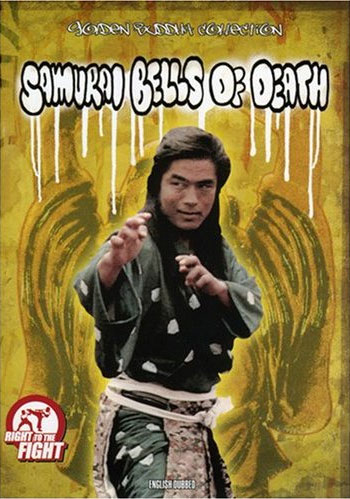
Here would be a great entry in the halls of legendarily terrible re-titles. Beauty Escort is also known as “Samurai Bells of Death,” the English title that appears on the English dubbed print, a reference to a weapon that appears in the movie called The Death Song Bells. One assumes that “Samurai” was added to the title so as not to be confused with Yueh Feng’s 1968 Shaw Brothers film, Bells of Death. It (Beauty Escort, not Bells of Death) is also based on the Gu Long novel Hu Hua Ling (护花铃), available in English translation under the title The Flower Guarding Bells. Perhaps a clue as to what sort of movie Beauty Escort is, the explanation of the title itself is convoluted enough to have been devised by Gu Long.

Also, whoever came up with the English title was a liar. There are no samurai in Beauty Escort. It’s kind of like the Taiwanese Gu Long adaptation, The Lost Swordship, which has the alternate title “The Lost Samurai Sword,” in spite of there being no samurai or samurai swords in that film either. Unlike The Lost Swordship, however, Beauty Escort is unavailable in a widescreen, English language print. I watched the film on a Crash Cinema disc sourced from a terrible pan-and-scan VHS source, which is still better than the film being lost or prohibitively scarce.

The film starts with a duel between the Dragon and Phoenix clans, planned ten years prior. Dragon, leader of the Dragon Clan, has prepared to fight Phoenix, leader of the Phoenix Clan, but she died shortly before the duel was to take place. So a subordinate agrees to fight. Only she has less internal strength than Dragon, so, to insure a fair fight, he asks his subordinates to handicap him before the duel. Dragon’s daughter and her husband, Fei Ya, don’t really like this idea, but Nam Goong Ping agrees. Dragon and Phoenix Clan’s Yee Man Ching go to a secluded spot to duel, with Man Ching returning as the victor.

Already shocked by the outcome, the Dragon Clan receives an even greater surprise by Dragon’s will, which names Nam as his successor, rather than Fei Ya or his wife. The Dragon Clan hardly has time to fight amongst themselves, though, as bandits immediately arrive to steal their dead master’s coffin. Nam manages to apprehend the bandit as he runs away, only to find out that the bandits do not intend to steal any of the precious jewels from the coffin. They believe that the coffin hides a criminal in the martial world, a villainous seductress and master swordfighter by the name of “Cold Blooded Mistress” Mei Win Shu.

As it turns out, she’s hiding in a false bottom in the coffin, but she is not a villainess. She has been framed by various elements within the martial world who sought to force her into marriage, rape her, or otherwise subjugate her. After a duel, Dragon found out the truth, and hid her for eight years, his final wish that Nam would protect her and help to restore her reputation. In the mean time, Fei Ya and Dragon’s daughter have designs to take control of the Dragon Clan for themselves, while the shady business of how the Phoenix Clan won the duel has not been resolved and Nam’s wealthy, powerful family faces danger from growing forces who intend to seize their fortune.

So it is rather par the course for a Gu Long adaptation, convoluted and prone to barely explained coincidences. The dubbing is a problem, as it refers to some characters only by their nicknames – Dragon’s full name, Long Bushi, is never uttered – and others are not named at all, hence my referring to “Dragon’s Daughter.” And, like many of Gu Long’s stories, Beauty Escort is not really so much about the martial arts and clan rivalries, but about the romance between two of the protagonists, Nam and Mei Win Shu.

Unless the movie was also re-edited for its English dubbed version (a very real possibility), Beauty Escort devotes very little of its duration to the relationship between Nam and Wei, although even an inattentive viewer could tell where it’s headed once they meet. It’s not only unfortunate in that it ignores what was likely a central part of the novel, it lessens the opportunity for the sort of dialog that makes Gu Long fun to read or watch. Gu writes marvelous passive aggression, misdirection, and projection, all of which make for lively conflict and lively romance. Again, the dubbing captures none of this, assuming that it was ever there in the first place (also a very real possibility).

It’s hard, then, to give this movie a fair review, a problem endemic to kung fu and wuxia movies in general. Because of the broad perception that the appeal of this genre lies entirely in fight scenes, they were often dubbed without care. For reasons much more complicated, they were released on VHS in pan-and-scan, usually positioned to chop off embedded subtitles, the original prints often not well-preserved. So even visually, this film has been handicapped.

Which is a shame, since it was directed by alumni Shaw Brothers cinematographer Pao Shuh-Li, scripted by alumni Shaw Brothers screenwriter Katy Chin Shu Mei, and produced by legendary screen fighter Phillip Ko Fei. Stars Ling Yun and Nora Miao. Chan Wei Man plays the villain! It even looks like it had a bit more of a budget than a lot of other independent Hong Kong genre films. The fight scenes are acceptable, but it’s pretty clear that the movie is aiming for more than a highlight reel of kung fu sequences.

So, hey, if a nice, clean print shows up, maybe I can watch this movie again and give it a fair review. But the most seen, most available version of Beauty Escort is far from ideal, and with so many great films based on Gu Long novels available, it’s far from a must-see.

7/25/11

Sleaze for Social Justice

Somebody on the internet referred to this 1996 South Korean film as “Korean style UHF with sexiness.” It’s more like “sexy UHF-like paean to media piracy,” but – and I write this as though anybody would read past “sexy UHF” – that is fundamentally wrong description, as Channel 69 (Lee Jeong-kuk, 1996) has little in common with Weird Al’s film opus besides amateur filming being key to the film’s premise.

The film starts with a young lady auditioning for a modeling job, using her film test to launch into a diatribe against actresses who want good roles while expecting to keep their modesty intact. She’s Cho Minhee, but she goes by “Super Mini.” When one of the expectant producers treats her to dinner and invites her for a post-audition interview on the casting couch, she hurts him off-camera, storming out of the restaurant with him in pursuit. Another patron trips him, takes Minhee’s business card, and proceeds about his business.

He’s Koo Je-ha, a former television journalist and expert computer hacker, who now works as something of a civilian detective, illegally acquiring hidden camera footage of corrupt politicians for an equally corrupt prosecutor. He had previously tried to cover the illegal fundraising tactics of political hopeful Yoo Chang Min, but now he’s taking illicit footage of his illicit affair with his secretary.

While the prosecutor is uninterested in Je-ha’s vendetta against Yoo, he does want to hire Je-ha to find the programmer of a computer virus, The Dark Messiah. He shows Je-ha the virus on his computer, which shows clips of Minhee’s screen test set to Handel’s Hallelujah Chorus before murdering the infected computer system. Recognizing Minhee from the business card he picked up in the restaurant, Je-ha finds and recruits her in his hunt for the creator of The Dark Messiah.

When Je-ha and Minhee find The Dark Messiah, he turns out to be a middle school drop-out named Koo Seokki, a young guy with a poodle named Handel, a plan for making pornographic video games, and a huge crush on Sharon Stone. He turns down what he thinks is a proposition from Minhee, saying that he’ll only lose his virginity to Sharon Stone via cybersex. He has two assistants, Yong Jontae and Im Saengko, a dancing electrical engineer and sound engineer, respectively, who seem to be in a relationship, neither of whom made it in college.

In keeping with the film’s cynicism about political figures and those who consort with them, the prosecutor who dispatched Je-ha plans to take credit for the apprehension of The Dark Messiah. Je-ha takes offense to this, and since he has nothing to lose, decides to aid and abet the hacker and his crew. Now an accessory to Seokki’s crimes, Je-ha devises a plan that utilizes everybody’s skills and gives everybody what they want: Channel 69.

Je-ha plans to interrupt the newscast from NBS, the station he used to work for, with his own, which will be anchored by Minhee, who he dubs the PJ, short for “porn jockey.” This allows Seokki to broadcast porn, which is his only ambition. Minhee gets to work off her exhibitionist tendencies and become famous, which is her only ambition. Im gets to broadcast the music he composes, which is his only ambition. And Yong gets to put his engineering training to use in the creation of a mobile pirate TV studio. If this is his ambition, the script never makes it clear. I think he’s along for the ride so that he can hang out with Im, cutting his hair and sleeping with his head in Im’s lap.

And Je-ha finally gets to expose the corrupt Yoo. That he gets to show up his ex-girlfriend, an anchor on NBS news, is just the icing on his cake.

As with any worthy ribald comedies, there’s more to see in Channel 69 than butt and boobies. The script is actually pretty smart, even subtle with its characterization, dropping subtle hints about Je-ha’s feelings for Minhee. And a little line implies that Minhee, in spite of her exhibitionism, is more innocent than she lets on. While the characters initially come off as broad stereotypes – Minhee is a ditz, Im and Yong are gay, Soekki is a pathetic nerd -- they’re endearingly stereotypes, and the film is non-judgmental. Except when it comes to politicians, and rightly so.

I also like Channel 69 for all sorts of Meta reasons. Low-brow, ‘90’s era Korean film is underrepresented on subtitled DVD, and that’s not even begun to change. There’s a certain charm to seeing all of the IBM logos, and the silly hacking sequences that might have been more convincing back when the internet was not something that everybody had to use daily. It looks a lot like the fantasy I had of computer hackers when I was a little kid, mucking about on my dad’s DOS based IBM in the early nineties.

More importantly, the movie is funny. And sexy. That politicians, the only people in the world I hate more than lawyers, get thematically broadsided sweetens the deal. As do female nudity and punny humor. It's not a great movie, and it is pretty slight, but it is also simple, good fun.

7/18/11

It Only Took Me Twelve Years

In the car, driving back from an early dinner at a favorite restaurant, RockManXZ24, my game playing friend whose obsession has provided him with a unique ability to find extra hours in the day to finish absurdly long JRPGs, asked me the same question he’s asked for about four months: “did you ever beat Final Fantasy 5?”

The question would have hung in the air had I not known it was coming. RockMan started asking about my progress about two weeks after I, on a whim, started playing it again, likely my favorite game that I never bothered to beat. RockMan reminded me that it came out nearly twelve years ago – The twelfth anniversary for Final Fantasy Anthology, the first official English release of Final Fantasy 5, is on September 30th.

Final Fantasy 5 was one of the games that set off the internet translation scene, with various groups trying their hardest to push out a fully playable, English language rom hack before the others could take credit. Derrick Sobodash, one of the key figures in that era, had an insightful, honest article about the time he spent translating video games as a very young man. It seems to have disappeared, for the time being, or I would link to it here. It would be an interesting footnote for any retrospective on the game or its series. Not only was Final Fantasy 5 a “lost gem” for fans of the series and Japanese RPGs, but the catalyst for what is now an expansive community of hobbyists who seemingly spend more time working on games than playing them.

A lot of reviewers who look at the game in hindsight get hung up on the story, which is rudimentary and filled with shonen manga clichés about the importance of friendship, bursting with deus-ex-machina solutions left largely inexplicable, a cast of orphaned children trying to please their parents. All while trying to save the world.

Those more inclined to play a game for its mechanics praise its “job system.” The player decides on a character class for each of the four party members, and learns skills that can then be used while the character learns the skills of another class. So, if the player were inclined to do so, Bartz, the lead character, could be a thief who can also cast black magic, or a ninja who can steal items from monsters, or a knight who wields two swords like a ninja. Until Final Fantasy 7, this was the most customizable game in the series, and with the job system added on top of the typical equipment management and character progression, it is easily the numerically driven player experiences developed for the SNES/Super Famicom. But it’s also recognizably a Final Fantasy title, what with the moogles, chocobos, Nobuo Uematsu music and active time battle system.

In case it isn’t obvious, I am a numbers fetishist. At least when it comes to video games, that is. Grinding my way through Etrian Odyssey is, for me, a good time. But I also like games that feel that they were made by real people rather than assembled according to a formula. These sentiments seem slightly opposed. I’ve often considered that my ineptness at mathematics maybe created the desire to play with numbers in a less daunting way than doing geometrical proofs or solving equations. Is that why I want both warmth and pure number-crunching in my games? It could very well be.

But why would I like Final Fantasy 5 so much when it is generally agreed upon as having a totally rote story and cast? I’m thinking, maybe, that the familiarity is part of why it appeals to me. It’s so purely unpretentious, so reminiscent of the sort of anime I watched as a kid, before Neon Genesis Evangelion kinda-sorta ruined anime as a whole for me, that it somehow doesn’t matter that every twist in the plot and characterization appears close to the face, rather than peaking over the horizon or hiding in the margin. I’ve said it before: if I wanted a challenging narrative, I would read a book (and I often do).

After I got home, I hooked up my Playstation, inserted the Final Fantasy 5 CD; three hours later, I had made it through the final dungeon in the “N-Zone,” and was fighting Neo X-Death, the evil tree bent on destroying the planet. Yes, the last boss is an evil, world destroying tree.

I had grinded to the point that two of my characters had learned the “mimic” battle skill. Walking about in dungeons and fighting random battles had become a sort of before-bed ritual for about a month, and it made the last boss battle rather easy. Two characters with mimic, one with Black magic and a “Red X 2” ability (two spells cast for the same turn), and two characters in the mime cast made for entire rounds of “flare” cast on all sections of the boss. Four characters, each casting flare twice, meant that my party caused around 20,000 to 24,000 damage each round. As mentioned, it was easy.

And watching the ending, with the Nobuo Uematsu’s crystal theme, the overworld theme, and the Final Fantasy fanfare playing in a medley that evoked every ounce of nostalgia in my small, cynical heart to come bursting forth in a deluge of unexpected and unwanted melancholy, I thought about how I had been playing this game for almost twelve years. It was fun. I loved it.

The only other game that I think has ever gotten an emotional reaction from me was Final Fantasy 4. Unlike its immediate, unrelated sequel, I’ve beaten that game numerous times, and on multiple systems. The world has changed a lot in the twelve years between the time I first played Final Fantasy 5 and the time at which I beat it. It’s a landmark title, for a lot of people, and for a lot of reasons. Nostalgia has a funny way of working like that.

7/11/11

Progress

I have not said anything about the closing of the local Borders because it was traumatic enough that I don’t want to dwell on it. I bought my first Zatoichi DVD at Borders. I spent more afternoons than I can well remember hanging out there, reading manga with my best friend from high school. It was a convenient stop on my way back from school; it fed my collecting habits, first with reasonably priced Japanese comics and movies, later with an efficient special order system that suitably made up for my inability to order unusual books and movies from Amazon.com. I even signed up for their discount program, and put it to good use.

Extenuating circumstances prevented me from picking through the carcass of their clearance sale until the day just before they shut their doors for good. I hoped to grab some Wolfe or Vance or Chesterton for cheap; maybe find some interesting popular history titles – I intended to buy various Jonathan Spence books that usually sat on their shelves untouched – only to find that the other bookworms had eaten through the inventory well before I got there. Most of the remaining merchandise was of no interest to me, although I did contemplate buying a table or a plate from their café. The insistence of the manager that potential buyers consider buying shelves and chairs and light fixtures as well persuaded me away. I loved that Borders, but not enough to want it relocated in my house.

So I bought the only what I could justify owning at a seventy percent discount: David Gaider’s Dragon Age: The Calling.

I’ve read about a quarter of Gaider’s second foray into actual fiction. Slow going: it’s pretty dull so far, but I’ve noticed a couple of improvements over The Stolen Throne already.

- First of all, the writing is much tighter. The Stolen Throne had me hitting my face with its incessant flood of adverbs and inappropriate turns of phrase. For instance, the infamous: “Maric stared at her in disbelief. He wasn’t quite sure she could have said anything else that would have been less surprising. Well perhaps a confession that she was actually made of cheese.” So far, no especially egregious instances of childish humor.

Also, the adverbing didn’t start until about twenty pages in, and it’s much less frequent. Every sentence in The Stolen Throne went according to a formula. “Subject verbs object, adverbingly.” It’s a bad formula. It tells, rather than shows. Thankfully, it’s employed much less in The Calling.

- For all the good that it does, Gaider also seems to have taken some notice of courtly formality. Among the litany of complaints I threw at The Stolen Throne was that its author used “my lord,” “your highness,” and “your majesty” interchangeably. The Calling was published shortly before my review of The Stolen Throne hit the net, so I cannot take credit for bringing this to the author’s attention. But since it only figures into a single scene in any meaningful way, it’s not really an issue – just nice to see.

I’ll have a more detailed review of the last book I’ll ever buy from my beloved book store chain location if/when I finish reading it. But it’s a bittersweet experience, even at a seventy percent discount.

6/28/11

The Lost Bladesman (Alan Mak and Felix Chong, 2011)

While watching The Last Bladesman with a room full of fellow Dynasty Warriors nerds, I could not help wondering how somebody unfamiliar with China’s Three Kingdoms era would react to it. I suspect they would be bored. I also suspect that the ones that would not be bored would be looking for “Little Red Book” references, contemporary political issues coded onto historical ones, and barely veiled nationalism or Han racial superiority. I might have too, except that I couldn’t really be bothered to when Donnie Yen is playing Guan Yu. Yes, that Guan Yu, the one to whom Chinese gangsters offer their prayers in return for protection. Can you say -- Testosterone EXPLOSION!? Don't worry, it's not.

The Lost Bladesman is actually a slightly embellished adaptation of one of the most memorable parts of Luo Guanzhong’s The Romance of the Three Kingdoms. Captured by duplicitous duke Cao Cao after a lost battle, General Guan Yu finds himself courted by his captor, who admires his incredible physical strength, tactical skills, and loyalty. Guan Yu agrees to kill warlord Yan Liang for Cao Cao, but only under the condition that he lets his hostages, including the wives of his sworn brother and Shu leader Liu Bei, go free. Cao, with the greatest reluctance, allows them to leave, but as they journey, Guan and his retinue come across armed opposition from Cao’s allies and subordinates, not least of which are former allies of Guan Yu’s, even soldiers whose lives he had previously saved.

The film’s epic melodrama comes from the very Confucian sense of duty and reciprocity that governs Guan Yu’s actions towards Cao Cao, the puppet emperor Xian, and the mostly absent Liu Bei. The script portrays Guan as a somewhat naïve true believer; he cannot go against the emperor, the son of heaven, even though he is weak, even though Cao Cao sees no issue with manipulating and disrespecting him openly. He must repay Cao’s kindness, but cannot do so at the expense of Liu Bei, with whom Cao has a nearly personal, ongoing feud. He cannot make his feelings known to Qi Lan, Liu Bei’s betrothed with whom he is hopelessly in love, much less consummate them (this is one of those embellishments previously mentioned).

Writer/directors Alan Mak and Felix Chong clearly want to show the tragedy inherent in idealism. No matter what Guan Yu wants to accomplish, he cannot wring rightness out of the corrupt political machinations of powerful bureaucrats like Cao Cao; and pursuing his own ends earns the resentment of peasants and soldiers tired of war and chaos, willing to compromise with the despotic Cao in return for some semblance of peace. The Lost Bladesman probably marks the first time that the legendarily powerful, physically monstrous, magnificently bearded Guan Yu seems powerless -- helpless even. It actually resembles, a little, Zhang Xinyan’s 1986 martial arts film, Yellow River Fighter thematically, although The Lost Bladesman eventually reaches more believable conclusions (Zhang was something of a left-wing idealist, and, ironically perhaps, it hurts his work).

But while aiming for high pathos, the film often finds itself hitting rank bathos. Part of the problem is rote direction. The cinematography is nice, as far as it goes, but with the cheesy cross-fades that segue between important scenes and Donnie Yen’s non-presence as Guan Yu, The Lost Bladesman feels, somehow, like half-baked leftovers. Scenes of expository dialog spoon-feed themes to the audience, even when the shown events make those themes quite clear. Yet it seems almost like the real meaty thematic concerns get lost in the spectacle of the production, which is appropriately expensive looking – just like every other recent film of this type, of which there are many.
Too often, the film looks for a fight sequence to keep its momentum going, like a genre flick rather than prestige picture. And given that the mainland market is largely middle class, and also willing to compromise with ruthless governmental clout for the sake of maintaining stability, Chong and Mak might have thought it prudent to diminish their own themes. Nobody likes to know that their compromises hurt strong, moral people. Nobody likes to hear a message that indicts them for their cravenness.

Or maybe the script needed another revision to trim out the unnecessary dialog, to more precisely show the tragedy of Guan’s situation, rather than tell it in between spectacular set-pieces.

Either way, it’s unfortunate, especially for poor, miscast Donnie. The fight scenes are well-done (I say this as somebody who has never been fond of Yen’s weapon choreography), but they seem like filler, especially given that they are filmed in a way that would not require a physical talent like Donnie to pull them off; they could have been as easily made with a double filling in for a less martially inclined, real thespian. And a real thespian Donnie Yen is not. He spends much of the film looking lost, and suffers in his scenes across Jiang Wen as Cao Cao.

But, for all that, I think that The Lost Bladesman is almost a nice counterpart to the unrelenting bombast and bromance of John Woo’s Red Cliff. Jiang Wen is the highlight here, as his Cao Cao is believably perspicacious, and even convincingly literate (historically, Cao was a prodigious literary talent). The somber, elegiac atmosphere really works well, and, in spite of a weak lead performance, The Lost Bladesman adequately renders the sorrow of a man caught up in the chaos of an awful, turbulent time in history.
I actually really liked this movie, in much the same way I like the messy films of Hong Kong’s earlier decades. The way I liked Red Cliff, to be frank. It’s much more watchable than some of the blunt political allegories that gained, to my astonishment, so much critical praise in the west. It’s certainly better than Resurrection of the Dragon (Daniel Lee, 2008), but that’s not setting the bar very high. The fact that the guys behind The Lost Bladesman actually tried to make a real movie with a real point makes it stand out amongst its competition.

So it’s a flawed, uneven success, in my book.

6/21/11

What do I have to do to see some elf nipples?

 I’ve never seen the DVD for the second Dragon Knight OVA, Dragon Knight: Another Knight on the Town (bleh, pun), for sale at a discount, and I refuse to bother ordering it. But, as mentioned, I do have the third OVA, based on the fourth game in the series, which was apparently a pretty decent little strategy title that some developer or other eventually ported to the Playstation, with updated illustrations. The DVD I bought a while back is another ADV product, with much of the actual erotic content cut out. Again, there’s some visible nipples here and there, but at 100 minutes, there’s almost a half-hour of sex scenes missing, I presume because ADV couldn’t find talented voice-over actors who would willing feign moans and grunts, though the fact that so many of the female characters appear a bit younger than the American age of consent might have as much to do with that decision as anything, and is quite reasonable. So instead of what might be an above average, fantasy themed hentai – though I hasten to add that, not being a connoisseur of animated porn, I wouldn’t really know – Dragon Knight: The Wheel of Time is a merely average example of low-budget fantasy anime.
The movie starts with Kakeru trapped in a dungeon after a lost battle against Lucefon, a wizard or some such from the underworld. Marlena, another survivor of the battle, gives him a black stone that allows him to travel back in time. Finding himself in the past, well before the final conflict, he teams up with his past self and his companions, hiding his identity with a mask and assuming the name Eto. From the future events he’s already experienced, he knows that Marlena is not merely an elf who wants to kill Lucifon and that only she can help him resolve the final conflict. He only needs to know how to win her over to his side in order to make that happen.

The obvious answer, which we don’t really see in the censored version for the American market, is a good roll in the hay. In fact, the transition for this is rather clearly marked, if you know when to look for it. The missing content always seems to lurk in the background. I would have congratulated the makers of the OVA for their restraint and good taste during a scene where one of Eto’s companions, a female warrior with a bad attitude, decides that she cannot follow him unless he proves himself superior as a warrior and a man. After a sword fight and a knock-out punch, the typical hentai would follow up with a scene in which Eto wows the Amazonian mutineer with his – not to be too blunt about it – penis. This likely happened in the original, unaltered video, as Dragon Knight: The Wheel of Time was intended to be a typical hentai in its original incarnation, but I like that it doesn’t happen. I only wish that somebody had found a way to provide closure to that particular story arc in a way that left both Eto and the warrior-woman’s dignity intact, but the character practically disappears afterwards. It’s a trade-off that leaves neither the viewer wanting sexual fantasy nor the viewer wanting non-porny fantasy happy.
Believe it or not, she's actually about to be saved.
Dragon Knight: The Wheel of Time also takes itself rather seriously, which is something of a departure from the outright goofiness of the first Dragon Knight. There are, of course, some funny moments. Young Kakeru is much like his father, Takeru, in that he’s prone to making bad jokes and is quite immature. Eto, at times, is the same, but as most of the narrative is told from his perspective, the audience hears his internal monologues and philosophizing about the nature of time. In the third episode, he wonders if he’s not the first Eto, if history has begun to replay itself in a loop with the battle routinely fought and fought again with the same outcome. This is pretty heady stuff for an anime that seems like it wants to focus on romantic entanglements and panty shots, and it never quite works because it never develops into anything of consequence for the narrative or the characterization.

Is it worth watching, then, without any of the attractions for which it was originally created? I actually kind of liked it, at least more so than Dragon Knight. The animation is actually better, with more (and longer) fight scenes. I think I liked it more because of my affinity for the visual conventions and character designs of nineties era anime and video games than for any genuine appreciation of the narrative, characterization, or dialog. And much of my affinity for nineties era anime and video games probably stems from my ambivalence towards current anime and, to a lesser extent, Japanese video games. But that’s me.
There’s better anime features in this genre that, not having potentially offensive or illegal content, don’t suffer from content cuts the way that Dragon Knight: The Wheel of Time does. But it did kind of make me want to play Dragon Knight 4, in spite of the fact that I know I’ll roll my eyes at the erotic content and sexualized loli characters. It’s left me with another conundrum, in that sense. Do I bother to play a game that has content I was happy to not see in the licensed anime adaptation? Honestly, probably not. I figure the experience isn't too different from playing a Record of Lodoss War game while thinking about elf tits. And since there's a pretty good one translated in English (for the Dreamcast) it'd be easier to do.

6/20/11

Bioware Fandumb

Indeed, nobody at all believes that I wrote that review of Dragon Age: The Stolen Throne for any reason other than to troll Bioware fanboys. If I am a troll, I am one of the rare, righteous ones. I troll with the truth; it is super effective.

I logged onto blogger a couple of days ago to see a huge spike in views and an incoming link from Bioware’s forums. David Gaider has new book, Dragon Age: Asunder, the third of his Dragon Age novels, now set during the same time frame as Dragon Age 2. I haven’t finished reading Gaider’s other novel, Dragon Age: The Calling. In fact, I’ve only just started to read it. David Gaider’s comments in that thread will likely receive due attention when I get around to reviewing The Calling, where my remarks will likely be more pertinent (and pointed). To my surprise, the rest of the responses in that forum thread actually got me thinking.

I posted a response to all of the negative attention my review of The Stolen Throne received not long after it went online. It’s been linked on Bioware’s forums before, to similar reactions, and most of the negative comments accuse me of either being “pretentious” or not having played the games; I admit to the latter in the text of my review, while the former is actually incorrect (few of these people seem to understand what that word means). When I wrote that first response, I thought that the fans were taking issue with the fact that I did not like The Stolen Throne. I was wrong; they do not like that I wrote out the reasons why I disliked it.

There’s a certain line of thinking that runs through many of these posts, a way of viewing things common, at least from what I’ve observed, amongst younger fans of certain media, especially amongst fans of video games. It’s an attitude that informs many of the arguments in the evergreen “video games and art” debate. It revolves around the term “subjective.”

The fanboy/girl’s typical defense of their half-formed thoughts or opinions or appraisals goes like, “well that’s just my opinion,” as if it could be anything else. Another one: “well I liked it.” Yeah. Likely nobody would tell you otherwise. Often they invoke subjectivity directly, under the false impression that if something has a subjective element, that all criticism that surrounds it is inherently subjective as well. Take, for instance, the following post from Imported Beer, in response to my review:


I’m only going to address that last part, as it serves to illustrate my point, and I will try to refrain from snarking at the repeated use of the term “personal construct.” Imported Beer makes two claims in this paragraph. The first is that prose aesthetics are subservient to narrative. The second is that all criticism is subjective, and only personally useful. Basically: “I don’t care what you think, and it doesn’t matter what you think.”

That people of this mindset would denigrate criticism – but only negative criticism aimed at the objects of their fanaticism – is unsurprising. Another Bioware forum-goer, nedpepper, contributed what he calls an old cliché: “Writers write because they can, critics critique because they can't write.” I suppose he’s unaware of how many professional writers of fiction publish criticism of their peers; I suppose he’s also unaware of the semi-colon.

Of course, if everything about fiction is subjective, their evaluations of Gaider’s work do not matter either. They think that they have marginalized an outspoken critic; they have attempted to do so by marginalizing an entire media, the liberal arts, and those who study them. And they do so -- I think -- unwittingly.

Few things in the world are purely subjective. Fiction, for instance, is not. The text is an object. An evaluative critique is based on observations of that object.

Fuckin’ duh.

The only person to respond to the review rather than react to it (sorta) was RosaAquafire, who would later accuse me of “rocking a big dumb bias.” Disregarding that second post, I appreciate that she both read my review and expressed disagreement with points I made rather than accusing me of “elitism” and “snobbery.” But then, she didn’t actually respond in the comments. In fact, none of the posters bothered to write a comment on my blog, in spite of my comments remaining open, even to anonymous posters. Bravely done, fellas.